Español
 عربى
عربى русский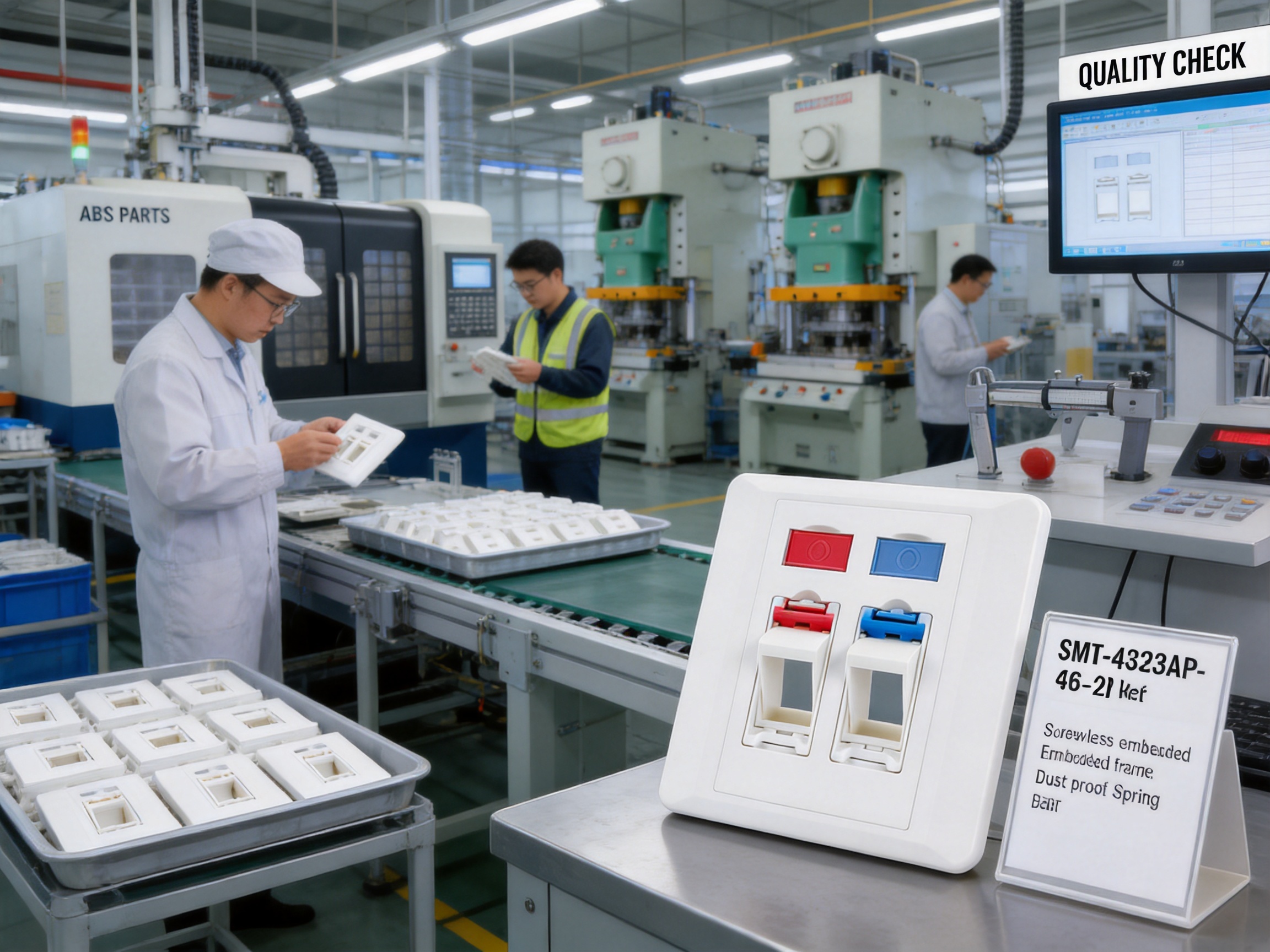
Modern communication networks depend on many small installation components that must work together accurately, safely, and consistently. While active equipment such as switches and wireless access points often receives the most attention, the quality of the passive infrastructure is equally important. Faceplates, data sockets, keystone modules, patch panels, and connecting hardware form the physical interface between network equipment and users. If these components are poorly designed, difficult to install, or vulnerable to dust and impact, they can reduce the efficiency and service life of an entire cabling system.
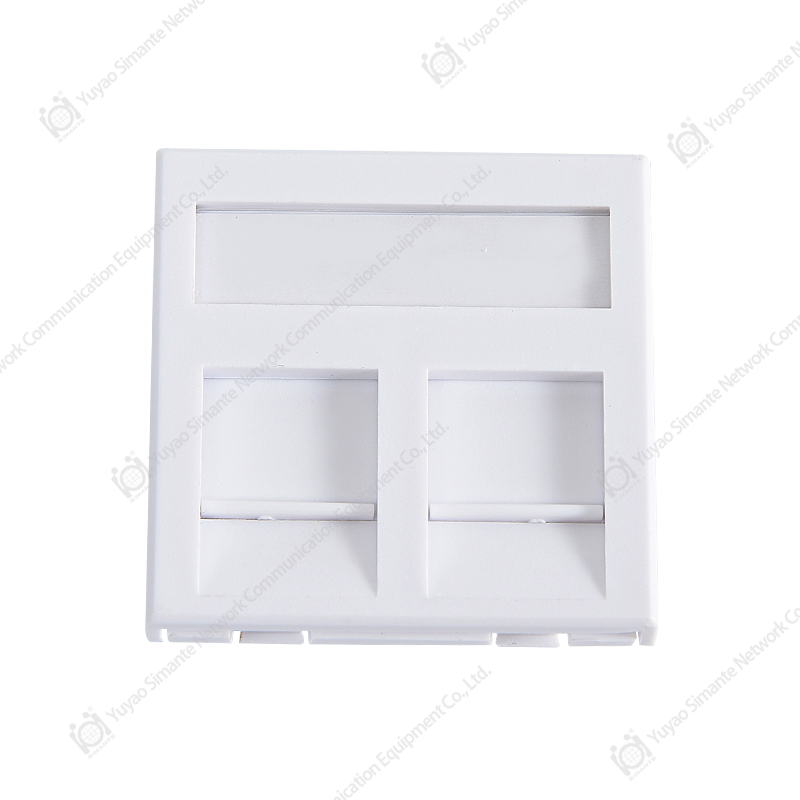
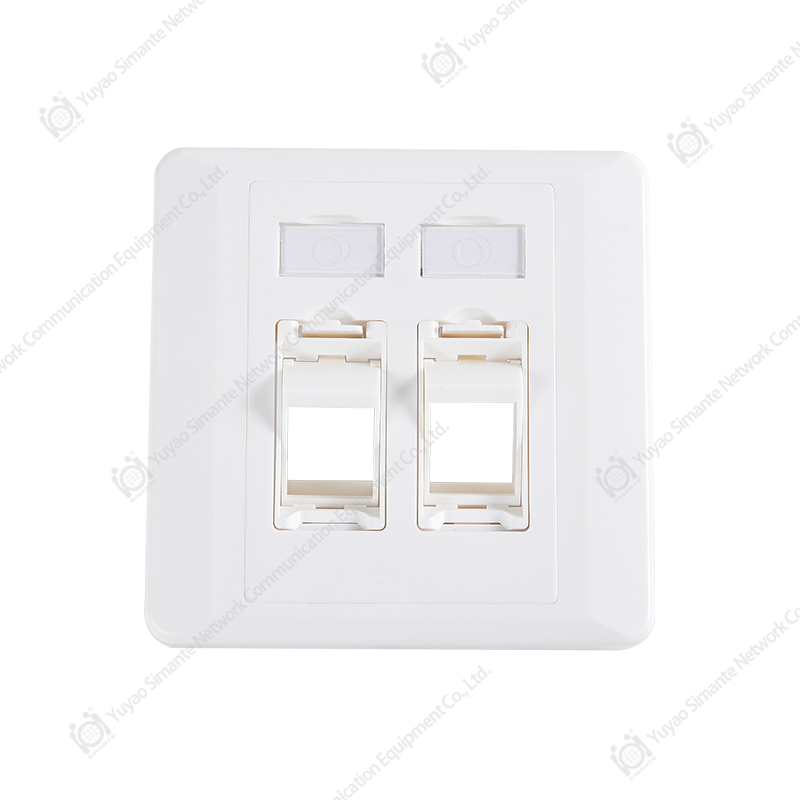
The SMT-4323AP-86-2P 86 Type 2 Ports Rotary Faceplate is designed to provide a clean, practical, and durable termination point for copper and compatible information or telephone modules. It is a wall-mounted faceplate for common Type 86 exposed and concealed back boxes. With two module positions, a screwless embedded face frame, identification features, a spring-type dust-proof door, and a high-quality ABS construction, it supports professional installations in residential, commercial, and light industrial environments.
This product is manufactured by Yuyao Simante Network Communication Equipment Co., Ltd., a specialist manufacturer of network cabling solutions and optical fiber products. The company integrates product design, research and development, production, sales, and service. Its manufacturing capabilities include automatic and semi-automatic injection molding, automated assembly equipment, customized production lines, and product performance testing. These capabilities help ensure that the faceplate is not simply attractive when new, but also reliable during installation, operation, maintenance, and future network upgrades.
Product Overview
The SMT-4323AP-86-2P is a two-port rotary faceplate designed around the widely used Type 86 wall-box format. The Type 86 form factor is commonly used in structured cabling, telephone systems, data communication installations, and residential information outlets. By supporting common Type 86 exposed and concealed back boxes, the faceplate can be integrated into a broad range of wall installation projects without requiring a specialized enclosure.
The faceplate provides two openings for compatible AMP interface information or telephone modules. This allows installers to configure the outlet according to the application. One port may be used for data and the other for telephone service, or both positions may be assigned to data, voice, or another compatible low-voltage communication function. The final configuration depends on the selected modules and the requirements of the structured cabling system.
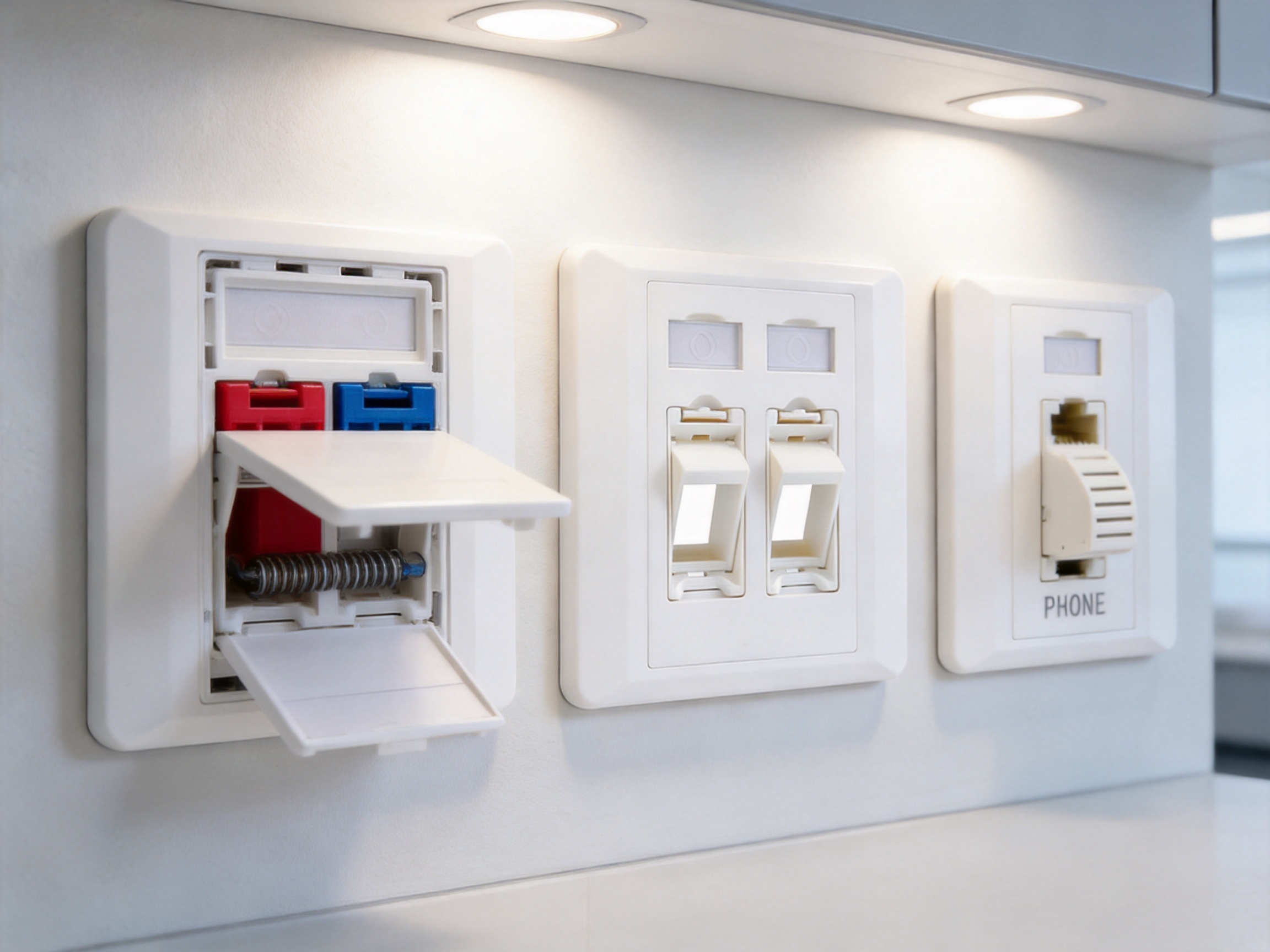
The front of the product includes red and blue identification blocks. These colored indicators help distinguish telephone and data services and make the finished installation easier to understand. Clear identification is especially useful in office buildings, hotels, apartment projects, schools, healthcare facilities, and other locations where multiple communication outlets may be installed close together.
A spring-type dust-proof door protects the port area when the outlet is not in use. The door helps reduce the entry of dust and other airborne particles while presenting a neat appearance on the wall. Its design also provides a larger frontal identification area, which can support port labeling and service management. A detachable signboard is included to make port identification more flexible when network layouts change.
| Item | Product Information |
|---|---|
| Product model | SMT-4323AP-86-2P |
| Product type | 86 Type two-port rotary faceplate |
| Application | Wall-mounted copper, telephone, and information outlet installations |
| Compatible installation format | Common Type 86 exposed and concealed back boxes |
| Port capacity | Two module positions |
| Module compatibility | Compatible AMP interface information and telephone modules |
| Material | High-quality ABS engineering plastic |
| Protection feature | Spring-type dust-proof door |
| Identification features | Red and blue identification blocks and detachable signboard |
| Environmental compliance | Designed to meet RoHS requirements |
| Operating temperature | -25°C to +70°C |
| Storage temperature | -5°C to +30°C |
| Recommended storage humidity | Relative humidity not exceeding 70% |
Designed for Efficient Wall Installation
One of the most visible advantages of the SMT-4323AP-86-2P is its embedded face-frame design. Conventional faceplates may use exposed screws on the front surface. Although screws can provide a secure attachment, they also interrupt the appearance of the outlet and may collect dirt around the screw heads. Exposed hardware can also make the installation look unfinished, particularly in premium residential, hospitality, and commercial interiors.
The embedded face frame conceals the fixing structure from normal view. As a result, the finished product has a cleaner and more integrated appearance. The wall outlet appears to be part of the wall installation rather than an externally mounted accessory. This design is beneficial where visual consistency matters, such as executive offices, meeting rooms, retail environments, apartment interiors, and hotel rooms.
The screwless visible surface also supports easier cleaning. Without exposed screw heads or deep recesses around the front fixing points, the faceplate can be wiped more efficiently during routine maintenance. A clean, flat visual surface can be especially valuable in locations where outlets are frequently inspected or where dust accumulation must be minimized.
Despite the concealed appearance, the faceplate is intended to remain practical for installers. It can be installed and disassembled when necessary, supporting cable termination, module replacement, testing, and future changes. The ability to remove the faceplate without damaging surrounding wall materials is important during network upgrades or service troubleshooting.
The two-port format provides a useful balance between capacity and space efficiency. A single-port outlet may be insufficient for a workstation or residential media area, while a larger multi-port plate may be unnecessary in a small room. Two positions allow installers to provide separate services in a compact wall footprint. The configuration can support combinations such as data and voice, two data connections, or other compatible modules required by the project.
Type 86 Compatibility and Application Flexibility
Type 86 is a familiar installation format in many markets and is used with both exposed and concealed back boxes. Compatibility with common Type 86 boxes helps simplify project planning because installers can work with established wall-opening dimensions and commonly available mounting arrangements. It also allows the faceplate to be considered for new construction as well as refurbishment projects.
In a new building, the faceplate can be specified together with Type 86 back boxes and selected communication modules. In a renovation, it can replace an older or visually outdated outlet while using the existing wall-box format, provided that the box and module arrangement meet the installation requirements. This can reduce the need for extensive wall modification.
The faceplate is suitable for a wide range of low-voltage communication environments. Potential applications include office workstations, hotel rooms, classrooms, residential bedrooms, living rooms, conference areas, retail counters, reception desks, network equipment rooms, and controlled-access facilities. It can also be used in smart-home and automation installations where information and communication outlets must be presented in a consistent wall format.
Because the faceplate is compatible with AMP interface information and telephone modules, system designers can choose the actual communication function separately from the wall plate. This modular approach makes it easier to standardize the external appearance across a project while changing the internal service configuration according to room requirements.
For contractors, modular compatibility can simplify procurement and installation. A common faceplate body may be ordered for multiple room types, while different information modules are selected as needed. This can reduce the number of unique visible components and help maintain a consistent appearance across a building.
Port Identification for Better Network Management
Communication outlets are easier to operate and maintain when their functions are clearly identified. The SMT-4323AP-86-2P includes red and blue identification blocks at the front. These color elements provide an immediate visual reference for distinguishing telephone and data services. In installations with multiple outlets, such differentiation can reduce confusion for users and maintenance personnel.
Color identification is particularly valuable when data and telephone connections use similar connectors or are installed in the same room. A technician can understand the intended service more quickly without tracing every cable back to a distribution point. This can shorten inspection time and reduce the likelihood of incorrect patching or accidental service interruption.
The larger frontal identification space adds another level of management. Installers or facility managers can apply port numbers, room references, service labels, or other project-specific information. When outlets are installed in offices, classrooms, or hotel rooms, a clear label can associate each port with the relevant network location or patch-panel position.
The detachable signboard is useful when the network changes over time. A port may initially be assigned to a telephone service and later be converted to data, or a room numbering system may be revised during a building renovation. A removable signboard allows the identification system to be updated without replacing the complete faceplate.
This attention to identification distinguishes a professional communication outlet from a basic blank wall plate. The faceplate is not only a mechanical cover; it is also part of the network administration system. Accurate labeling supports faster troubleshooting, easier moves and changes, and better documentation of the structured cabling installation.
SMT-4323AP-86-2P 86 Type 2 Ports Rotary Faceplate
Spring-Type Dust Protection
Dust and airborne particles can accumulate around communication ports, especially in environments undergoing construction, renovation, or frequent occupancy. Although a faceplate cannot replace proper cleaning and environmental control, a protective door can help reduce direct exposure when the port is not being used. The spring-type dust-proof door on the SMT-4323AP-86-2P automatically returns toward its closed position, helping maintain a covered and orderly outlet.
The spring action supports everyday convenience. Users do not need to search for a separate cover or remember to close a loose cap after disconnecting a cable. The door is integrated into the faceplate and remains available at the port. This is useful in offices, classrooms, hotel rooms, and homes where different users may connect and disconnect equipment over the life of the installation.
The protective door also contributes to the visual quality of the product. When a port is vacant, the front of the outlet remains more uniform than an open connector position. This creates a cleaner appearance on walls containing several outlets. In areas with strict interior design requirements, the door can help the communication installation blend into the surrounding space.
The dust-proof feature should be understood as a practical protective measure rather than a claim of complete environmental sealing. The product is intended for normal indoor wall-mounted applications within the stated environmental conditions. Installers should evaluate special conditions such as heavy industrial contamination, water exposure, chemical vapors, or outdoor installation separately.
High-Quality ABS Engineering Plastic
The product uses high-quality ABS engineering plastic. ABS is widely used for communication accessories because it offers a useful combination of impact resistance, rigidity, processability, and appearance. For a wall faceplate, the material must withstand handling during installation, minor knocks during daily use, and repeated removal or replacement of modules.
The specified material is designed to resist collision and impact and to remain less vulnerable to deformation than unsuitable general-purpose plastics. This is important because a distorted faceplate may not sit flush against the wall or may interfere with the correct alignment of the modules. Dimensional stability supports a more professional finished installation.
ABS is also well suited to injection molding. Properly controlled molding can produce consistent contours, mounting features, port openings, and snap-fit or embedded components. Consistency is essential when faceplates are installed in large quantities. A small variation in one unit may be acceptable in isolation, but repeated variation across hundreds of outlets can affect appearance, installation time, and user perception of quality.
The surface finish of a molded ABS faceplate can be designed to support both appearance and routine maintenance. A carefully controlled surface is easier to wipe and can maintain a consistent look across a project. Material selection, mold design, injection parameters, cooling, and inspection all contribute to the final result.
Material performance must also be considered together with the installation environment. The product is specified for operation from -25°C to +70°C. This broad temperature range supports many indoor and semi-controlled applications. However, the actual installation should still avoid direct exposure to conditions outside the product specification, including persistent moisture, corrosive gases, and severe ultraviolet exposure unless the complete system has been specifically assessed for those conditions.
RoHS-Oriented Product Design
The SMT-4323AP-86-2P is designed to meet RoHS requirements. Restriction of hazardous substances is an important consideration for electrical and communication products supplied to international markets. Compliance-oriented material selection can support customer procurement requirements, environmental policies, and responsible product management.
For project buyers, RoHS-oriented products make it easier to align passive network infrastructure with broader environmental standards. This is especially relevant for international construction projects, multinational companies, public-sector procurement, and customers that maintain restricted-substance documentation for their supply chains.
RoHS considerations extend beyond a statement on a product page. They involve material selection, supplier management, production control, and documentation. A manufacturer with established engineering and production processes is better positioned to control the consistency of materials used in molded parts and related components.
Customers requiring formal compliance records should confirm the precise documentation required for their destination market and project. Product compliance can depend on the applicable regulation, revision, product configuration, and supporting declarations. Nevertheless, the product’s RoHS-oriented design provides a suitable foundation for environmentally conscious structured cabling projects.
Manufacturing Strengths Behind the Product
The quality of a wall faceplate is closely connected to the manufacturing process used to produce it. The product requires accurate molding, controlled assembly, reliable spring and door operation, clean surface finishing, and stable dimensional performance. Yuyao Simante Network Communication Equipment Co., Ltd. has developed manufacturing capabilities intended to support these requirements.
The company operates regular and customized production lines. Regular lines support repeat production of established products, helping maintain stable output and consistent work instructions. Customized lines provide flexibility for customers that require a different configuration, marking method, packaging arrangement, color, or project-specific adaptation.
The factory includes ten fully automatic injection molding machines and twenty semi-automatic injection molding machines. This combination gives the manufacturer both capacity and flexibility. Automatic machines can support repeatable, high-volume production with reduced manual intervention. Semi-automatic machines can be useful for product variations, lower-volume orders, development work, and manufacturing arrangements that require additional operator control.
Injection molding is a critical stage for this faceplate because the molded body determines the visible quality and the dimensional relationship between the frame, port openings, mounting points, dust-proof door, and identification features. Stable molding parameters help reduce problems such as warpage, sink marks, incomplete filling, flash, inconsistent color, and dimensional deviation.
The factory also has eight types of automatic installation machines. Automated installation equipment can improve repeatability when fitting components or carrying out assembly operations. It can help maintain consistent positioning and reduce variation caused by fatigue or differences in manual technique. Automation is particularly valuable for products that are manufactured in large quantities and must meet uniform appearance and operating requirements.
Automation does not eliminate the importance of engineering and inspection. Instead, it works together with process design, tooling maintenance, operator training, incoming material control, and final quality checks. A stable production system uses automation where it improves repeatability while retaining human oversight for setup, verification, troubleshooting, and continuous improvement.
The reported annual output exceeds nine million units across the factory’s product range. This level of capacity indicates that the company is equipped to support volume orders while continuing to serve customers that need customized solutions. High output capability can be important for construction schedules, distributor inventory planning, and multi-site network deployment programs.
Research, Development, and Engineering Support
Product reliability begins before the first part reaches the molding machine. The company maintains a research and development system supported by more than ten engineers and more than thirty full-time technical personnel. Their work covers product design, process improvement, quality control, production support, and product updates.
An experienced engineering team can review the relationship between the faceplate and the installation environment. This includes assessing module fit, back-box compatibility, assembly sequence, wall clearance, identification features, dust-door operation, and packaging protection. Such reviews help identify potential installation difficulties before they appear in large-scale field use.
Engineering support is also important when customers require OEM or ODM services. A customer may need a special color, logo, label arrangement, packaging format, module combination, or product adaptation for a regional market. The manufacturer’s existing molding and assembly capabilities can provide a practical base for evaluating these requests.
Design stability is especially valuable in structured cabling because projects often involve hundreds or thousands of identical outlets. A product that is carefully designed for repeatable production can reduce installation variation and simplify replacement. Consistency also assists distributors and contractors by allowing them to use familiar installation methods across different projects.
The company’s experience in network cabling products includes keystone jacks, patch panels, wall faceplates, data sockets, and related components. This broader product knowledge can help engineers understand how the faceplate operates as part of a complete structured cabling system rather than as an isolated plastic accessory.
Quality Control and Performance Testing
A professional faceplate should be checked at multiple stages of production. Incoming materials must be suitable for molding and assembly. Molded parts should be inspected for dimensions, surface quality, color consistency, flash, deformation, and other visible defects. Assembly should be checked to ensure that the door, spring, frame, signboard, and module openings function as intended.
Performance testing provides additional confidence beyond visual inspection. Depending on the product configuration and customer requirements, testing may examine mechanical fit, repeated operation, impact resistance, temperature exposure, material compliance, and packaging protection. Testing methods should be selected according to the product’s intended use and the standards or specifications applicable to the project.
The manufacturer emphasizes performance testing to meet comprehensive customer requirements. This is important for international customers because procurement decisions often consider more than unit price. Buyers may require stable dimensions, reliable assembly, documentation, sample approval, production inspection, and consistent batch quality.
Quality management also includes process records and corrective action. If a deviation is found, a capable manufacturer should be able to investigate the cause, determine the affected production range, and implement an appropriate correction. This approach helps prevent the same issue from recurring and supports long-term supplier reliability.
For distributors and contractors, quality consistency reduces hidden project costs. Fewer defective parts mean less sorting, fewer installation delays, lower replacement requirements, and less risk of customer complaints. A faceplate with a competitive purchase price may become expensive if it creates repeated labor or service problems. Stable manufacturing is therefore part of the product’s overall value.
Advantages Compared with Basic Faceplates
Basic faceplates may provide only a plastic frame and one or more openings. The SMT-4323AP-86-2P adds features intended to improve the complete installation experience. The embedded face frame provides a cleaner appearance than designs with visible screws. The two-port capacity offers more flexibility than a single-port outlet. The red and blue identification blocks help distinguish services, while the detachable signboard supports future administration.
The spring-type dust-proof door is another practical difference. An open port can collect dust and look unfinished when no cable is connected. An integrated protective door helps keep the outlet more orderly. The door also avoids the inconvenience of loose covers that can be lost during normal use.
Material performance is another consideration. A low-grade plastic may become brittle, deform, or show inconsistent surfaces when exposed to handling and temperature changes. High-quality ABS engineering plastic is selected to provide a more durable balance of impact resistance and dimensional stability. This can contribute to a longer usable life and a more professional appearance.
Compatibility with common Type 86 exposed and concealed back boxes also creates an advantage over proprietary faceplates that require unusual wall boxes or specialized installation accessories. Standardized compatibility can simplify design, purchasing, field installation, and replacement.
The product is not intended to compete solely on decorative appearance. Its value comes from combining installation flexibility, port management, protection, material performance, and manufacturing consistency in one compact wall outlet. For customers responsible for complete structured cabling projects, these combined characteristics may be more important than a small difference in the initial faceplate price.
Applications in Structured Cabling Projects
Office Workstations
Office workstations often require more than one communication connection. A two-port wall outlet can provide a data connection and a telephone connection, or two data connections for equipment such as a computer, printer, IP telephone, wireless access point, or conference device. The front identification features help employees and technicians understand the intended function of each port.
The faceplate’s clean appearance is suitable for open-plan offices, private offices, meeting rooms, and reception spaces. Because the outlet can be installed with a common Type 86 box, it can be used consistently throughout a workplace project.
Residential and Smart-Home Installations
Homes increasingly require structured connections for internet access, entertainment, security, and automation. A two-port faceplate can provide flexible connection options in bedrooms, living rooms, study areas, and media spaces. The wall-mounted design keeps the connection point organized and avoids an improvised arrangement of loose cables and adapters.
In smart-home projects, a consistent faceplate appearance can help integrate low-voltage communication outlets with electrical accessories and interior finishes. The detachable signboard may also support room-specific labeling in larger residences or multi-unit developments.
Hotels and Hospitality Facilities
Hotels require products that are visually clean, easy to maintain, and able to withstand frequent use by different guests. The concealed fixing appearance and spring-type dust-proof door support a tidy installation in guest rooms, conference areas, and service spaces. Clear identification can assist hotel maintenance teams when communication services must be checked or changed.
Education and Public Buildings
Schools, training centers, libraries, and public buildings may contain a large number of information outlets. Standardized Type 86 faceplates can simplify deployment across classrooms and offices. Port labels and color indicators can help staff identify services without requiring specialized network knowledge.
Commercial and Retail Spaces
Retail stores, showrooms, banks, and service counters often require communication outlets that remain visually unobtrusive. The embedded face frame provides a neat finish, while the two-port configuration can support point-of-sale equipment, telephones, computers, or dedicated data links.
Installation and Maintenance Considerations
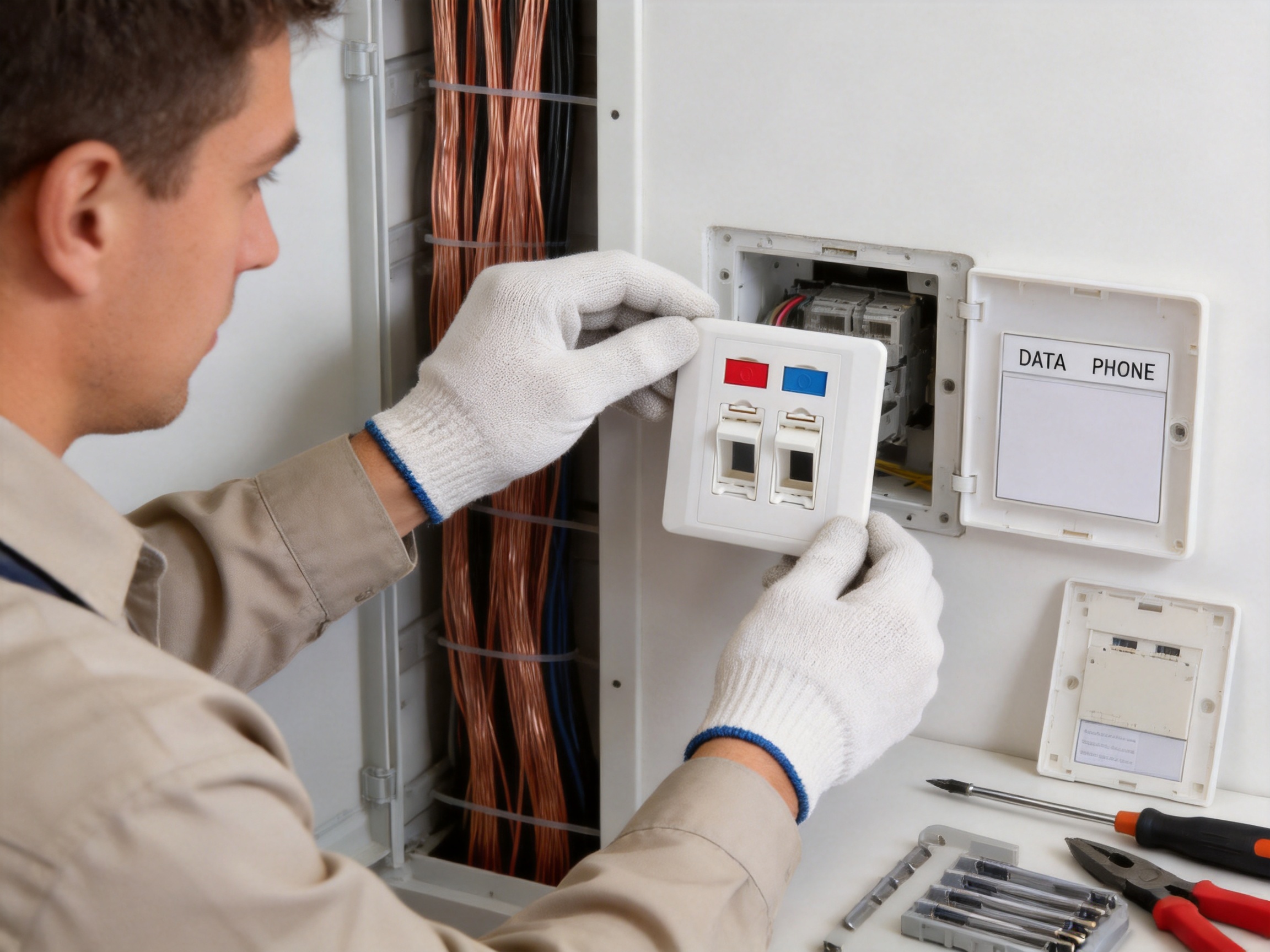
Before installation, the contractor should confirm that the wall box is a compatible Type 86 exposed or concealed back box and that the selected information or telephone modules match the faceplate openings. The back box should be securely fixed, correctly aligned, and positioned at the required height and orientation.
Cables should be routed and terminated according to the requirements of the selected modules and the applicable structured cabling standards. Excessive bending, pulling, or compression should be avoided. The faceplate should not be forced into position if the cable bundle or module arrangement prevents a flush fit.
After the modules are installed, the technician should confirm that the faceplate is seated evenly and that the embedded frame is properly engaged. The spring-type dust-proof door should be opened and released to verify smooth movement. The detachable signboard should be fitted securely and labeled according to the project documentation.
Maintenance is generally straightforward. The external surface can be cleaned with a soft, dry, or slightly damp cloth suitable for the material. Abrasive cleaners, harsh solvents, and sharp tools should be avoided because they may damage the surface finish or identification areas. The dust-proof door should be kept free from obstructions so that it can return to its closed position.
If a communication module must be replaced, the faceplate can be disassembled using an appropriate method that avoids stressing the plastic frame or damaging the wall box. Technicians should follow the module and installation instructions applicable to the specific system. Before returning the outlet to service, the connection should be tested and the label updated.
Environmental and Storage Requirements
The operating temperature range is specified as -25°C to +70°C. This range supports a wide variety of indoor applications, including locations that may experience seasonal temperature variation during transport, installation, or building operation. Even within this range, the product should be installed in an environment appropriate for communication accessories and protected from direct water exposure.
For storage, the recommended ambient temperature is -5°C to +30°C, with relative humidity not exceeding 70%. Products should be stored in a warehouse free from acid, alkali, and other corrosive gases. These conditions help preserve the molded plastic, labels, packaging materials, and associated accessories before installation.
The stated storage period is three years when the products are kept under the recommended conditions. Proper warehouse management should include protection from crushing, excessive stacking, moisture, contamination, and direct sunlight. The original packaging should remain intact until the product is required for installation whenever practical.
These requirements are relevant to distributors and contractors that hold inventory for construction projects. A suitable storage environment helps ensure that products delivered to the installation site remain in the same condition as when they left the factory.
Packaging and Logistics
The product is placed in a dedicated blister bag and then packed into a cardboard box. Product accessories are placed together with the faceplate, and a label identifying the product model and quantity is applied to the upper-left area of the carton front. This packaging arrangement supports product identification during warehouse handling and project distribution.
Packaging is not merely a transport convenience. It also protects the faceplate surface from scratches, keeps small accessories associated with the correct product, and helps warehouse staff verify stock. Clear model and quantity labeling can reduce picking errors when several similar faceplates are stored together.
The regular packing information indicates ten boxes per carton, twenty units per box, and two hundred units per carton. Customers should confirm the final packing configuration, labeling, and accessory count with the supplier for each order, especially when a customer-specified packaging arrangement is required.
The product note specifies customer-designated packaging as an option. This can support distributor branding, project-specific labels, language requirements, barcode systems, or internal inventory codes. OEM and ODM customers may also request packaging adjustments as part of a broader product program.
Customization and OEM/ODM Capability
Structured cabling projects are not always identical. A customer may need a different label format, packaging method, color, logo position, port identification scheme, or product combination. The manufacturer’s combination of regular and customized production lines provides a foundation for handling these requirements.
Customization should begin with a clear technical review. The customer and manufacturer can define the required dimensions, compatible modules, material expectations, markings, packaging quantities, quality standards, and inspection procedures. Samples or pre-production approvals may be used to confirm the appearance and fit before mass production.
OEM and ODM capability is valuable for distributors that want to develop a private-label structured cabling range. It can also support system integrators that need a faceplate matched to a particular project standard. By working with a manufacturer experienced in molded communication accessories, customers can coordinate product development and production more efficiently.
Customized packaging can include the customer’s product code, barcode, language, installation information, carton marking, and internal stock references. These details may improve distribution efficiency, particularly when products are supplied to multiple countries or through different sales channels.
Why Manufacturing Scale Matters to Buyers
Manufacturing scale can affect more than delivery volume. It can support investment in molds, testing equipment, process automation, engineering resources, and production management. A factory with multiple injection molding machines and automated installation equipment can allocate capacity according to product type and order requirements.
Scale also helps a manufacturer serve both standard and customized orders. Standard products can be produced efficiently for distributors and recurring projects, while customized products can be scheduled through dedicated production arrangements. This flexibility is important when customers require a combination of regular catalog items and project-specific products.
For international buyers, a stable production base can reduce supply risk. The company reports stable exports to Europe, Australia, Africa, the Middle East, and Southeast Asia. Experience serving different markets can help the manufacturer understand the importance of documentation, packaging, product consistency, and communication across international orders.
However, buyers should evaluate each project according to its specific requirements. They may request samples, technical drawings, inspection standards, compliance documents, production schedules, and packaging confirmations before placing a large order. A professional supplier should be able to discuss these requirements clearly.
Project Selection Guide
The SMT-4323AP-86-2P is a strong candidate when a project requires a two-port wall outlet, a common Type 86 installation format, a clean screwless appearance, and improved port identification. It is also suitable when the project values a protective dust door, ABS engineering plastic, and flexible use with information or telephone modules.
Before ordering, the project team should verify the exact module type, back-box dimensions, wall construction, faceplate color, labeling requirements, and applicable local standards. If a project uses a nonstandard box or a module system outside the stated compatibility range, a sample fit check is recommended.
For high-volume projects, customers should also confirm production lead time, carton quantities, accessory configuration, inspection arrangements, and customer-specified packaging. These details help prevent delays during installation and ensure that the delivered product matches the project documentation.
Where the outlet will be installed in unusually harsh conditions, the project team should assess temperature, humidity, chemical exposure, impact risk, and cleaning procedures. The faceplate is designed for general communication installations within its stated environmental conditions and should not be treated as a substitute for a specialized industrial or weatherproof enclosure.
Frequently Asked Questions
What is the SMT-4323AP-86-2P?
The SMT-4323AP-86-2P is an 86 Type two-port rotary faceplate for wall-mounted information and telephone installations. It is designed for use with common Type 86 exposed or concealed back boxes and compatible AMP interface information or telephone modules.
How many modules can the faceplate accommodate?
The faceplate provides two module positions. The positions may be configured according to the requirements of the installation, such as one data connection and one telephone connection or two compatible data connections.
What is the purpose of the red and blue identification blocks?
The red and blue identification blocks help distinguish telephone and data services. They provide a quick visual reference for users, installers, and maintenance personnel.
Does the faceplate have a protective cover?
Yes. It includes a spring-type dust-proof door that helps cover the port area when the outlet is not in use. The door also contributes to a cleaner appearance and helps reduce direct exposure to dust.
Is the fixing hardware visible from the front?
The product uses an embedded face-frame design intended to conceal screws from the visible front surface. This creates a cleaner appearance than a faceplate with exposed front screws.
What material is used?
The faceplate is made from high-quality ABS engineering plastic. The material is selected for impact resistance, dimensional stability, and resistance to deformation during normal use and installation.
What temperature range is supported during operation?
The specified operating temperature range is -25°C to +70°C. The product should still be installed in an environment appropriate for indoor communication accessories and protected from conditions outside the stated specification.
Does the product meet environmental requirements?
The product is designed to meet RoHS requirements. Customers that need formal declarations or market-specific documentation should confirm the applicable records with the supplier before procurement.
What are the storage requirements?
The recommended storage environment is -5°C to +30°C, with relative humidity no higher than 70%. The storage area should be free from acid, alkali, and other corrosive gases. Under recommended conditions, the stated storage period is three years.
Can the product be customized?
Customer-specified packaging is supported, and the manufacturer also undertakes OEM and ODM projects. Potential customization should be reviewed in advance, including markings, packaging, colors, product configuration, and inspection requirements.
Is the faceplate suitable for outdoor use?
The product is intended primarily for wall-mounted communication installations in suitable indoor or controlled environments. Outdoor or harsh industrial use should be evaluated separately because additional protection may be required.
How is the product packaged?
The product is placed in a dedicated blister bag and then packed in a cardboard box with its accessories. The carton is labeled with the product model and quantity. The regular packing arrangement should be confirmed with the supplier for each order.
Why is the detachable signboard useful?
The detachable signboard provides a convenient location for port or room identification. Because it can be removed or updated, it supports network changes and helps maintain accurate documentation during future moves, additions, and alterations.
Conclusion
The SMT-4323AP-86-2P 86 Type 2 Ports Rotary Faceplate combines practical installation features with a clean finished appearance. Its compatibility with common Type 86 exposed and concealed back boxes makes it suitable for many structured cabling projects, while the two-port design provides flexible service capacity in a compact wall outlet.
The embedded face frame hides visible screws, the spring-type dust-proof door helps protect unused ports, and the red and blue identification blocks improve service recognition. The larger identification area and detachable signboard support better port management, which can reduce confusion during installation and future maintenance.
Its high-quality ABS engineering plastic is designed to resist impact and deformation, and the product is specified for operation from -25°C to +70°C. RoHS-oriented design supports environmental procurement requirements. Together, these characteristics make the faceplate a practical choice for offices, homes, hotels, schools, commercial spaces, and other communication environments.
The product is supported by a manufacturer with extensive experience in network cabling solutions and optical fiber products. More than ten engineers, over thirty technical personnel, multiple automatic and semi-automatic injection molding machines, automated installation equipment, regular production lines, and customized production capabilities provide a strong manufacturing foundation. The reported annual output of more than nine million units also demonstrates the ability to support large-scale and recurring orders.
For customers seeking a reliable wall interface for copper and information communication systems, the SMT-4323AP-86-2P offers a balanced combination of modular compatibility, visual quality, protection, labeling, material performance, and production support. Its value is strongest when evaluated as part of the complete structured cabling system, where consistent installation, clear administration, and long-term maintainability are essential.
References
1. Product specification materials for SMT-4323AP-86-2P 86 Type 2 Ports Rotary Faceplate.
2. Manufacturer-provided information on Type 86 wall-mounted faceplates and compatible information modules.
3. General principles of structured cabling installation, labeling, administration, and maintenance.
4. General technical references for ABS engineering plastics and injection-molded communication accessories.
5. RoHS-oriented material and environmental compliance guidance for electrical and electronic products.
6. Manufacturer-provided information on production lines, injection molding equipment, automated assembly, engineering resources, quality testing, and OEM/ODM services.
7. General warehousing and packaging practices for network communication components.