Español
 عربى
عربى русский
In structured cabling systems, the faceplate is the visible point where users connect telephones, computers, access points, control devices, and other communication equipment. Although it is a relatively small component, its design affects installation efficiency, port identification, protection against dust, appearance, long-term durability, and the overall maintainability of the cabling system. The SMT-4323AP-86-1X 86 Type Single Port Rotary Faceplate is designed to provide a practical and professional interface for copper and compatible information-module installations.
This single-port rotary faceplate combines an embedded mounting structure, spring-type dust protection, detachable identification features, color-coded markers, and durable ABS engineering plastic. It is suitable for common Type 86 exposed or concealed back boxes and is compatible with AMP interface information and telephone modules. As a result, it can be used in residential, commercial, office, educational, industrial, and smart-building environments where organized communication outlets are required.
The product is manufactured by Yuyao Simante Network Communication Equipment Co., Ltd., a professional network cabling and optical fiber product manufacturer with experience in design, development, sales, service, OEM, and ODM production. The company’s production capabilities include automated injection molding equipment, automatic assembly machinery, multiple regular and customization production lines, and a technical team focused on product quality and continuous improvement.
For installers, system integrators, distributors, and project owners, the value of a faceplate is not limited to its visual appearance. A well-designed faceplate can reduce installation time, make ports easier to manage, protect unused interfaces, and create a consistent finish across an entire project. The SMT-4323AP-86-1X is developed around these practical requirements.
SMT-4323AP-86-1X 86 Type Single Port Rotary Faceplate
Product Overview
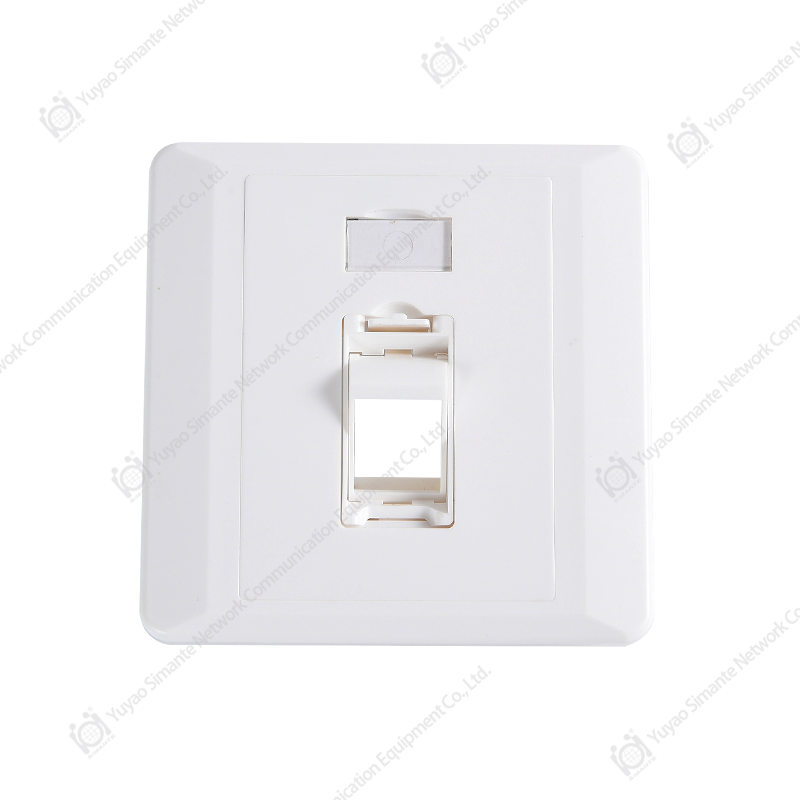
The SMT-4323AP-86-1X is an 86 Type single-port rotary faceplate intended for wall-mounted information outlets. It belongs to the one-port faceplate category and is suitable for use with common Type 86 exposed or concealed back boxes. The faceplate provides a finished interface for installing one compatible telephone, data, or other information module.
Its rotary structure supports convenient module positioning and service access. Instead of relying on a complicated visible screw arrangement, the product uses an embedded face frame. This creates a cleaner front surface and allows the installer to complete installation and disassembly efficiently when maintenance or module replacement is required.
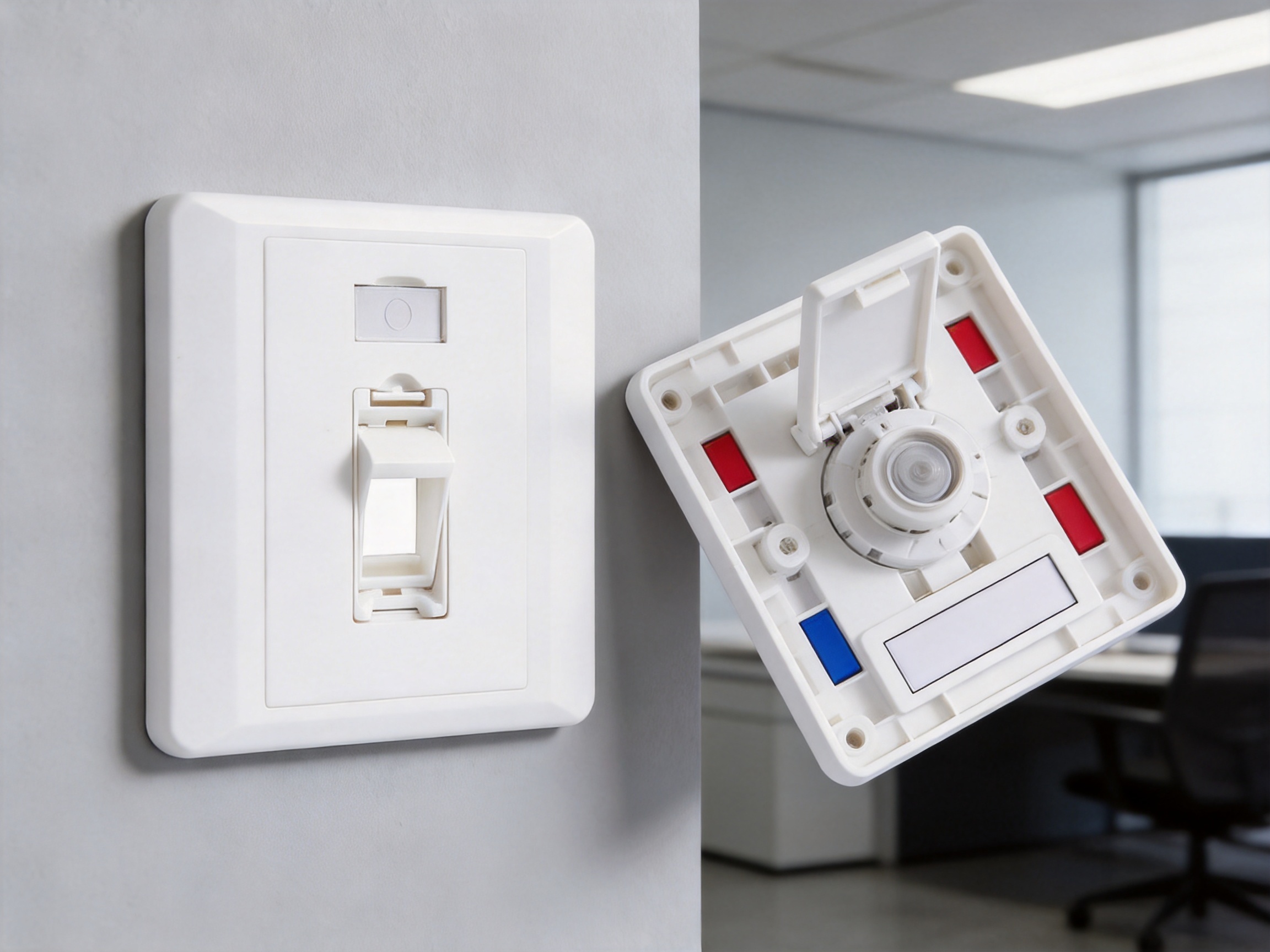
The front of the faceplate includes red and blue identification blocks. These color markers can help distinguish telephone and data applications or identify the type of connector installed. In projects containing many outlets, visual identification can reduce confusion during installation, testing, troubleshooting, and later expansion.
A spring-type dust-proof door is also integrated into the design. When the port is not in use, the door helps reduce the entry of dust and other common environmental contaminants. The protective door is especially useful in offices, homes, equipment rooms, public buildings, and other locations where outlets may remain unused for extended periods.
The faceplate also includes a large front identification area and a detachable nameplate. These features support port labeling and structured documentation. A port can be marked according to room number, workstation, network switch position, telephone extension, device function, or project-specific numbering rules.
| Item | Specification or Feature |
|---|---|
| Product model | SMT-4323AP-86-1X |
| Product type | 86 Type single-port rotary faceplate |
| Application category | One-port faceplate for information modules |
| Installation compatibility | Common Type 86 exposed or concealed back boxes |
| Module compatibility | Compatible with AMP interface information and telephone modules |
| Front identification | Red and blue identification blocks, large labeling area, detachable nameplate |
| Protection feature | Spring-type dust-proof door |
| Material | ABS engineering plastic |
| Environmental compliance | Designed to meet RoHS requirements |
| Operating temperature | -25°C to +70°C |
| Recommended storage temperature | -5°C to +30°C |
| Recommended storage humidity | Relative humidity not more than 70% |
| Standard packaging quantity | 10 boxes per carton, 20 pieces per box, 200 pieces per carton |
Why the Faceplate Matters in a Structured Cabling System
A structured cabling installation is made up of many interconnected elements, including cables, patch panels, keystone jacks, modules, faceplates, cabinets, connectors, and distribution equipment. The faceplate is the final user-facing component at the work area. It provides the physical transition between the concealed cable infrastructure and the device cable used by the end user.
If the faceplate is poorly designed, several practical problems may occur. Screws may be visible or difficult to access. Dust may accumulate around unused ports. Labels may be too small to read. The outlet may not align properly with the back box. The plastic may deform under installation pressure. A replacement module may require excessive disassembly. These issues can increase labor costs and reduce the professional quality of the completed project.
The SMT-4323AP-86-1X addresses these concerns through a combination of installation-oriented features. The embedded frame produces a neat appearance. The rotary design supports convenient assembly and removal. The identification system helps with port management. The dust-proof door provides additional protection for the interface. The ABS material is selected for strength, impact resistance, and dimensional stability during normal use.
Because the faceplate is compatible with common Type 86 back boxes, it can be integrated into many existing wall outlet layouts. This can simplify planning for contractors and reduce the need to redesign the surrounding wall infrastructure. Compatibility with established box dimensions is also useful for renovation projects, office upgrades, apartment developments, hotels, and new commercial construction.
Embedded Face Frame for a Cleaner Installation
One of the most visible advantages of the product is its embedded face frame. Traditional wall outlets may expose screws on the front surface, creating a less refined appearance and making the outlet look more like a basic utility component. The embedded design of this faceplate conceals the fastening structure from normal view and gives the front panel a more integrated appearance.
A clean front surface is valuable in environments where appearance matters. Offices, hotels, retail spaces, schools, hospitals, apartments, and smart homes often require communication outlets to blend with the interior design. A faceplate with a smooth and organized surface can complement the surrounding wall, furniture, and electrical accessories.
The embedded structure also supports practical installation and disassembly. Installers can mount the faceplate without dealing with prominent front screws, while maintenance personnel can remove the relevant component when necessary. This is particularly beneficial in projects where outlets may need to be inspected or reconfigured over time.
Disassembly is an important consideration in structured cabling. Network requirements can change as businesses expand, rooms are reassigned, and new equipment is introduced. A faceplate that allows straightforward access can reduce service interruptions and help technicians complete changes with less disruption to the wall finish.
Rotary Structure and Module Accessibility
The rotary faceplate design is intended to make the front assembly convenient to install and disassemble. This is useful when the information module must be positioned correctly, when the installer is working in a confined space, or when a module needs to be replaced after the initial installation.
Rotary access can also support consistent orientation. The module and faceplate can be aligned so that the connector, label, and protective door are positioned correctly in relation to the wall outlet. Proper orientation improves both appearance and user experience, especially when a project includes a large number of identical outlets.
For contractors, accessible assembly can contribute to faster project completion. Installation teams often work under time pressure, and small improvements at each outlet can produce significant savings across hundreds or thousands of ports. A faceplate that is easy to handle reduces the likelihood of installation errors and helps standardize the work of different technicians.
For maintenance teams, the ability to disassemble the front structure can simplify troubleshooting. If a module, label, or protective element requires attention, the technician can work on the outlet without unnecessarily disturbing the back box or the concealed cable. This supports a more controlled approach to service work.
Color Identification and Port Management
The red and blue identification blocks on the front of the SMT-4323AP-86-1X provide a simple visual method for distinguishing application types. In many communication installations, red is associated with telephone service and blue is associated with data service, although project managers can apply identification rules according to their own standards.
Color identification is especially useful during installation and testing. When multiple outlets are positioned close together, a technician can recognize the intended service type without immediately reading a small label or tracing the cable. This can reduce the possibility of connecting the wrong module or assigning an outlet to the wrong service category.
Clear identification is also useful for end users. In an office or classroom, staff members may need to distinguish a telephone outlet from a network outlet. In a hotel or residential project, the color markers can help maintenance personnel understand the purpose of a port before beginning service work.
The large front identification area expands the product’s port-management capabilities. Labels may be used for room names, outlet numbers, rack and patch-panel references, telephone extensions, department names, workstation codes, or other information required by the project documentation.
The detachable nameplate makes it possible to update identification when the use of a room or outlet changes. For example, a workstation may be reassigned to another employee, a room may change from an office to a meeting room, or an outlet may be allocated to a different network device. A replaceable label helps keep the installation documentation and physical outlet markings aligned.
Benefits of a Structured Labeling Method
A labeling system should be planned before installation begins. Each outlet can be assigned a unique code that corresponds with the patch panel port, cable route, rack position, or network switch port. The detachable nameplate on the faceplate can then display the local identifier, while the complete information is recorded in the project database or as-built documentation.
Consistent labeling can reduce troubleshooting time. When a user reports a connection problem, the service technician can identify the outlet and compare it with the patch-panel and switch records. This is more efficient than tracing an unidentified cable through a crowded telecommunications room.
In large buildings, labeling also supports future expansion. New equipment can be connected to an available port more confidently when the existing outlets are clearly identified. This can reduce accidental disconnection of active services and support better change management.
Spring-Type Dust-Proof Door
Unused communication ports can collect dust, lint, and other particles. Over time, contamination around a connector may affect the cleanliness of the interface and make maintenance more difficult. The spring-type dust-proof door on the faceplate helps cover the opening when it is not being used.
The spring mechanism allows the door to return to its protective position after the user disconnects a cable. This provides a convenient balance between accessibility and protection. The user does not need to keep a separate cap nearby or manually replace a loose cover after every use.
The dust-proof door is useful in both residential and commercial environments. In an office, many outlets may remain unused after furniture is rearranged. In a home, a spare data outlet may be used only occasionally. In a hotel or public facility, different rooms may have different usage patterns. An integrated protective door provides a consistent appearance across all outlets.
The door also contributes to visual organization. Instead of leaving an open connector recess exposed, the faceplate presents a more complete and finished surface. This is helpful in interior spaces where wall outlets are visible to visitors, employees, tenants, and customers.
It is important to understand that a dust-proof door is not a guarantee of complete sealing or waterproof performance. The product is intended for normal indoor structured cabling applications unless a project specification states otherwise. Outdoor, wet, chemically aggressive, or unusually dusty environments may require specialized enclosures and additional protection.
ABS Engineering Plastic Construction
The faceplate is manufactured using high-quality ABS engineering plastic. ABS is widely used for communication accessories because it offers a useful combination of strength, processability, surface quality, and dimensional stability. For a wall-mounted faceplate, these properties help the product withstand ordinary installation, handling, and daily use.
The material is described as anti-collision and impact resistant. This is important because faceplates may experience contact with furniture, equipment, cleaning tools, luggage, or other objects. A material with suitable impact resistance can help reduce the likelihood of cracking during normal service.
Resistance to deformation is another important characteristic. A faceplate must remain sufficiently stable so that it aligns with the back box and allows the module to operate correctly. Excessive deformation can create gaps, uneven edges, or difficulty during assembly. Proper material selection and controlled injection molding help support a consistent product shape.
The surface of ABS engineering plastic can also provide a neat appearance suitable for professional interiors. The faceplate is intended to complement other structured cabling components, electrical accessories, and wall-mounted information outlets. Consistency in color, shape, and fit can improve the visual quality of a complete installation.
Material Selection and Production Control
The final performance of an injection-molded faceplate depends not only on the resin itself but also on mold design, processing conditions, cooling, inspection, and assembly. A stable manufacturing process helps reduce dimensional variation and supports reliable fit across production batches.
Manufacturing controls may include inspection of incoming materials, monitoring of injection molding parameters, visual checks for surface defects, dimensional verification, assembly inspection, and packaging review. These activities are particularly important for products installed in large quantities, where a small variation repeated across an entire project can cause significant installation difficulty.
The manufacturer’s production system includes fully automatic injection molding machines, semi-automatic injection molding machines, and automatic installation equipment. This combination allows the factory to support both stable regular production and customized requirements. Automated equipment can improve repeatability, while technical personnel can manage product development, process adjustment, testing, and project-specific needs.
Environmental and Temperature Performance
The product is designed to meet RoHS requirements. RoHS-oriented production supports the reduction or control of certain restricted hazardous substances in electrical and electronic products and related components. For international projects, environmental compliance is often an important part of supplier evaluation and product approval.
The specified environmental temperature range is -25°C to +70°C. This range indicates the intended temperature conditions for product use as provided in the product information. It offers a broad margin for many indoor installations, including spaces that may experience seasonal temperature changes or limited heating and cooling.
Project engineers should always compare the specified temperature range with the actual installation environment. Areas exposed to direct sunlight, extreme heat, freezing moisture, outdoor weather, strong chemicals, or abnormal mechanical stress may require a separate evaluation. The faceplate is primarily intended for structured cabling and information outlet applications in suitable building environments.
Environmental performance also depends on correct installation. The back box should be properly positioned, the faceplate should be secured without excessive force, and compatible modules should be used. Avoiding over-tightening and preventing physical stress on the plastic can help preserve the appearance and function of the assembly.
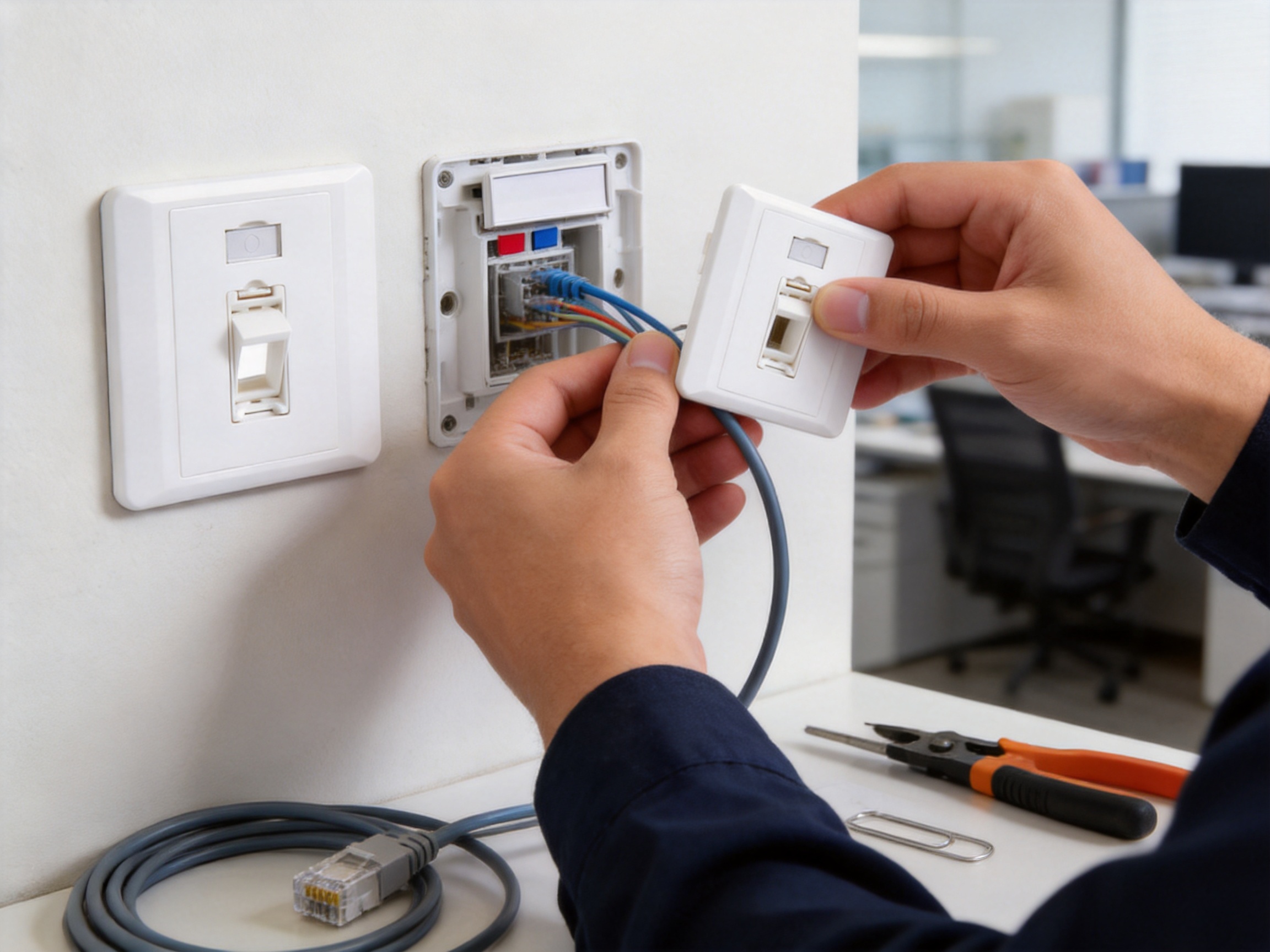
Compatibility with Type 86 Back Boxes
Type 86 wall boxes are widely used in many building and electrical installation environments. Compatibility with common Type 86 exposed or concealed back boxes allows the faceplate to fit into established wall infrastructure and simplifies project planning.
For new construction, this compatibility helps designers specify a familiar wall outlet format. For renovation projects, it can reduce the need to replace existing back boxes or modify the wall opening. This is especially valuable when upgrading older telephone outlets to support modern data communication or when standardizing outlets throughout a building.
Before installation, the contractor should verify the dimensions, mounting method, module type, and local electrical or communication requirements. Although the faceplate is compatible with common Type 86 back boxes and AMP interface information and telephone modules, the complete assembly should be checked as a system before large-scale deployment.
System compatibility includes more than the faceplate. The cable category, connector, module, patch panel, patch cord, and active network equipment must all be appropriate for the intended application. A high-quality faceplate can provide a dependable mechanical interface, but the performance of the overall link depends on every connected component and on the workmanship of termination and testing.
Installation Guidance
Step One: Confirm the Installation Location
Check that the wall opening and Type 86 back box are correctly positioned, securely installed, and free from debris. The box should be level and aligned with adjacent electrical and communication outlets. A properly positioned back box helps the faceplate sit evenly against the wall.
Step Two: Prepare the Communication Module
Confirm that the selected information or telephone module is compatible with the faceplate and the intended cable system. Terminate the cable according to the module manufacturer’s instructions. Keep the cable bend radius within the recommended limit and avoid unnecessary pulling or twisting.
Step Three: Organize the Cable
Arrange the cable behind the module so that it does not interfere with the faceplate, rotary mechanism, or dust-proof door. Excessive cable pressure can make assembly difficult and may place stress on the termination. A neat cable arrangement also makes future maintenance easier.
Step Four: Install and Align the Faceplate
Position the faceplate on the Type 86 back box and use the embedded structure as intended. Confirm that the front surface is level, the module is correctly oriented, and the protective door can move freely. Do not use excessive force during installation.
Step Five: Apply Identification
Use the red and blue identification blocks according to the project’s port-identification standard. Add the appropriate label to the front identification area or detachable nameplate. The identifier should correspond with the patch-panel port and the project’s cable records.
Step Six: Test the Completed Outlet
After installation, test the copper or telephone link with suitable equipment. Verify continuity, wire mapping, connector seating, and any performance requirements specified for the project. Inspect the faceplate for correct fit, clean appearance, and unobstructed movement of the dust-proof door.
Advantages for Contractors and System Integrators
Contractors benefit from products that are easy to install consistently across many locations. The embedded face frame and rotary access help simplify the physical installation process. The faceplate is designed around a familiar Type 86 format, making it suitable for common wall outlet planning and reducing the learning curve for installers.
System integrators also benefit from the identification features. Projects involving voice and data services require accurate port assignment. The color markers, large labeling area, and detachable nameplate provide several layers of visual management without requiring a separate labeling accessory for every outlet.
The spring-type dust-proof door can reduce the need for loose protective caps. Loose caps are easy to misplace during construction or maintenance. An integrated door remains attached to the faceplate and returns to the closed position, providing a more convenient solution for regularly changing workspaces.
For project owners, the product can contribute to a uniform appearance and more manageable infrastructure. A standardized outlet format helps simplify spare-parts planning, maintenance training, and future expansion. When the same faceplate family is used across a building or portfolio of properties, replacement and inventory management may become more efficient.
Advantages Compared with Basic Faceplates
Basic faceplates may provide only a mounting surface and an opening for a connector. While such products can satisfy the minimum mechanical requirement, they may lack the details that improve daily usability and long-term management. The SMT-4323AP-86-1X is differentiated by combining several practical features in one product.
| Evaluation area | Basic faceplate limitation | SMT-4323AP-86-1X approach |
|---|---|---|
| Front appearance | Visible screws or a less integrated surface | Embedded face frame with a cleaner front appearance |
| Module service | Removal may require more steps or tools | Rotary structure supports convenient installation and disassembly |
| Port identification | Limited space for labels | Large identification area and detachable nameplate |
| Service distinction | Telephone and data outlets may look similar | Red and blue identification blocks support visual differentiation |
| Unused port protection | Open port or separate loose cap | Integrated spring-type dust-proof door |
| Material durability | Lower-grade plastic may be more vulnerable to impact or deformation | High-quality ABS engineering plastic with impact-resistant properties |
| Project flexibility | May be limited to a specific box or module format | Designed for common Type 86 back boxes and compatible information modules |
These comparisons do not mean that every competing product has the same limitations. Faceplates vary by manufacturer, design, material, and target application. The key advantage of this model is that it integrates installation, identification, protection, and appearance features in a compact single-port platform.
Manufacturing Strength and Technical Capability
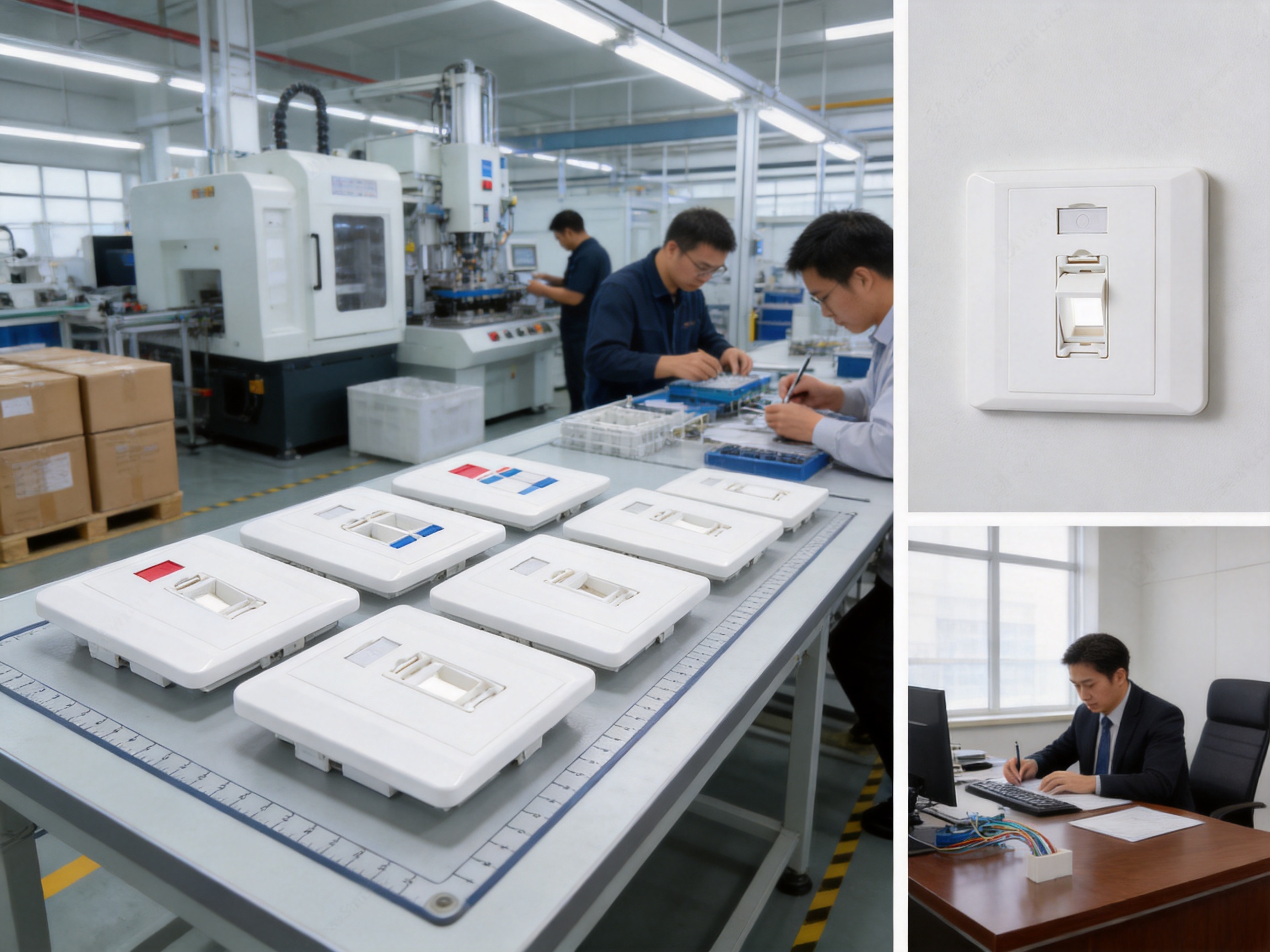
The product is supported by a manufacturer with an integrated development and production structure. Yuyao Simante Network Communication Equipment Co., Ltd. combines product design, research and development, sales, and service. This structure allows customer requirements to be communicated through multiple stages, from initial product discussion to engineering development, production, inspection, packaging, and after-sales support.
The company has more than 10 engineers and more than 30 full-time technical personnel. A technical team of this kind can support mold development, product improvement, production-line optimization, quality control, and customized project requirements. Ongoing technical involvement is important for communication products because installation standards, connector formats, and project expectations can change over time.
The factory operates 10 regular and customization production lines. This provides flexibility for standard orders as well as projects that require customized packaging, labeling, colors, configurations, or other approved product details. Production-line flexibility can be valuable for distributors and system integrators that serve different markets with different packaging or identification requirements.
The production facility includes 10 fully automatic injection molding machines, 20 semi-automatic injection molding machines, and eight types of automatic installation machines. This equipment base supports efficient production of molded plastic components and related assembly operations. Automation can improve consistency, reduce manual handling, and support stable output when manufacturing large quantities.
The factory maintains a stable annual output of more than nine million units across its product range. High production capacity can help support large construction projects, distributor replenishment, and recurring orders. Capacity alone does not guarantee product quality, but it demonstrates the manufacturer’s ability to organize materials, equipment, labor, scheduling, and inspection for sustained production.
Design-Source Quality Control
Quality begins before a product reaches the production line. Mold design, material selection, wall thickness, reinforcement, assembly tolerances, spring placement, label positioning, and connector clearance all influence the final user experience. The manufacturer emphasizes a mature research and development system intended to support quality stability from the design source.
For a faceplate, design-source control is particularly important because multiple functions must fit into a small structure. The product must provide enough strength without becoming unnecessarily bulky. The dust-proof door must move correctly. The nameplate must remain secure but removable. The rotary mechanism must permit access while maintaining a stable finished assembly. These details require coordination between engineering design and manufacturing process control.
Product testing and performance verification are also important. The manufacturer reports that it supports comprehensive customer testing requirements through performance testing. Depending on project specifications, evaluation may include visual inspection, dimensional checks, material review, assembly checks, mechanical operation, temperature considerations, and packaging verification.
OEM and ODM Project Support
Different markets may require different packaging formats, identification systems, colors, labels, documentation, or product configurations. The manufacturer undertakes OEM and ODM projects, allowing customers to discuss requirements beyond standard catalog products.
OEM cooperation may involve producing an established design under a customer’s packaging or distribution requirements. ODM cooperation may involve developing or adapting a product for a specific application, brand architecture, market, or installation standard. In either case, successful cooperation requires clear technical drawings, approved samples, quality criteria, packaging instructions, and production schedules.
The supplied product information notes that packaging can be customer specified. This is useful for importers, wholesalers, project suppliers, and private-label distributors that need packaging aligned with their own logistics or sales channels. Customized packaging may include carton labels, product identification, quantity markings, language requirements, and accessory arrangements.
Customers considering customization should confirm minimum order quantities, tooling requirements, sample approval procedures, lead times, inspection standards, and change-control procedures before production. A clearly documented process helps ensure that the final product meets both technical and commercial expectations.
Packaging, Storage, and Logistics
The product is placed in a dedicated blister bag and then packed into a cardboard box. Product accessories are placed together with the faceplate. A label showing the product model and quantity is attached to the upper-left front area of the carton. This arrangement supports warehouse identification and helps personnel confirm the contents before opening every package.
The standard packing quantity is stated as 10 boxes per carton, 20 pieces per box, and 200 pieces per carton. These quantities can help distributors plan shelf space, pallet loading, order quantities, and project deliveries. Customers should confirm final packing details with the supplier for each order, particularly when customized packaging is requested.
Packaged products should be stored in a warehouse with an ambient temperature of -5°C to +30°C and relative humidity of not more than 70%. The surrounding air should not contain acid, alkali, or other corrosive gases. Under the stated storage conditions, the storage period is three years.
Correct storage is important for plastic communication accessories. Cartons should be protected from excessive moisture, direct sunlight, crushing, and contamination. Packages should be stacked in a way that does not place excessive pressure on the faceplates or deform the cartons. Stock rotation can also help ensure that older inventory is used in accordance with the recommended storage period.
During transportation, distributors and project contractors should protect cartons from impact and water exposure. The product’s ABS construction provides practical resistance during ordinary handling, but packaging should still be treated as protective equipment rather than as a substitute for careful logistics management.
Applications
Office Buildings
In offices, the faceplate can provide a professional outlet for telephone and data modules. Color markers and labels can help staff distinguish services, while the dust-proof door protects outlets that are not currently assigned to a workstation.
Residential and Smart Home Projects
Modern homes increasingly use structured cabling for internet access, home offices, entertainment systems, security devices, and automation equipment. A compact single-port faceplate can provide a neat wall interface while maintaining the flexibility to connect different compatible modules.
Hotels and Hospitality Facilities
Hotels require outlets that are clean, easy to identify, and visually consistent. A detachable nameplate can support room-specific port management, while the protective door helps maintain a finished appearance when the outlet is not in use.
Schools and Training Centers
Educational facilities often contain classrooms, offices, laboratories, and shared equipment spaces. Consistent faceplates and clear port identification can simplify network administration and make service points easier for technicians to locate.
Commercial and Retail Environments
Retail stores, showrooms, and commercial spaces may require communication outlets for point-of-sale equipment, office terminals, surveillance devices, and customer services. The faceplate’s clean front design can be integrated into visible interior spaces.
Industrial Offices and Control Areas
In industrial facilities, the product may be used in suitable indoor office, administration, control, or equipment-support areas. Project managers should evaluate environmental conditions carefully before using any wall faceplate in areas exposed to chemicals, moisture, dust, or severe mechanical conditions.
Maintenance and Long-Term Service
Routine maintenance begins with visual inspection. Technicians should check that the faceplate remains securely mounted, that the protective door moves correctly, and that the label remains readable. Any unusual cracking, looseness, discoloration, or deformation should be investigated.
Dust and surface dirt can normally be removed using a soft, dry cloth or a cleaning method approved for ABS plastic. Strong solvents, abrasive cleaners, excessive water, and sharp tools should be avoided unless specifically authorized by the project’s maintenance procedure.
When replacing a module, technicians should record the change and update the port documentation. The detachable nameplate can be replaced or updated so that the physical label remains consistent with the network records. After service, the connection should be tested again before the outlet is returned to use.
Maintenance personnel should avoid placing excessive pressure on the rotary structure or forcing the spring-type dust-proof door beyond its normal movement. Proper handling helps preserve the mechanism and prevents unnecessary damage to the faceplate.
Project Selection Considerations
Before specifying the SMT-4323AP-86-1X, project teams should confirm the required module type, back-box format, installation orientation, labeling method, color-identification rules, and environmental conditions. These checks help ensure that the faceplate is suitable for the complete system rather than evaluated as an isolated component.
For large projects, buyers should request technical documentation, samples, packaging information, and quality requirements before placing a mass order. Sample installation can confirm fit with the selected back box and module. It can also reveal whether the labeling area is adequate for the project’s numbering system.
Procurement teams should also review supply continuity, production capacity, lead time, spare-parts planning, and inspection procedures. The manufacturer’s multiple production lines and substantial output can support volume requirements, but order planning remains important for projects with fixed construction schedules.
Where customized packaging or product identification is required, the buyer should approve artwork, carton markings, accessory lists, and product labels in writing. This avoids confusion during manufacturing and makes the final shipment easier to receive and distribute.
Quality, Reliability, and Value
Product value should be evaluated across the entire service life rather than only by purchase price. A low-cost faceplate may appear attractive initially, but difficulties with installation, labeling, module access, breakage, or replacement can increase the total project cost.
The SMT-4323AP-86-1X is designed to provide value through practical details. The embedded face frame supports a neat installation. The rotary structure assists assembly and service. The color markers and detachable nameplate improve identification. The spring-type dust-proof door protects unused ports. The ABS material provides a balance of durability and appearance. Compatibility with Type 86 back boxes supports broad installation use.
For distributors, a product with several integrated features may be easier to position in different market segments. It can serve standard data outlets, telephone installations, renovation projects, and customized structured cabling programs. For system integrators, consistent availability and manufacturer support can be as important as the physical product design.
Reliability also depends on installation quality and system compatibility. The faceplate should be installed with suitable modules and correctly terminated cables. The complete link should be tested according to the required standards. When these conditions are met, the faceplate can serve as a durable and manageable user interface for a structured cabling system.
Frequently Asked Questions
What is the SMT-4323AP-86-1X?
The SMT-4323AP-86-1X is an 86 Type single-port rotary faceplate for wall-mounted information outlets. It is designed for one compatible telephone, data, or other information module.
Which wall boxes can be used with this faceplate?
The faceplate is designed for common Type 86 exposed or concealed back boxes. Installers should verify the specific box, mounting arrangement, and module dimensions before completing a large project installation.
What modules are compatible with the product?
The product is compatible with AMP interface information and telephone modules. The exact module should be checked against the project design and the supplier’s current technical documentation.
What is the purpose of the red and blue identification blocks?
The red and blue blocks provide visual identification for telephone and data applications or for other project-defined connector categories. They help installers, maintenance personnel, and users distinguish different outlet functions.
Does the faceplate include port labeling features?
Yes. It includes a large front identification area and a detachable nameplate. These features can be used for room numbers, outlet codes, telephone extensions, patch-panel references, or other project information.
How does the dust-proof door work?
The spring-type door covers the port when it is not in use and moves away when access is required. After use, it is designed to return toward the protective position. It is intended to reduce dust entry under normal indoor conditions, not to provide waterproof sealing.
What material is used for the faceplate?
The faceplate uses high-quality ABS engineering plastic. The material is selected for practical impact resistance, anti-collision performance, and resistance to deformation during normal use.
What temperature range is specified for the product?
The stated environmental temperature range is -25°C to +70°C. The actual installation environment should be reviewed to confirm that it is appropriate for the product and the complete cabling system.
Does the product meet environmental requirements?
The product information states that it meets RoHS requirements. Customers with project-specific compliance needs should request the applicable documentation and confirm the requirements before ordering.
Can the product be used in renovation projects?
Yes. Its compatibility with common Type 86 back boxes makes it suitable for many renovation and upgrade projects. Existing wall-box dimensions and module compatibility should be checked before installation.
Is customized packaging available?
The product information indicates that customer-specified packaging is available. Customers should confirm carton markings, labels, accessory arrangements, order quantities, and approval procedures with the manufacturer.
What is the standard packaging quantity?
The stated regular packing quantity is 10 boxes per carton, 20 pieces per box, and 200 pieces per carton. Final packaging should be confirmed for each order, especially when customization is requested.
How should the product be stored?
Packaged products should be stored at -5°C to +30°C, with relative humidity no higher than 70%, in a warehouse free from acid, alkali, and other corrosive gases. The stated storage period is three years under the recommended conditions.
Does the manufacturer support OEM and ODM projects?
Yes. The manufacturer undertakes OEM and ODM projects and operates regular and customization production lines. Project-specific technical, packaging, and quality requirements should be documented and approved before production.
Conclusion
The SMT-4323AP-86-1X 86 Type Single Port Rotary Faceplate is designed to address the practical requirements of modern wall-mounted communication outlets. Its embedded face frame creates a clean appearance, while the rotary structure supports convenient installation and maintenance. The spring-type dust-proof door helps protect unused ports, and the red and blue identification blocks provide quick visual differentiation between service types.
The large identification area and detachable nameplate support organized port management, which is essential in structured cabling systems where accurate documentation can reduce future troubleshooting time. High-quality ABS engineering plastic contributes to impact resistance and dimensional stability, while the stated RoHS compliance and -25°C to +70°C temperature range support a broad range of suitable applications.
Beyond the product itself, the manufacturer offers substantial production and technical capabilities. Its engineering team, automated injection molding equipment, automatic assembly machinery, multiple production lines, customer testing support, and OEM and ODM experience provide a foundation for stable supply and project customization.
For contractors, distributors, system integrators, and building owners seeking a professional single-port interface for Type 86 installations, this faceplate offers a balanced combination of appearance, usability, protection, identification, compatibility, and manufacturing support. When correctly matched with the selected module, cable system, and back box, it can contribute to a cleaner, more manageable, and more reliable structured cabling installation.
References
1. Product information sheet for the SMT-4323AP-86-1X 86 Type Single Port Rotary Faceplate.
2. Manufacturer technical information covering Type 86 wall-mounted information panels and compatible telephone and data modules.
3. General structured cabling installation and administration practices for work-area outlets, telecommunications rooms, and port identification.
4. RoHS environmental compliance principles for electrical and electronic products.
5. General guidance for injection-molded ABS engineering plastic components and quality-control procedures.
6. Manufacturer information concerning design, development, automated injection molding, assembly, OEM, ODM, packaging, and storage capabilities.