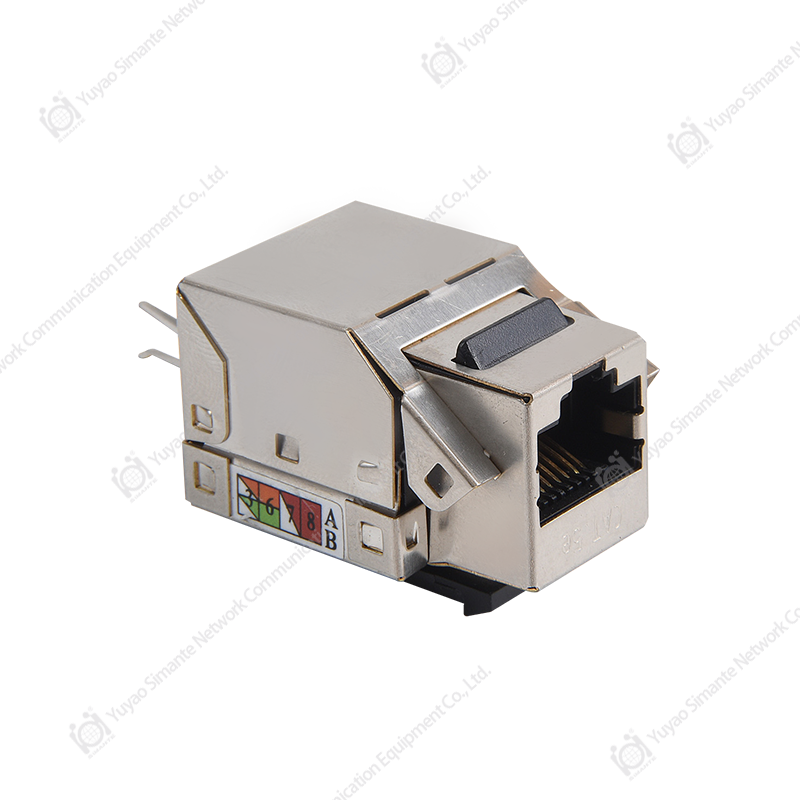
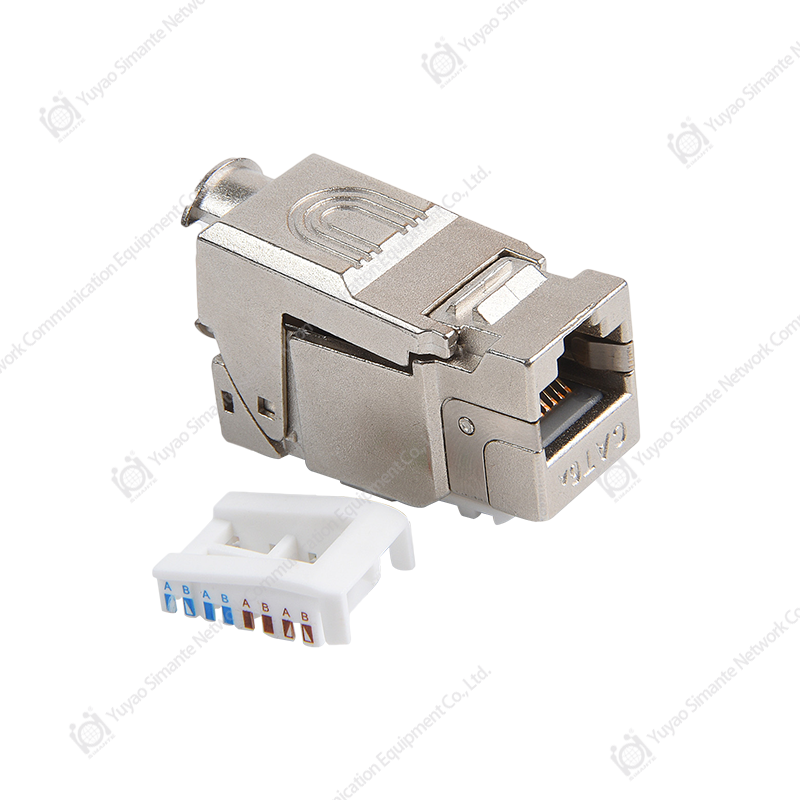
Español
 عربى
عربى русский
Modern data networks require cabling infrastructure that is organized, adaptable, serviceable, and prepared for future upgrades. Although active equipment such as switches, routers, and wireless controllers often receives the most attention, the passive infrastructure surrounding these devices has an equally important role. A well-designed patching system protects cable terminations, simplifies identification, improves rack organization, and helps network technicians maintain reliable connections over many years.
The SMT-2049-24P 1U 24-port blank patch panel is designed for this purpose. It provides a compact rack-mounted platform for installing modular keystone-style connectivity components in copper and fiber structured cabling environments. Instead of forcing an installation to use a fixed connector configuration, a blank patch panel allows the user to select compatible modules according to the network’s requirements. This flexibility makes it suitable for commercial buildings, data rooms, telecommunications cabinets, smart-home infrastructure, security systems, automation installations, and other low-voltage applications.
Manufactured by Yuyao Simante Network Communication Equipment Co., Ltd., the SMT-2049-24P combines a standard 1U rack format with 24 modular port positions. Its design supports clean cable management, convenient port identification, and efficient use of cabinet space. More importantly, the product reflects the manufacturer’s wider capabilities in network cabling solutions, including product design, mold development, injection molding, automated assembly, quality inspection, OEM production, and ODM cooperation.
This article examines the product’s construction concept, installation value, application advantages, manufacturing strengths, quality considerations, and comparison with conventional fixed patch panels. It also explains how a blank patch panel can help network integrators create a more adaptable and economical structured cabling system.
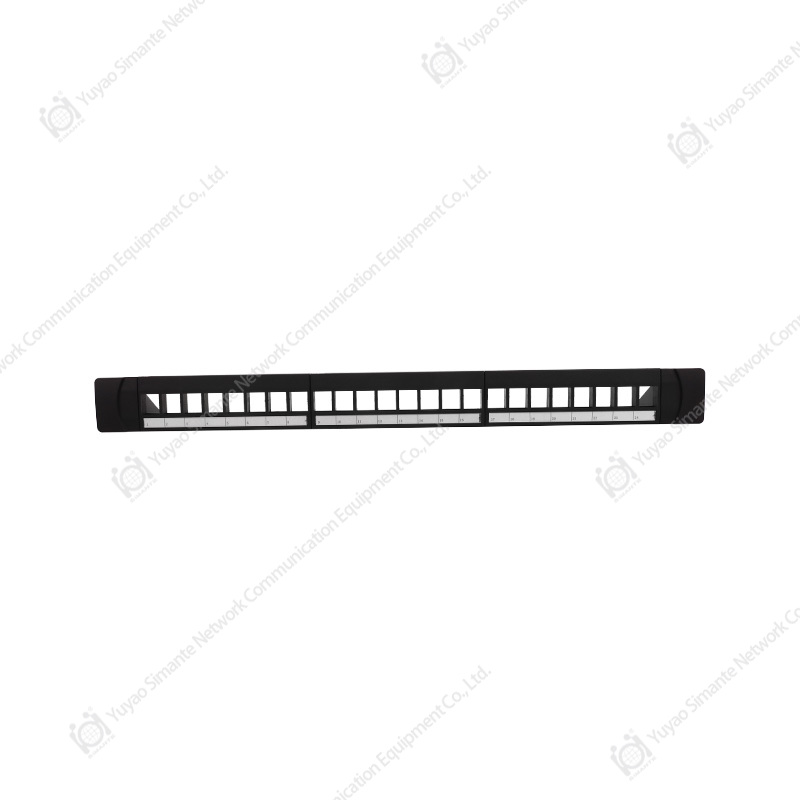
SMT-2049-24P 1U 24 port blank patch panel
1. Product Overview
The SMT-2049-24P is a 24-port blank patch panel designed to occupy one standard rack unit in a 19-inch equipment cabinet or wall-mounted rack. The blank configuration means that the front panel contains modular openings rather than permanently installed RJ45, fiber optic, telephone, or audiovisual connectors. Compatible modules can be installed in the openings to create a configuration appropriate for the project.
This design approach is especially useful when a project includes several types of connectivity. For example, one installation may require Category 6A copper keystone jacks for high-speed Ethernet, while another may need a combination of copper data modules, fiber adapters, coaxial modules, HDMI modules, USB modules, or blank inserts. A modular patch panel allows the same basic chassis to support different combinations without requiring a completely different fixed panel for every application.
The principal product characteristics include the following:
- 24 modular port positions.
- 1U rack-mounted format.
- Blank-panel construction for flexible module selection.
- Suitability for copper and fiber structured cabling applications when paired with compatible modules.
- Front-facing port organization for easier patching and maintenance.
- Port identification capability for labeling and administration.
- Compatibility with professional cabinet, rack, and structured cabling installation practices.
Because the panel itself is passive, it does not require an independent power supply or active electronic components. Its main functions are mechanical organization, connector support, labeling, and protection of the installed modules. This simplicity contributes to long service life and makes the unit a practical component in both new installations and network expansion projects.
2. Why a Blank Patch Panel Is Valuable
A fixed patch panel is manufactured with a predetermined arrangement of connectors. This can be convenient when every port in a project has the same function, but it may become restrictive when the network includes different media types or when future changes are expected. A blank patch panel solves this limitation by separating the panel chassis from the selected connector modules.
In a conventional fixed copper patch panel, the installer receives a panel with permanently integrated RJ45 ports. If the network later changes to a different connector type, the panel may need to be replaced. By contrast, a modular blank panel can often be reconfigured by removing and replacing individual modules. This reduces material waste and can shorten the time required for network modifications.
The blank format also helps project planners avoid overcommitting to a single technology. Structured cabling systems frequently remain in service for many years, while the connected equipment may change several times during that period. A flexible physical infrastructure allows the network to adapt as equipment, transmission speeds, security requirements, and building services evolve.
Another benefit is procurement efficiency. A distributor, system integrator, or contractor can maintain a smaller inventory of standard panels while stocking compatible modules separately. Instead of carrying many connector-specific patch panels, the supplier can combine the SMT-2049-24P with the required modules for each order. This may simplify logistics and improve responsiveness for customized projects.
2.1 Support for Mixed Connectivity
Many communication rooms contain more than one type of connection. Copper Ethernet may be used for workstation links, wireless access points, cameras, and access-control devices. Fiber may be used for backbone links, building-to-building connections, or high-bandwidth uplinks. Other modules may be required for telephone, audio, video, or specialized control systems.
A blank 24-port panel can be configured to accommodate a mixed set of modules, provided that the selected modules are mechanically compatible with the panel openings and are suitable for the intended application. This makes the product useful for projects where the network designer wants a unified rack appearance and consistent labeling across multiple media types.
2.2 Simplified Future Changes
Network infrastructure is rarely static. A company may add employees, install more surveillance cameras, upgrade access points, or deploy new building-automation systems. A modular panel helps technicians add or change ports without replacing the entire panel assembly.
For example, an initially installed panel could contain copper modules for office connections and a small number of fiber adapters for uplinks. During a later renovation, unused positions could be populated with additional fiber, data, or service modules. This provides a practical path for phased expansion while preserving the original rack layout.
2.3 Better Space Utilization
Rack space is valuable in data rooms and telecommunications cabinets. A 1U panel with 24 ports provides a high port density while leaving additional rack units available for switches, cable managers, fiber enclosures, power distribution equipment, and other components.
Using a consistent 1U format can also make rack planning easier. The installer can group patch panels with switches, reserve space for service loops, and maintain clear separation between active and passive equipment. A well-organized rack reduces the risk of accidental disconnection and provides technicians with more working space during maintenance.
3. Product Design and Functional Advantages
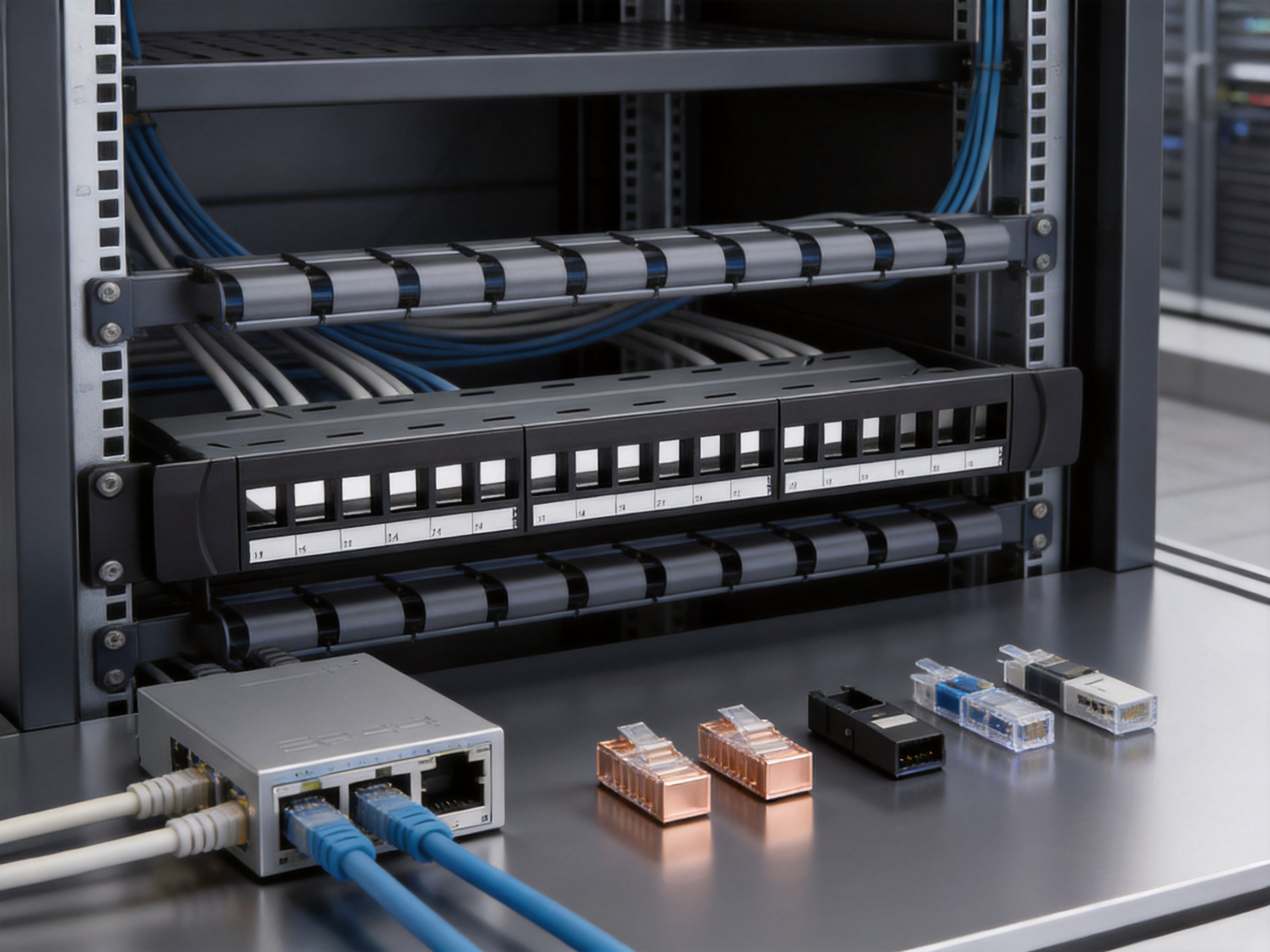
The SMT-2049-24P is built around several practical design priorities: modularity, rack compatibility, visibility, accessibility, and installation efficiency. These priorities are important because a patch panel is not simply a metal or molded frame. It is an interface between permanent horizontal or backbone cabling and the patch cords that connect active equipment.
3.1 24-Port Capacity
Twenty-four ports are widely used in small and medium-sized communication cabinets because the capacity aligns well with common switch configurations and office cabling zones. A 24-port panel can serve a group of workstations, wireless access points, cameras, or building systems while maintaining a clear relationship between the patch panel and the associated switch.
For larger projects, multiple panels can be installed in sequence. This supports structured port numbering and allows the network administrator to divide connections by floor, department, service type, or cable category. For smaller projects, one 24-port panel may provide sufficient capacity while preserving room for future additions.
3.2 Standard 1U Rack Format
The 1U form factor is suitable for standard 19-inch racks and cabinets commonly used in commercial networking installations. This format allows the panel to be integrated with other standard rack components. A 1U patch panel can be positioned above or below a network switch, near a horizontal cable manager, or within a dedicated passive-cabling section.
Standard rack mounting also benefits maintenance teams. Technicians familiar with conventional 19-inch systems can install or replace the unit using established procedures. The product does not require an unusual cabinet design or a specialized mounting structure.
3.3 Modular Port Openings
The blank openings are the central feature of the product. They allow the user to select modules based on transmission medium and project requirements. The installer can plan port assignments before assembly, then populate the panel with the selected connector types.
Modularity can also help with spare-parts management. If a single module is damaged or needs to be upgraded, the affected position may be serviced independently rather than replacing the whole panel. The exact replacement process depends on the module design and installation method, but the modular principle generally improves serviceability.
3.4 Clear Port Administration
Structured cabling performance depends not only on the physical quality of connectors and cables but also on proper administration. Ports should be labeled consistently, documented accurately, and connected according to a planned numbering scheme. A blank patch panel provides a clear front-facing arrangement for labels and port identification.
Technicians can assign each port to a room, outlet, device, cable route, or service category. This is particularly valuable in environments where many cables enter the cabinet from different directions. Clear labeling reduces troubleshooting time and helps prevent accidental changes to active connections.
3.5 Compatibility with Professional Installation Practices
The panel is intended to be used as part of a complete structured cabling system. Its performance therefore depends on correct module selection, proper cable termination, suitable patch cords, appropriate grounding practices where applicable, and compliance with the requirements of the chosen cabling category or media type.
When integrated correctly, the panel provides a professional transition point between permanent cables and equipment connections. It helps separate the fixed cabling plant from frequently changed patch cords, improving organization and making moves, adds, and changes easier to manage.
4. Comparison with Conventional Fixed Patch Panels
Both fixed and modular patch panels have important roles in network infrastructure. A fixed panel may be suitable when a project has a uniform and unchanging connector requirement. However, the SMT-2049-24P offers several advantages in projects where flexibility, mixed media, and long-term adaptability are important.
| Feature | Blank Modular Patch Panel | Conventional Fixed Patch Panel |
|---|---|---|
| Port configuration | Selected by the installer using compatible modules | Predetermined during manufacturing |
| Mixed media support | Well suited to mixed copper, fiber, and other compatible modules | Usually limited to the connector type built into the panel |
| Future modification | Individual positions may be reconfigured or replaced | Major changes may require panel replacement |
| Inventory management | One panel platform can support multiple project configurations | Several connector-specific models may be required |
| Project customization | High, because modules can be selected per application | Lower, unless a special model is ordered |
| Serviceability | Modular maintenance can simplify localized replacement | Faults may affect the integrated panel assembly |
| Rack space | Efficient 1U, 24-port arrangement | Depends on the specific fixed-panel model |
The comparison does not mean that a blank panel is always superior. A fixed panel may provide a faster installation when all ports are identical and the design will not change. However, for contractors, system integrators, distributors, and end users who need configurable infrastructure, the modular approach provides a stronger balance of flexibility and long-term value.
5. Applications in Structured Cabling Systems
The SMT-2049-24P can be used in many structured cabling environments. Since the panel is blank, the final application depends on the modules installed and the cable system selected.
5.1 Enterprise Office Networks
Office buildings typically require connections for computers, printers, telephones, wireless access points, meeting-room systems, and security devices. A 24-port modular panel can organize these connections within a telecommunications room or floor-distribution cabinet.
Ports can be assigned according to office zones or departments. Copper modules may support horizontal links to work areas, while fiber modules can be used for uplinks between distribution points. A consistent panel design simplifies documentation when the building expands or departments move.
5.2 Data Rooms and Equipment Cabinets
Small and medium-sized data rooms often have limited rack space. The 1U panel provides a compact location for terminating and organizing connections near network switches and servers. By keeping permanent cables on the patch-panel side and short patch cords on the equipment side, the installation can remain orderly and easier to inspect.
For larger data-center applications, multiple panels may be installed with dedicated cable managers and fiber-management equipment. Project designers should verify the required cable bend radius, airflow requirements, labeling scheme, grounding method, and applicable data-center standards before deployment.
5.3 Security and Surveillance Networks
Security systems increasingly use Ethernet-connected cameras, access-control devices, intercoms, recording systems, and monitoring stations. A modular patch panel can provide an organized termination point for copper network links and selected fiber backbone connections.
Clear labeling is particularly important in security installations. Technicians need to identify camera zones, door controllers, network segments, and recording equipment quickly. A structured port arrangement helps reduce service delays when a device or cable requires inspection.
5.4 Smart Buildings and Automation
Building-automation systems may connect environmental sensors, lighting controllers, access systems, energy-management devices, and other intelligent equipment. These systems may be installed in stages, and their communication requirements can change as the building becomes more automated.
The modular format allows the cabling cabinet to accommodate different connector and service requirements without relying on a single fixed panel design. This is useful for integrators who manage several building systems within a shared telecommunications infrastructure.
5.5 Educational and Public Facilities
Schools, hospitals, libraries, transportation facilities, and government buildings often require reliable networks across many rooms and departments. These projects may be completed in phases, with additional services added as funding, construction, or operational requirements develop.
A blank 24-port panel supports a planned and orderly expansion strategy. It can be installed as part of the original cabinet build and populated according to immediate needs, while reserved positions remain available for future services.
5.6 Residential and Smart-Home Installations
Advanced residential developments may include structured wiring for internet access, home entertainment, surveillance, intercoms, access control, and automation. A compact 1U panel can organize these connections in a central low-voltage cabinet or equipment enclosure.
The panel’s modular nature is useful in homes where each project has a different combination of services. One residence may need primarily copper data ports, while another may require fiber distribution and audiovisual connectivity. The same basic panel platform can support both configurations when compatible modules are selected.

6. Installation and Configuration Considerations
Correct installation is essential to obtain the expected value from any patch panel. The SMT-2049-24P should be installed by personnel familiar with structured cabling practices and the requirements of the selected modules.
6.1 Planning the Port Layout
Before installing modules, the project team should prepare a port schedule. The schedule may identify the module type, connected area, cable number, service type, and corresponding switch port. Planning the arrangement in advance reduces rework and makes the final cabinet easier to understand.
Mixed configurations should be arranged logically. For example, copper data ports may be grouped together, fiber adapters may be positioned in a dedicated section, and specialized services may receive a separate labeling color. The exact layout depends on the project’s administration policy.
6.2 Selecting Compatible Modules
Only modules that match the panel’s opening dimensions and retention method should be used. The installer should also confirm that the module supports the required cable category, conductor size, shielding arrangement, fiber adapter type, and performance rating.
For copper systems, the module should be selected according to the required category, such as Category 5e, Category 6, or Category 6A, as specified by the network design. For fiber systems, the adapter and module should match the fiber type and connector style used in the backbone. Compatibility should be verified before purchase and installation.
6.3 Cable Routing and Bend Radius
Cables should be routed into the cabinet without excessive pulling force, twisting, compression, or sharp bends. Copper and fiber cables have different mechanical requirements, and the manufacturer’s cable recommendations should be followed. Fiber cables in particular require careful handling to avoid excessive bend stress or connector contamination.
Horizontal cable managers, vertical managers, and rear support accessories can be used to control cable movement. A well-supported cable route reduces mechanical strain on the installed modules and makes future service work safer.
6.4 Labeling and Documentation
Every active port should be labeled according to the project’s documentation system. Labels may include room numbers, outlet identifiers, device names, cable numbers, or service classifications. The same identifier should appear in the cable records, drawings, and switch documentation.
Good documentation is especially valuable when a cabinet contains multiple technologies. A technician should be able to determine the destination and purpose of a port without tracing every cable manually.
6.5 Testing and Acceptance
After installation, the completed cabling system should be tested using equipment appropriate for the selected medium. Copper links may require wire-map, length, insertion-loss, return-loss, crosstalk, and certification testing according to the applicable category. Fiber links may require inspection, cleaning, continuity testing, optical-loss measurement, and other relevant tests.
The patch panel is one component in the overall channel or permanent link. Therefore, test results depend on the cable, connector, module, patch cord, installation method, and test configuration. The use of a high-quality panel cannot compensate for incorrect termination or unsuitable components elsewhere in the link.
7. Manufacturing Expertise Behind the Product
The performance and consistency of a network accessory depend heavily on the manufacturer’s production system. Yuyao Simante Network Communication Equipment Co., Ltd. has developed its business around network cabling solutions and optical fiber products, with capabilities covering design, development, sales, and service.
The company reports nearly two decades of service in the industry. This experience is valuable because structured cabling products require more than basic molding or assembly. They must be designed for dimensional consistency, compatibility with related components, repeatable installation, and stable performance across large production volumes.
7.1 Engineering and Product Development
A mature engineering process begins before production. Product designers must consider rack dimensions, material selection, module retention, labeling space, assembly methods, packaging, and compatibility with installation practices. The company’s engineering team includes more than ten engineers, supported by over thirty full-time technical personnel.
This technical structure can support ongoing product refinement. Feedback from installers and customers can be reviewed by engineering staff and used to improve molds, production methods, assembly procedures, and product versions. The result is a development cycle that is more responsive than a purely trading-based supply model.
7.2 Mold Development and Injection Molding
Many network cabling accessories contain molded components that require accurate dimensions and stable material behavior. Injection molding quality affects the fit, appearance, strength, and repeatability of items such as module housings, connector bodies, faceplates, and related accessories.
The company operates ten fully automatic injection molding machines and twenty semi-automatic injection molding machines. This equipment base provides production flexibility for different component sizes, materials, and order quantities. Proper control of molding temperature, pressure, cooling, cycle time, and mold condition helps maintain consistent parts from batch to batch.
For a modular patch-panel system, dimensional control is important because modules must fit securely within the blank openings. Excessive variation can lead to loose components, difficult insertion, uneven appearance, or installation delays. A controlled molding and inspection process helps reduce these risks.
7.3 Automated and Semi-Automated Assembly
The company also operates eight types of automatic installation machines and maintains ten regular and customization production lines. Automation can improve repeatability in operations such as component insertion, fastening, labeling preparation, or packaging. Semi-automated lines provide flexibility when a product requires manual adjustment, special inspection, or a customized configuration.
The combination of automated and semi-automated production is particularly useful for serving both standard products and OEM or ODM projects. Standard products can be manufactured efficiently, while customized orders can receive the additional handling required for special packaging, marking, materials, or assembly instructions.
7.4 Production Capacity
The factory maintains an annual output of more than nine million units across its product range. This scale indicates that the manufacturer is equipped to support regular distribution orders as well as larger project requirements, subject to product availability, specifications, and production scheduling.
Production capacity alone does not guarantee quality, but it can provide supply-chain advantages. Stable capacity may help customers maintain continuity across multiple project phases, reduce the risk of product shortages, and coordinate delivery schedules more effectively.
7.5 Quality Control and Performance Testing
Quality control is integrated into the company’s manufacturing approach. The manufacturer emphasizes performance testing and the ability to meet comprehensive customer testing requirements. For network cabling products, testing may include dimensional checks, material inspection, assembly verification, connector compatibility, mechanical evaluation, and application-specific performance tests.
For the SMT-2049-24P, quality attention should include the accuracy of the rack format, the consistency of port openings, the strength of the panel structure, the quality of surface finishing, the reliability of module retention, and the clarity of identification areas. When the panel is used with copper or fiber modules, the complete assembly should be checked as a system.

8. Advantages for OEM, ODM, and Distribution Customers
The SMT-2049-24P is suitable not only for direct installation but also for customers who sell, integrate, or customize network infrastructure products. The manufacturer supports OEM and ODM projects, which can be important for distributors and solution providers seeking a product adapted to a specific market.
8.1 OEM Opportunities
OEM customers may require custom branding, packaging, product labels, instruction sheets, or order-specific configurations. A manufacturer with established production lines and technical personnel can coordinate these requirements within a controlled manufacturing process.
OEM cooperation may be useful for regional distributors that want to offer a consistent product family under their own commercial identity. The exact scope of customization should be discussed in advance, including minimum order quantities, packaging specifications, inspection procedures, and delivery schedules.
8.2 ODM Development
ODM projects generally require deeper cooperation during design and development. Customers may have requirements involving port count, rack height, material, color, labeling, module compatibility, mounting details, or packaging. Engineering support can help transform these requirements into a manufacturable product.
The company’s design and technical resources provide a foundation for such cooperation. Customers can benefit from the manufacturer’s experience with structured cabling components, injection molding, automated assembly, and product testing.
8.3 Stable Supply for Project Work
Large infrastructure projects often require products in stages. A contractor may need an initial quantity for one building, followed by additional orders for other floors or sites. Stable manufacturing resources and established quality procedures can help maintain consistency between deliveries.
For repeat projects, it is important to confirm product revision control, raw-material specifications, packaging details, and inspection standards. These controls help ensure that the same product remains consistent over time.
9. Competitive Advantages of the SMT-2049-24P
The SMT-2049-24P competes through a combination of adaptable design, efficient rack utilization, manufacturing support, and application versatility. Its most important advantage is that it gives installers control over the final port configuration instead of limiting them to a factory-fixed arrangement.
Compared with low-cost panels that may offer only basic openings and limited production support, this product benefits from a manufacturer with dedicated engineering, technical, molding, assembly, and testing capabilities. These resources can contribute to better consistency and more reliable supply for professional customers.
Compared with fixed panels, the product can reduce the need to stock many connector-specific designs. Compared with improvised mounting solutions, it provides a cleaner and more standardized rack presentation. Compared with non-modular installations, it offers a more practical path for future changes.
Its 1U, 24-port configuration is another strong point. It balances capacity and space efficiency, making it suitable for many standard cabinet layouts. The product can be installed as a single unit in a smaller network or combined with other panels in a larger structured cabling system.
The product also supports a system-oriented purchasing strategy. Customers can select the panel, compatible modules, cable management accessories, and labeling approach as a coordinated package. This helps integrators build solutions instead of purchasing isolated components without a clear installation plan.
10. Maintenance and Long-Term Serviceability
A patch panel is expected to remain in service for many years. Even when the connected active equipment changes, the passive infrastructure may continue to support the facility. For this reason, serviceability is an important part of the product’s value.
The modular design allows technicians to focus on individual port positions when changes are required. A damaged module, a new media requirement, or a rearranged port assignment may be addressed without immediately replacing the entire 1U panel. The precise method depends on the selected module and site procedure, but the overall design reduces dependence on a single permanent configuration.
Routine maintenance should include visual inspection of labels, patch cords, cable support, module seating, and signs of physical damage. Cabinets should be kept clean and protected from excessive dust, moisture, heat, and mechanical impact. Patch cords should not be pulled by their connectors, and unused positions should be managed according to the project’s cleanliness and protection requirements.
When a change is made, the documentation should be updated at the same time. A modular panel provides physical flexibility, but accurate records are necessary to convert that flexibility into practical operational value.
11. Sustainability and Lifecycle Value
Flexible products can contribute to more efficient use of materials over the service life of a network. If a project changes from one connector arrangement to another, a modular panel may remain in place while only selected modules are changed. This can reduce unnecessary replacement of the complete chassis.
The product’s passive construction also avoids the energy consumption and electronic obsolescence associated with active components. Its useful life is linked mainly to mechanical condition, compatibility, and the continued serviceability of the installed modules.
Manufacturing efficiency is another part of lifecycle value. The company’s combination of automatic injection molding, semi-automatic molding, automatic installation equipment, and multiple production lines supports repeatable production. Efficient processes can help reduce manufacturing waste, improve material utilization, and maintain dependable delivery for standard and customized products.
Customers should still evaluate the complete lifecycle, including packaging, transportation, installation, maintenance, module replacement, and end-of-life handling. Product selection is most sustainable when it matches actual project requirements and avoids both underbuilding and unnecessary over-specification.
12. Recommended Selection Checklist
Before ordering the SMT-2049-24P, project planners should review the following points:
- Confirm that the rack or cabinet uses a compatible 19-inch mounting format.
- Confirm that one rack unit of space is available.
- Determine the number and type of modules required for the initial installation.
- Verify that selected copper, fiber, or specialty modules fit the panel openings.
- Check the required transmission category and performance specifications.
- Plan port numbering, labels, and cable documentation.
- Review cable routing, bend-radius, support, and strain-relief requirements.
- Determine whether a front or rear cable-management accessory is needed.
- Confirm packaging, branding, inspection, and delivery requirements for project orders.
- Request technical confirmation when a customized or mixed configuration is planned.
This checklist helps ensure that the panel is purchased as part of a complete and compatible cabling solution rather than as an isolated rack accessory.
13. Frequently Asked Questions
Q1: What is a blank patch panel?
A blank patch panel is a rack-mounted panel with openings designed to accept removable modular connectors or inserts. Unlike a fixed patch panel, it does not permanently determine the connector type for every port. The installer selects compatible modules according to the project’s cabling requirements.
Q2: How many ports does the SMT-2049-24P provide?
The SMT-2049-24P provides 24 modular port positions in a 1U rack-mounted format.
Q3: Can the panel be used for both copper and fiber systems?
The panel is designed for flexible structured cabling applications and can support copper or fiber configurations when compatible modules are selected. Customers should verify the mechanical and technical compatibility of each module before ordering.
Q4: Does the panel contain active electronics?
No. The panel is a passive infrastructure component. It provides mechanical support, organization, and a termination or patching platform for compatible modules and cables. It does not require independent electrical power.
Q5: Is the product suitable for a standard network cabinet?
It is intended for standard 1U rack installation and is suitable for use in compatible 19-inch cabinets and racks. The cabinet depth, mounting hardware, cable routing space, and surrounding equipment should be checked during project planning.
Q6: What are the main benefits over a fixed patch panel?
The main benefits are configuration flexibility, support for mixed connectivity, easier future changes, simplified inventory, and the possibility of replacing or rearranging individual modules rather than replacing the entire panel.
Q7: Can unused positions be reserved for future expansion?
Yes. A project can install only the modules needed initially and reserve other positions for future use, subject to the selected inserts, protection requirements, and local installation practices.
Q8: Is the panel appropriate for OEM or ODM projects?
Yes. The manufacturer supports OEM and ODM cooperation. Custom requirements may include packaging, labeling, product configuration, branding, or design modifications. Specific requirements, quantities, tooling, and technical conditions should be confirmed with the manufacturer.
Q9: What should be considered when selecting modules?
The installer should consider the cable category, conductor type, shielding, connector type, fiber type, adapter style, module dimensions, retention method, transmission requirements, and applicable installation standards. The module must be mechanically compatible with the panel.
Q10: How should the completed installation be tested?
The completed system should be tested using instruments appropriate for the selected copper or fiber medium. Testing should follow the project specification and applicable cabling standards. Results depend on the complete link, including cable, modules, patch cords, termination quality, and installation practices.
Q11: Where is the manufacturer located?
Yuyao Simante Network Communication Equipment Co., Ltd. is located in Yuyao, Ningbo City, Zhejiang, China. The company serves customers in Europe, Australia, Africa, the Middle East, Southeast Asia, and other markets.
Q12: How can customers request technical or commercial information?
Customers can contact the manufacturer to discuss product compatibility, customized requirements, OEM or ODM projects, testing expectations, delivery schedules, and structured cabling solution needs.
14. Conclusion
The SMT-2049-24P 1U 24-port blank patch panel provides a flexible and space-efficient foundation for modern structured cabling systems. Its modular format allows installers to select the appropriate copper, fiber, or other compatible connectivity modules instead of accepting a fixed configuration. This makes the product particularly valuable for projects that combine different services or require future expansion.
With 24 ports in a standard 1U rack format, the panel supports efficient cabinet organization without consuming excessive rack space. Its blank configuration can simplify inventory, improve port administration, and reduce the need to replace an entire panel when the network changes.
The product is supported by the manufacturing capabilities of Yuyao Simante Network Communication Equipment Co., Ltd., including nearly twenty years of industry experience, engineering resources, injection-molding capacity, automated and semi-automated production lines, performance testing, and OEM and ODM support. These strengths provide a foundation for consistent production and customized project cooperation.
For contractors, distributors, system integrators, and network owners seeking an adaptable passive infrastructure component, the SMT-2049-24P offers a practical combination of modularity, rack efficiency, serviceability, and manufacturing support. When paired with compatible modules and installed according to recognized structured cabling practices, it can contribute to a clean, maintainable, and future-ready communication system.
References
1. ISO/IEC 11801, Information Technology—Generic Cabling for Customer Premises.
2. ANSI/TIA-568 Series, Telecommunications Cabling and Component Standards.
3. ANSI/TIA-606, Administration Standard for Telecommunications Infrastructure.
4. IEC 61754 Series, Fibre Optic Interconnecting Devices and Passive Components—Interfaces.
5. IEC 60529, Degrees of Protection Provided by Enclosures.
6. BICSI, Telecommunications Distribution Methods Manual.
7. Manufacturer-provided product information for the SMT-2049-24P 1U 24-port blank patch panel.
8. Manufacturer-provided company information concerning network cabling products, engineering resources, production equipment, quality testing, and OEM/ODM services.