Español
 عربى
عربى русский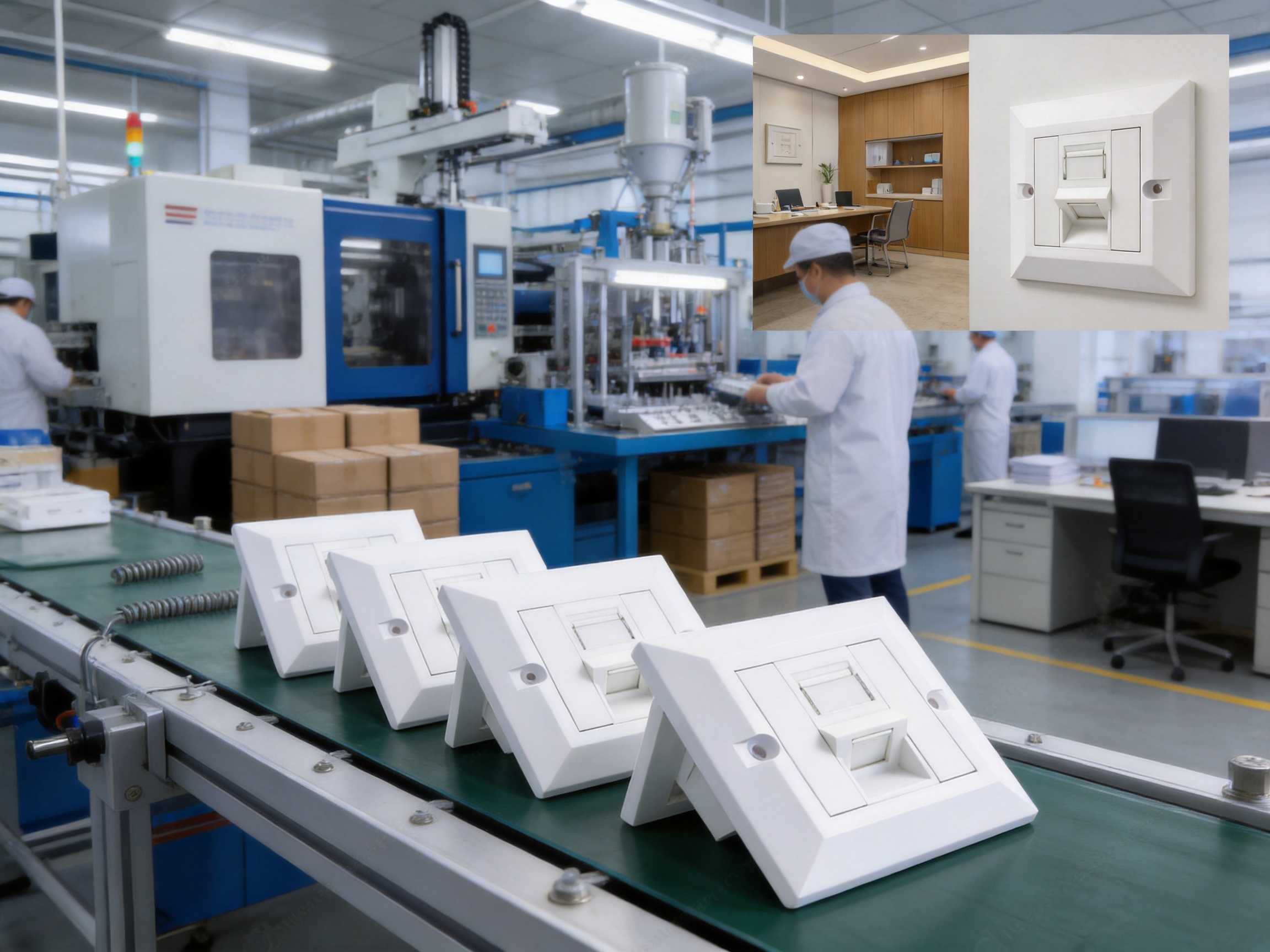
Modern communication networks depend on more than high-performance cables and active equipment. The quality of the termination point is equally important. A faceplate forms the visible and functional interface between the structured cabling system and the user’s equipment. It protects the installed connector, supports accurate port identification, contributes to a professional wall finish, and helps maintain the long-term reliability of the network. For this reason, selecting an appropriate faceplate is an important decision for installers, system integrators, distributors, and building owners.
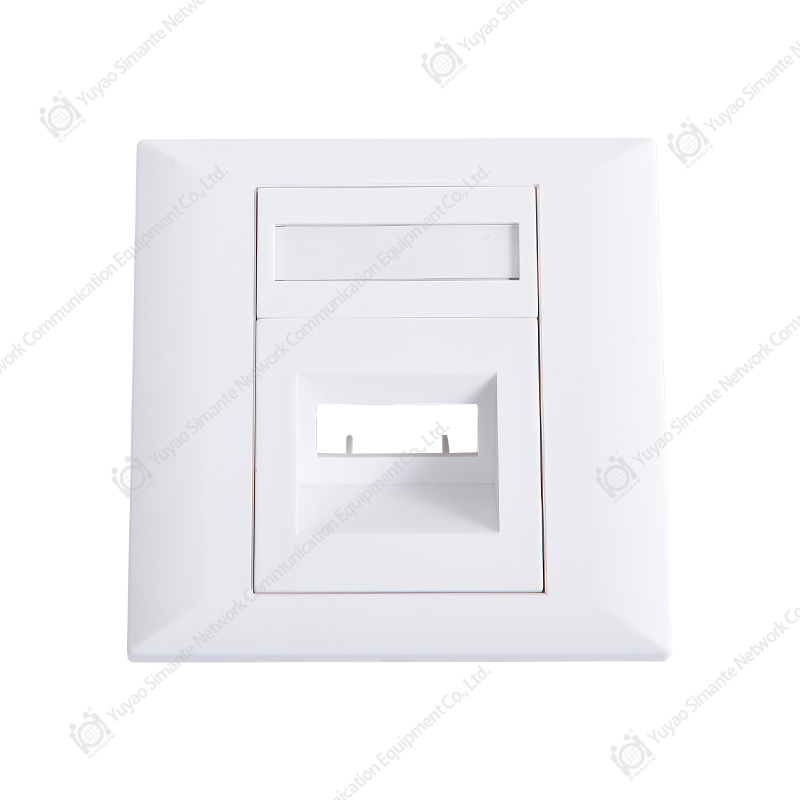
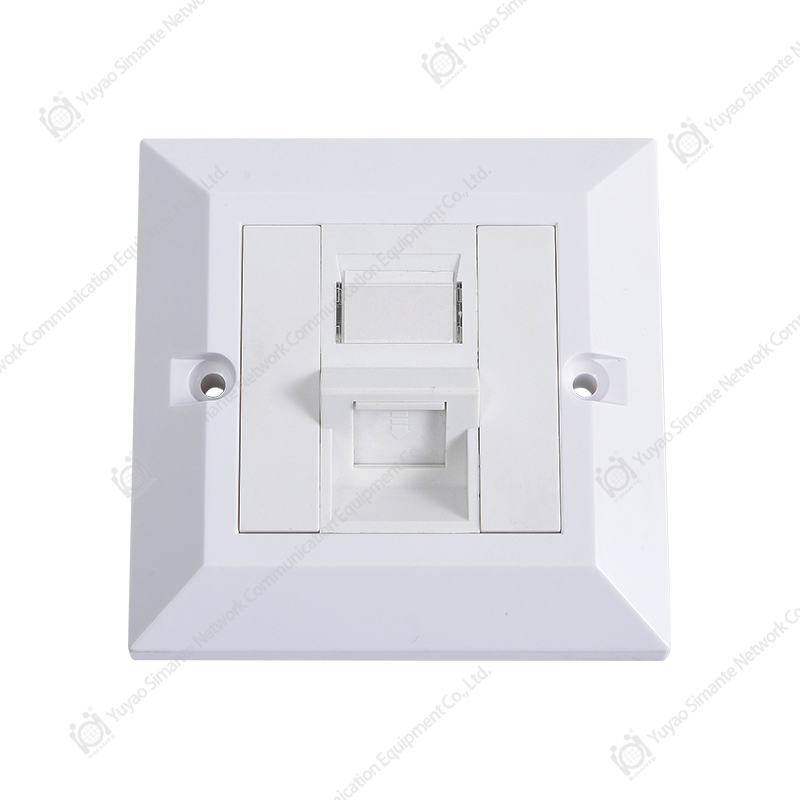
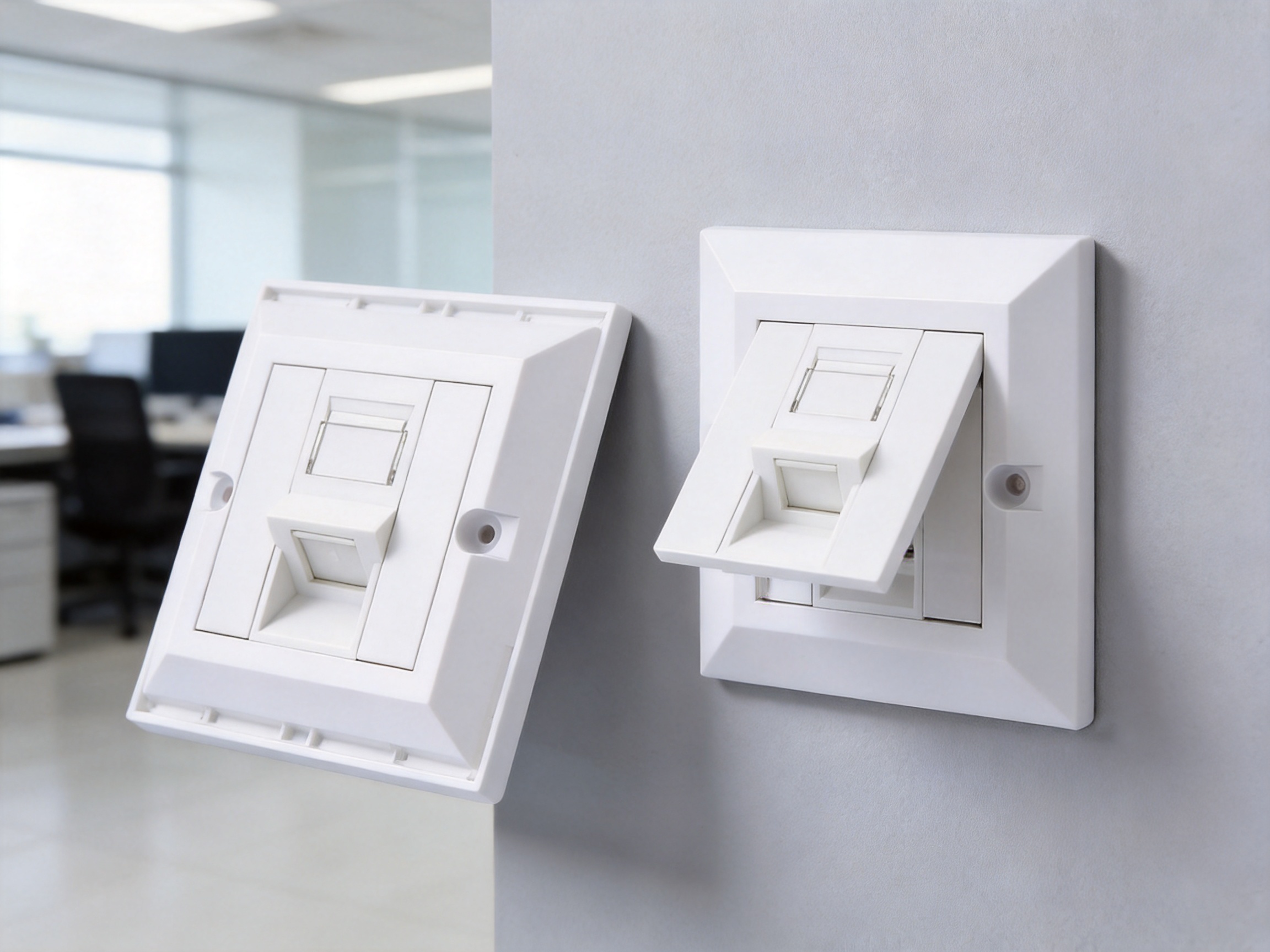
The SMT-4306-86X-1X One Port Beveled Frame 45° UK Type Faceplate is designed for copper and fiber structured cabling applications that require a compact, neat, and durable single-port outlet. Based on the Type 86 installation format, the faceplate is suitable for common exposed and concealed back boxes. Its beveled 45-degree frame provides a practical connection angle, while its embedded design conceals mounting screws from the visible surface. The result is a clean appearance combined with convenient installation and maintenance.
This faceplate is suitable for offices, schools, hotels, residential buildings, commercial properties, smart-home projects, automation systems, and other locations where information or telephone modules must be securely installed. It can accommodate one compatible connector from the Amp interface and is supplied with standard M3.5 or M4 bolts. Its spring-type dust-proof door, replaceable identification plate, high-quality ABS construction, and broad operating temperature range make it a practical alternative to basic, unprotected wall outlets.
In addition to the product design, the manufacturing capabilities behind the faceplate are important. Yuyao Simante Network Communication Equipment Co., Ltd. combines product development, tooling, injection molding, automated assembly, inspection, customization, and export service. The company’s production resources include regular and customized production lines, fully automatic injection molding machines, semi-automatic injection molding machines, and automatic installation equipment. These capabilities support stable production volumes while allowing the manufacturer to respond to project-specific requirements.
This article explains the construction, installation value, performance advantages, application possibilities, manufacturing strengths, quality considerations, packaging requirements, and purchasing benefits of the one-port 45-degree UK-type faceplate.
Product Overview
The SMT-4306-86X-1X is a single-port wall-mounted faceplate developed for Type 86 exposed or concealed back boxes. It is intended for use with compatible information and telephone modules using the Amp interface. The product supports the installation of one connector, making it suitable for locations where a single network, telephone, or other low-voltage communication outlet is required.
The faceplate uses a beveled 45-degree frame. This angled presentation can help guide the connector and cable toward the user or connected equipment while reducing the visual prominence of the outlet. Compared with a completely flat outlet, an angled port may also help manage cable direction in certain installations, particularly where furniture, desks, wall-mounted equipment, or patch cords are positioned directly below the outlet.
The embedded face-frame structure is one of the product’s most noticeable design characteristics. Once installed, the mounting screws are not visible on the front surface. This creates a cleaner appearance than conventional products that leave screw heads exposed. It also helps the faceplate integrate more naturally into commercial and residential interiors where a neat finish is important.
The product is supplied with two M3.5 or M4 bolts as standard. These fasteners are intended for mounting the faceplate to a compatible back box. Because Type 86 boxes are widely used in many electrical and low-voltage installations, the design can simplify selection and installation when the wall infrastructure already follows this format.
The faceplate is manufactured from ABS engineering plastic. This material provides a useful combination of low weight, rigidity, impact resistance, and dimensional stability. The plastic is intended to resist ordinary collision and handling during installation and routine use without easily deforming. The product also meets stated RoHS environmental requirements, supporting use in projects that require restricted hazardous substances compliance.
Key Design Features
Single-Port Configuration
The one-port configuration is appropriate for applications that do not require a multi-port outlet. A single connector can be installed without leaving unused openings or requiring a larger wall plate than necessary. This makes the product suitable for individual workstations, telephone points, small offices, hotel rooms, bedrooms, security equipment locations, and distributed smart-home connection points.
A single-port faceplate can also be useful in modular designs. Instead of installing the same large plate throughout a building, an installer can select one-port, two-port, or other configurations according to the actual service requirements of each room. This approach may improve the appearance of the completed installation and reduce unused capacity at low-density locations.
45-Degree Beveled Frame
The 45-degree beveled frame gives the faceplate a distinctive angled profile. The angle can provide a more convenient cable exit direction, especially when the connected patch cord or equipment cable needs to move downward or outward from the wall. It can also reduce the likelihood of sharply bending a cable immediately at the connector area.
Although cable bend radius must always be controlled according to the cable and connector manufacturer’s requirements, a properly oriented faceplate can help the installer create a more orderly cable path. This is particularly beneficial in office environments where patch cords are frequently connected and disconnected, or in residential environments where the outlet is positioned behind furniture.
Concealed Screw Installation
The embedded face-frame design conceals screws from the front surface. This feature provides a more refined appearance and reduces the chance that exposed screw heads will collect dust, become scratched, or detract from the installation. It also supports consistent visual results across multiple outlets.
For contractors, concealed fixing can help create a higher-quality handover. Customers often evaluate a completed cabling installation not only by network performance but also by the neatness of visible components. A faceplate without exposed screws contributes to a finished appearance that is suitable for professional offices, hotels, educational facilities, and premium residential projects.
Spring-Type Dust-Proof Door
The product is equipped with a spring-type dust-proof door. When the port is not in use, the door helps cover the connector opening and reduce the entry of dust and other airborne particles. The spring action supports automatic return after the connected cable is removed, helping keep the outlet protected during periods of non-use.
A protective door is valuable in locations where outlets may remain unused for long periods. Dust accumulation around a connector can affect the appearance of the outlet and may complicate later maintenance. The cover does not replace proper cleaning or inspection, but it provides an additional protective feature compared with open-face designs.
Integrated Identification Area
A logo window is provided on the front of the faceplate for port identification. The product also includes a detachable logo plate, allowing the installer or facility manager to mark the outlet according to a local labeling plan. Identification may include a room number, workstation reference, service designation, rack reference, or port number.
Clear labeling is an important part of structured cabling administration. When every outlet is visibly identified, technicians can trace connections more efficiently, reduce troubleshooting time, and lower the risk of accidental disconnection. A removable identification plate also supports future changes, as labels can be updated when workstations or services are relocated.
Installation Compatibility
The faceplate is common to Type 86 exposed and concealed back boxes. Type 86 installation formats are widely used in many building projects, making compatibility with this box style an important practical advantage. Before installation, the installer should verify the dimensions, mounting-hole arrangement, available depth, and compatibility of the selected connector and back box.
The faceplate is designed to work with compatible information and telephone modules using the Amp interface. The connector itself is not included in the product description as a universal component, so the module should be selected according to the required application. Possible applications may include copper data modules, telephone modules, or other compatible communication inserts.
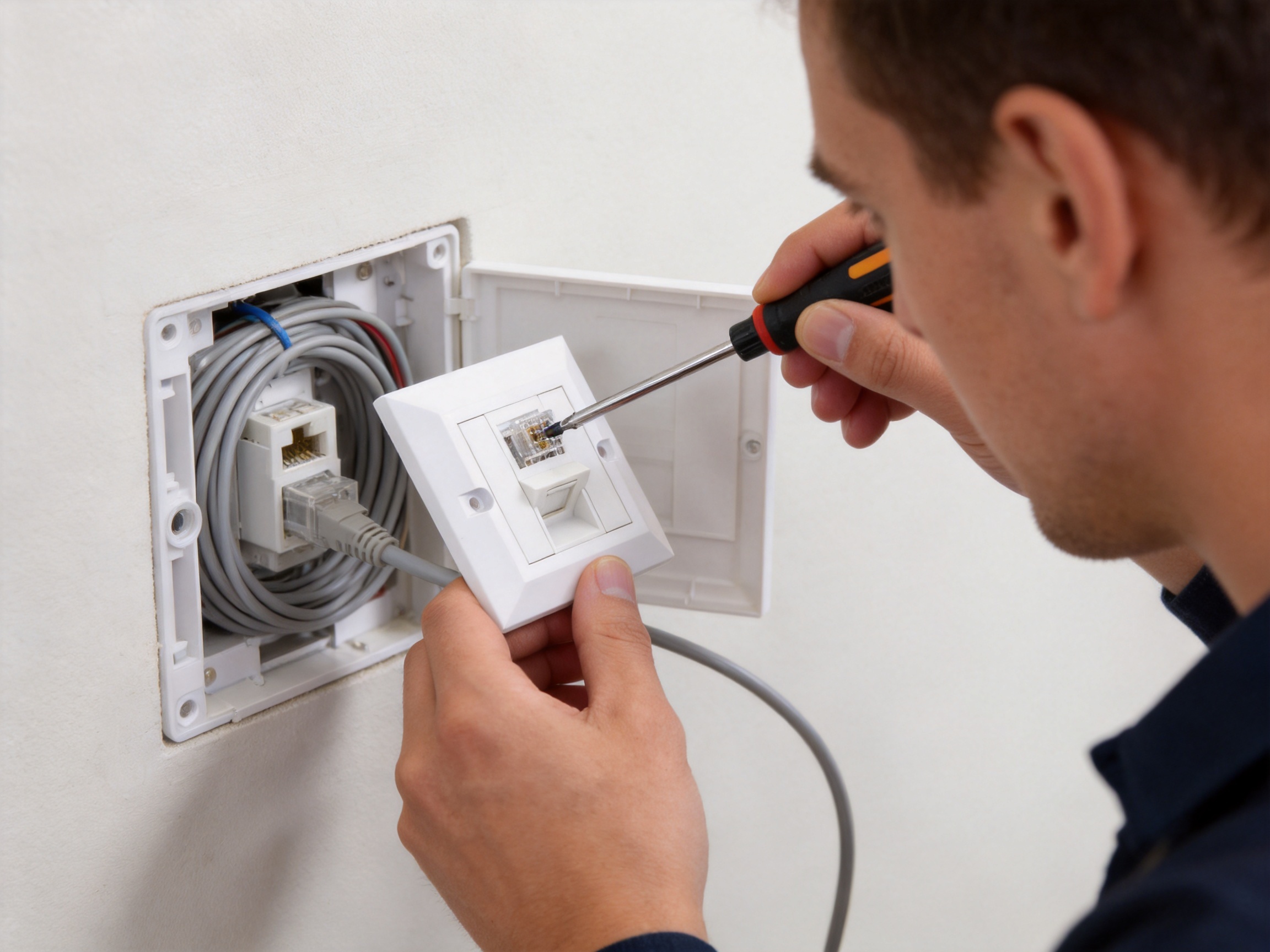
Correct installation begins with checking that the back box is securely fixed and level. The cable should be routed into the box with enough service length to allow termination and future maintenance. Excessive cable tension should be avoided, and the cable should not be sharply folded behind the module. The connector should be terminated according to its own wiring instructions before the faceplate is fixed to the back box.
After termination, the module can be installed into the faceplate and the faceplate mounted using the supplied M3.5 or M4 bolts. The installer should ensure that the plate is not forced into alignment if the box is incorrectly positioned. Excessive tightening may damage the plastic or distort the assembly, while insufficient tightening may allow movement during repeated plugging and unplugging.
When installation is complete, the dust-proof door should open and return smoothly. The identification plate should be fitted securely, and the connector should be checked for correct seating. A final visual inspection should confirm that the faceplate is level, the frame is not warped, and no gap remains between the plate and the wall surface beyond normal installation tolerance.
SMT-4306-86X-1X One Port Beveled Frame 45°UK Type Faceplate
Performance Advantages in Structured Cabling Projects
Professional Appearance
One of the primary advantages of this faceplate is its ability to provide a clean and organized wall outlet. The concealed fixing structure, beveled frame, identification area, and compact single-port design work together to produce a professional result. This is especially important when network outlets are installed in visible locations such as reception areas, meeting rooms, classrooms, hotel rooms, retail spaces, and executive offices.
Basic faceplates may provide only a simple plastic surround and an open connector aperture. Such products can be functional, but they may not deliver the same level of visual integration or port protection. The SMT-4306-86X-1X adds design features that address both appearance and day-to-day usability.
Improved Port Protection
The spring-type dust-proof door offers protection when the port is idle. In environments with significant airborne dust, construction residue, textile fibers, or frequent cleaning activity, keeping the connector opening covered can be beneficial. It also gives users a visual indication that the port is protected when no cable is connected.
This feature may help extend the clean operating condition of the outlet and simplify routine facility maintenance. It is a practical improvement over open outlets that expose the internal connector area continuously.
Convenient Port Management
Structured cabling systems are easier to operate when outlets are clearly labeled. The logo window and detachable logo plate provide a dedicated location for identification rather than requiring adhesive labels to be placed randomly on the wall plate. A consistent labeling area improves the appearance of the installation and supports future service work.
For larger projects, the labeling system can be coordinated with patch-panel and rack documentation. For example, a wall outlet may be assigned a room code and port number that corresponds to a patch-panel position. This relationship helps technicians identify the correct cable path without removing the faceplate or tracing every cable manually.
Efficient Use of Wall Space
A one-port plate is a suitable choice where only one connection is needed. It avoids the unnecessary use of a larger multi-port frame and can be positioned in areas with limited wall space. The compact format is useful in rooms where the outlet must share a wall with power sockets, lighting controls, thermostats, security systems, or other low-voltage equipment.
The one-port configuration can also support a more flexible project bill of materials. Contractors can order a dedicated product for low-density points while using other configurations for workstations that require multiple connections. This creates a practical balance between standardization and application-specific installation.
Durable Engineering Plastic
The use of high-quality ABS engineering plastic provides a balance of strength and weight. The material is described as resistant to collision and impact and not easily deformed under normal use. This is valuable during transportation, installation, and routine operation, when the faceplate may be touched, cleaned, or exposed to incidental contact.
ABS is also suitable for injection molding, allowing the manufacturer to produce repeatable shapes with integrated features such as beveled edges, spring-door supports, label windows, and concealed screw structures. Consistent molding contributes to dimensional accuracy and supports smooth module fitting across production batches.
Wide Temperature Range
The stated environmental performance range is -25 to +70 degrees Celsius. This range supports use in many indoor and semi-protected environments, including offices, homes, commercial buildings, equipment rooms, and other locations where seasonal or localized temperature changes may occur.
Installation conditions should still be evaluated as part of the overall project design. The faceplate is a passive component, and its performance depends on correct storage, installation, and use. Exposure to direct sunlight, chemical contamination, excessive moisture, or temperatures outside the stated range should be considered carefully before deployment.
Comparison with Conventional Faceplates
When evaluating a wall faceplate, buyers often compare basic functionality with long-term installation value. A conventional faceplate may hold a connector, but a more advanced design can also protect the port, improve identification, control cable direction, and create a better visual finish.
| Feature | SMT-4306-86X-1X | Basic Open Faceplate | Project Benefit |
|---|---|---|---|
| Port capacity | One compatible connector | Usually one or more connectors, depending on model | Suitable for low-density connection points |
| Frame design | 45-degree beveled frame | Commonly flat | Supports an angled cable exit and distinctive appearance |
| Mounting appearance | Embedded structure with concealed screws | Screws may remain visible | Creates a cleaner finished installation |
| Port protection | Spring-type dust-proof door | Often open when unused | Helps reduce dust entry during non-use |
| Identification | Logo window and detachable logo plate | May require external labels | Improves port administration and maintenance |
| Back-box compatibility | Type 86 exposed or concealed back boxes | Varies by product | Supports common installation formats |
| Material | High-quality ABS engineering plastic | Material quality varies | Offers impact resistance and dimensional stability |
| Environmental compliance | Designed to meet RoHS requirements | Depends on supplier and model | Supports projects with restricted-substance requirements |
This comparison does not mean that every competing product has the same limitations. Many manufacturers offer high-quality faceplates with similar functions. However, the value of the SMT-4306-86X-1X lies in combining several useful features in one compact product: compatibility with Type 86 boxes, one-port capacity, a beveled frame, concealed fixing, a dust-proof door, identification support, and ABS construction.
For procurement teams, combining these functions can reduce the need to source separate accessories or accept compromises in appearance. For installers, the integrated design may simplify the installation process and reduce the number of finishing operations required at the wall outlet.
Applications
Office and Commercial Buildings
Office buildings often require structured cabling outlets at workstations, conference tables, reception desks, printers, wireless access point locations, and shared equipment areas. A one-port faceplate can be used where one network connection is sufficient or where outlets are distributed individually along a wall.
The identification plate is useful in offices that regularly change seating arrangements. When an employee or department moves, the visible port label can be updated without replacing the complete faceplate. The dust-proof door is also beneficial in offices where some outlets may remain unused after furniture or equipment is relocated.
Residential and Smart-Home Installations
Residential structured cabling systems may require individual data, telephone, or media outlets in bedrooms, living rooms, home offices, and utility areas. The compact faceplate is appropriate for these locations because it provides necessary connectivity without making the wall appear crowded.
Its clean appearance can complement modern interior design. The concealed screws and beveled frame are particularly suitable for residential projects where visible hardware is often considered undesirable. The product can also be incorporated into smart-home and automation installations where low-voltage communication modules are distributed throughout a property.
Hotels and Hospitality Projects
Hotel rooms require durable and visually consistent outlets. Guests may connect laptops, telephones, televisions, and other equipment to wall-mounted communication points. The faceplate’s identification area can support room-specific labeling, while the dust-proof door helps protect unused ports between guest stays.
Hotels also benefit from products that are easy for maintenance teams to replace or service. A modular faceplate compatible with common back boxes can support faster repairs and reduce disruption when a connector needs to be changed.
Educational Facilities
Schools, universities, training centers, and libraries use network outlets in classrooms, laboratories, offices, and study areas. These locations may experience frequent contact with wall-mounted equipment and furniture. A durable ABS faceplate with impact resistance can help withstand ordinary handling and incidental collision.
Clear port identification can support information technology teams that maintain many outlets across multiple floors or buildings. A consistent outlet format also contributes to more orderly infrastructure documentation.
Industrial and Automation Areas
Communication outlets are increasingly used in automation, control, monitoring, and equipment-support areas. Although the faceplate is intended primarily for wall-mounted low-voltage applications, it may be suitable for protected indoor locations where communication modules are required and the environmental conditions remain within the stated operating range.
Before using the product in an industrial area, the project designer should consider dust levels, moisture, chemicals, vibration, mechanical impact, and cleaning methods. Where harsh conditions exist, additional enclosure protection may be necessary.
Manufacturing Process and Production Strengths
Integrated Product Development
The manufacturer operates as a professional supplier of network cabling solutions and optical fiber products, integrating design, development, sales, and service. This integrated model can improve communication between engineering, production, quality, and customer-support teams. Product feedback can be transferred more efficiently from the market to the development process.
For faceplates and other injection-molded accessories, design quality begins before production. The geometry of the frame, screw structure, module opening, dust-proof door, logo window, and label plate must be coordinated so that the components fit together correctly. A mature research and development system helps control these relationships at the design source.
Engineering and Technical Personnel
The company has more than ten engineers and over thirty full-time technical personnel. This technical base supports product development, production improvement, tooling coordination, assembly optimization, testing, and customization. A capable engineering team is especially important for products that may be manufactured in multiple colors, packaging formats, module combinations, or customer-specific versions.
Technical personnel also contribute to process consistency. Injection-molded parts require controlled temperatures, pressures, cooling times, and material handling. Assembly operations require correct positioning, spring installation, label-window alignment, and fastener compatibility. Continuous technical oversight helps reduce variation between batches.
Injection Molding Capability
The factory has ten fully automatic injection molding machines and twenty semi-automatic injection molding machines. This equipment base supports the production of ABS and other molded components used in network cabling products. Automatic machines can provide repeatable cycles and efficient output, while semi-automatic equipment can offer flexibility for different product sizes, tooling arrangements, and production requirements.
Injection molding is central to the faceplate’s quality. A stable molding process helps maintain the shape of the beveled frame, the alignment of the mounting holes, the fit of the connector opening, and the condition of the visible surface. Process control is also important for minimizing warpage, sink marks, flash, short shots, and other molding defects.
Because the faceplate contains functional features rather than being a simple flat plate, tooling accuracy is essential. The mold must reproduce the angled frame and embedded areas consistently. Cooling and ejection must be managed carefully to prevent deformation. Production inspection can then verify that the molded parts meet the required visual and dimensional expectations.
Automated Assembly Equipment
The factory operates eight automatic installation machines. Automated assembly can improve repeatability for products that include multiple small components. In a faceplate, assembly may involve the dust-proof door, spring mechanism, detachable identification plate, mounting elements, and other accessories.
Automation can also help maintain production efficiency when order quantities are large. It reduces dependence on manual repetition and can support consistent positioning across units. Manual inspection and technical supervision remain important, but automated equipment provides a stable foundation for high-volume manufacturing.
Regular and Customized Production Lines
The company has ten regular and customization production lines. Regular lines support established product models and recurring orders, while customization capability allows the manufacturer to respond to project-specific requirements. Depending on the order, customization may involve packaging, labeling, color, logo treatment, product combinations, or other agreed specifications.
Customization is valuable for distributors, contractors, and original equipment customers that need products aligned with a private-label program or a regional market requirement. However, customized production should always be confirmed through technical drawings, samples, approved specifications, and documented quality criteria before mass production begins.
Production Capacity
The factory maintains a stable annual output of more than nine million units across its product range. This capacity indicates that the manufacturer is equipped to support recurring orders and larger structured cabling projects. Stable capacity can be an advantage for customers that need continuity of supply across multiple construction phases or regional distribution channels.
High capacity alone does not guarantee product quality. Its value depends on production control, equipment maintenance, material management, inspection, and delivery coordination. When supported by these systems, production capacity can help reduce lead-time pressure and improve supply planning.
Quality and Environmental Considerations
Faceplates are relatively small components, but their quality affects the user’s experience and the maintenance condition of the network outlet. Important quality considerations include material consistency, surface finish, dimensional accuracy, screw-hole alignment, module retention, dust-door operation, label-plate fit, and resistance to ordinary impact.
The product uses ABS engineering plastic selected for anti-collision and impact-resistant properties. During incoming material control, the manufacturer should verify material specifications and color consistency. During molding, operators and quality personnel should monitor the appearance and dimensions of the molded parts. Finished units should be checked to confirm that moving and detachable components function correctly.
RoHS compliance is another important consideration for modern cabling projects. RoHS requirements restrict certain hazardous substances in electrical and electronic products and related components. The product is specified as meeting RoHS standards, helping customers address environmental and procurement requirements in applicable markets.
Although the faceplate is a passive accessory, responsible material selection and efficient manufacturing can contribute to more sustainable product management. Durable components may require fewer replacements during the service life of a building. Proper packaging and organized logistics can also reduce damage during transport and minimize avoidable waste.
Installers should protect the faceplate during construction. Cement dust, paint, solvents, excessive moisture, and sharp tools can damage the surface or interfere with the operation of the dust-proof door. Installing the final faceplate after major wet construction work is complete can help preserve its appearance.
Packaging, Storage, and Logistics
The product is placed in a dedicated blister bag and then packed into a cardboard box. Product accessories are packed at the same time. A label showing the product model and quantity is applied to the upper-left area of the carton front. This labeling arrangement supports warehouse identification and helps receiving personnel verify incoming goods.
The regular packing quantity is described as ten boxes per box, twenty units per box, and two hundred units per outer box. Customers should confirm the exact inner-pack and master-carton configuration when placing an order, particularly if they have special pallet, labeling, or retail packaging requirements.
Proper storage is important for molded plastic products and small installation accessories. Packaged products should be stored in a warehouse with an ambient temperature of -5 to +30 degrees Celsius and relative humidity not exceeding 70 percent. The surrounding air should be free from acid, alkali, and other corrosive gases.
The stated storage period is three years under the specified conditions. Cartons should be kept dry, protected from direct sunlight, and stacked in a way that avoids crushing or excessive pressure. Warehouse operators should use a first-in, first-out method where practical and inspect packaging before dispatch.
For export shipments, packaging requirements may be adapted to the customer’s instructions. The product-use marking is noted as customer-specified packaging, which means that private labels, carton marks, language requirements, barcodes, or other shipment identifiers can be discussed during order confirmation.
Procurement and Customization Advantages
Customers purchasing structured cabling components often require more than a standard catalog item. They may need specific packaging quantities, private labeling, regional compliance documentation, color matching, connector combinations, or coordinated product families. A manufacturer with both regular and customized production lines can provide a more flexible procurement experience than a supplier limited to fixed stock configurations.
OEM and ODM cooperation is available. OEM projects may involve producing an established design under the customer’s packaging or brand requirements. ODM projects may involve adapting an existing design or developing a product for a particular application. In either case, the project should begin with a clear technical brief covering dimensions, materials, surface finish, color, logo treatment, module compatibility, packaging, inspection standards, and delivery expectations.
Customers can also benefit from sourcing related products from the same manufacturing organization. The company’s main product range includes keystone jacks, patch panels, wall faceplates, data sockets, and other network cabling components. Coordinating these items through one supplier may simplify technical communication, product matching, packaging management, and quality follow-up.
For distributors, a consistent product family can make catalog management and sales training easier. For installers, compatible components can reduce uncertainty during site work. For system integrators, a coordinated product range may support complete copper and fiber structured cabling solutions for different project sizes.
Recommended Installation and Maintenance Practices
Before installation, verify the following conditions:
1. The wall box is a compatible Type 86 exposed or concealed back box.
2. The selected connector is compatible with the Amp interface and the one-port faceplate.
3. The back box is firmly mounted and positioned at the required height.
4. The cable has sufficient length for termination and future servicing.
5. The operating environment falls within the stated -25 to +70 degrees Celsius range.
6. The installation area is free from excessive moisture, corrosive gases, and construction contamination.
During termination, installers should follow the wiring sequence and performance requirements of the selected module. The faceplate itself does not replace proper cable management or testing. Copper links should be tested with appropriate certification equipment, while fiber links should be inspected and tested according to the selected fiber connector and system standard.
After installation, avoid pulling the connected patch cord sharply downward or sideways. The angled frame supports cable routing, but the connector should not be used as a handle or subjected to excessive mechanical load. Keep the faceplate clean with a soft, dry, or slightly damp cloth that is compatible with ABS plastic. Strong solvents and abrasive cleaners should be avoided unless specifically approved.
When the outlet is not in use, the spring-type door should remain closed. If the door does not return correctly, check for dust, paint, damaged springs, or obstruction around the hinge area. A faulty component should be replaced rather than forced into position.
Why the Product Is Suitable for Professional Projects
Professional projects require components that are easy to specify, install, identify, maintain, and reorder. The SMT-4306-86X-1X supports these requirements through a combination of standardized installation compatibility and user-oriented design features.
Its Type 86 compatibility helps align the product with commonly used wall-box formats. Its one-port capacity gives designers a compact option for individual connection points. The 45-degree frame provides a distinctive and practical cable orientation. The concealed screws improve the visible finish. The dust-proof door protects the unused port. The identification window and detachable logo plate support structured administration. ABS engineering plastic provides a durable enclosure, while RoHS compliance and the stated temperature range support broader project requirements.
The manufacturing organization adds further value through technical personnel, injection molding capacity, automatic assembly equipment, regular production lines, customization capability, and experience serving international markets. The company maintains export activity in Europe, Australia, Africa, the Middle East, and Southeast Asia, and undertakes OEM and ODM projects. This international experience can help customers coordinate documentation, packaging, and product requirements across different markets.
These combined strengths make the faceplate suitable not only for isolated retail purchases but also for larger structured cabling deployments. It can be considered for new construction, renovation, office relocation, hotel refurbishment, educational projects, residential developments, and system-integrator supply programs.
Ordering Information
When requesting a quotation or placing an order, customers should provide the required model, quantity, connector type, color, packaging arrangement, labeling requirements, delivery destination, and any applicable compliance documentation. If the faceplate will be used with a nonstandard module, the module drawing or sample should be supplied for compatibility confirmation.
For customized orders, customers should approve a technical drawing or pre-production sample before mass production. The approved documentation should define critical dimensions, logo position, label format, material, surface appearance, packaging, and inspection requirements. This procedure helps prevent misunderstandings between the design, production, and purchasing teams.
Customers should also confirm whether the quoted quantity refers to individual units, inner boxes, or master cartons. The standard packaging information indicates a total of two hundred units per outer carton, but project-specific packing may differ according to customer requirements.
Q&A
What type of product is the SMT-4306-86X-1X?
It is a one-port, wall-mounted, 45-degree beveled frame faceplate designed for Type 86 exposed or concealed back boxes. It supports one compatible information or telephone connector using the Amp interface.
How many connectors can be installed?
At most one connector can be installed in the faceplate. This makes it appropriate for single-port network, telephone, or other compatible low-voltage communication outlets.
What does the 45-degree design provide?
The beveled frame presents the port at an angled orientation. This can support a more convenient cable exit direction and provide a distinctive, streamlined appearance compared with a conventional flat faceplate.
Are the mounting screws visible?
No. The embedded face-frame design conceals the mounting screws from the visible front surface when properly installed.
Does the product include a dust cover?
Yes. It includes a spring-type dust-proof door that helps cover the port when no connector is installed or no patch cord is connected.
How is the port identified?
The front includes a logo window and a detachable logo plate. These areas can be used for port numbers, room references, service markings, or other project-specific identification.
What material is used?
The faceplate is made from high-quality ABS engineering plastic. The material is intended to provide impact resistance, collision resistance, and dimensional stability during normal use.
What temperature range is specified?
The stated environmental performance range is -25 to +70 degrees Celsius. Storage requirements are different and specify an ambient warehouse temperature of -5 to +30 degrees Celsius with relative humidity not exceeding 70 percent.
Is the faceplate RoHS compliant?
The product information states that it meets RoHS standards. Customers requiring formal documentation should request the applicable compliance records for their project or market.
Which bolts are supplied?
Two M3.5 or M4 bolts are standard. The exact fastener selection should be confirmed against the compatible Type 86 back box and project installation requirements.
Can the faceplate be used with fiber modules?
The product belongs to a manufacturer serving both copper and fiber structured cabling markets. Actual fiber-module compatibility depends on the specific module interface, dimensions, and mounting arrangement. Customers should confirm the intended fiber module before ordering.
Can the product be customized?
Customization is supported through the manufacturer’s customization production lines and OEM/ODM services. Possible requirements may include packaging, labeling, colors, logos, or coordinated product configurations, subject to technical review and order confirmation.
How should the product be stored?
Packaged products should be kept in a warehouse at -5 to +30 degrees Celsius, with relative humidity not exceeding 70 percent. The surrounding air should contain no acid, alkali, or other corrosive gases. Products should remain protected from direct sunlight, moisture, crushing, and contamination.
What is the regular packing quantity?
The stated regular packing arrangement is ten boxes per box, twenty units per box, and two hundred units per outer box. Customers should confirm the final packing list for each order, especially when customer-specified packaging is required.
Who can benefit from this product?
Distributors, network installers, structured cabling contractors, system integrators, property developers, telecommunications projects, office fit-out contractors, hotel operators, and smart-home solution providers can all consider this faceplate for suitable applications.
Conclusion
The SMT-4306-86X-1X One Port Beveled Frame 45° UK Type Faceplate is designed to provide a compact and professional termination point for structured cabling installations. Its Type 86 compatibility, single-port configuration, angled frame, concealed mounting screws, spring-type dust-proof door, identification window, detachable logo plate, ABS engineering plastic, RoHS-related environmental positioning, and broad operating temperature range address the practical needs of modern low-voltage infrastructure.
Compared with a basic open or flat faceplate, the product offers a more complete combination of protection, identification, visual quality, and installation convenience. These features can help installers produce cleaner wall outlets and help building operators manage network ports more effectively throughout the service life of the cabling system.
The manufacturer’s capabilities further support the product. Its engineering team, injection molding resources, automatic assembly equipment, regular and customized production lines, international market experience, and OEM/ODM services provide a foundation for stable supply and project-specific cooperation. Through integrated design, development, manufacturing, sales, and service, Yuyao Simante Network Communication Equipment Co., Ltd. is positioned to support customers seeking dependable copper and fiber structured cabling components.
For projects requiring a one-port wall outlet with a neat appearance, practical cable orientation, port protection, and clear identification, this 45-degree UK-type faceplate is a strong candidate for consideration.
References
1. Product specification and technical information for the SMT-4306-86X-1X One Port Beveled Frame 45° UK Type Faceplate.
2. Type 86 wall-box installation practices for exposed and concealed low-voltage back boxes.
3. RoHS restricted-substance compliance principles for electrical and electronic products.
4. General structured cabling administration and labeling practices.
5. ABS engineering plastic selection principles for molded communication accessories.
6. General injection molding process-control practices for precision plastic components.
7. Product packaging, storage, and environmental requirements supplied by the manufacturer.
8. General installation and maintenance practices for wall-mounted information outlets.