Español
 عربى
عربى русский
Modern data networks depend on more than high-performance switches, patch panels, and transmission media. The physical organization of every cable inside a rack has a direct influence on installation speed, maintenance efficiency, airflow, reliability, and future expansion. As structured cabling systems become denser and more flexible, a suitable horizontal cable manager is essential for keeping patch cords and equipment jumpers organized, protected, and accessible.
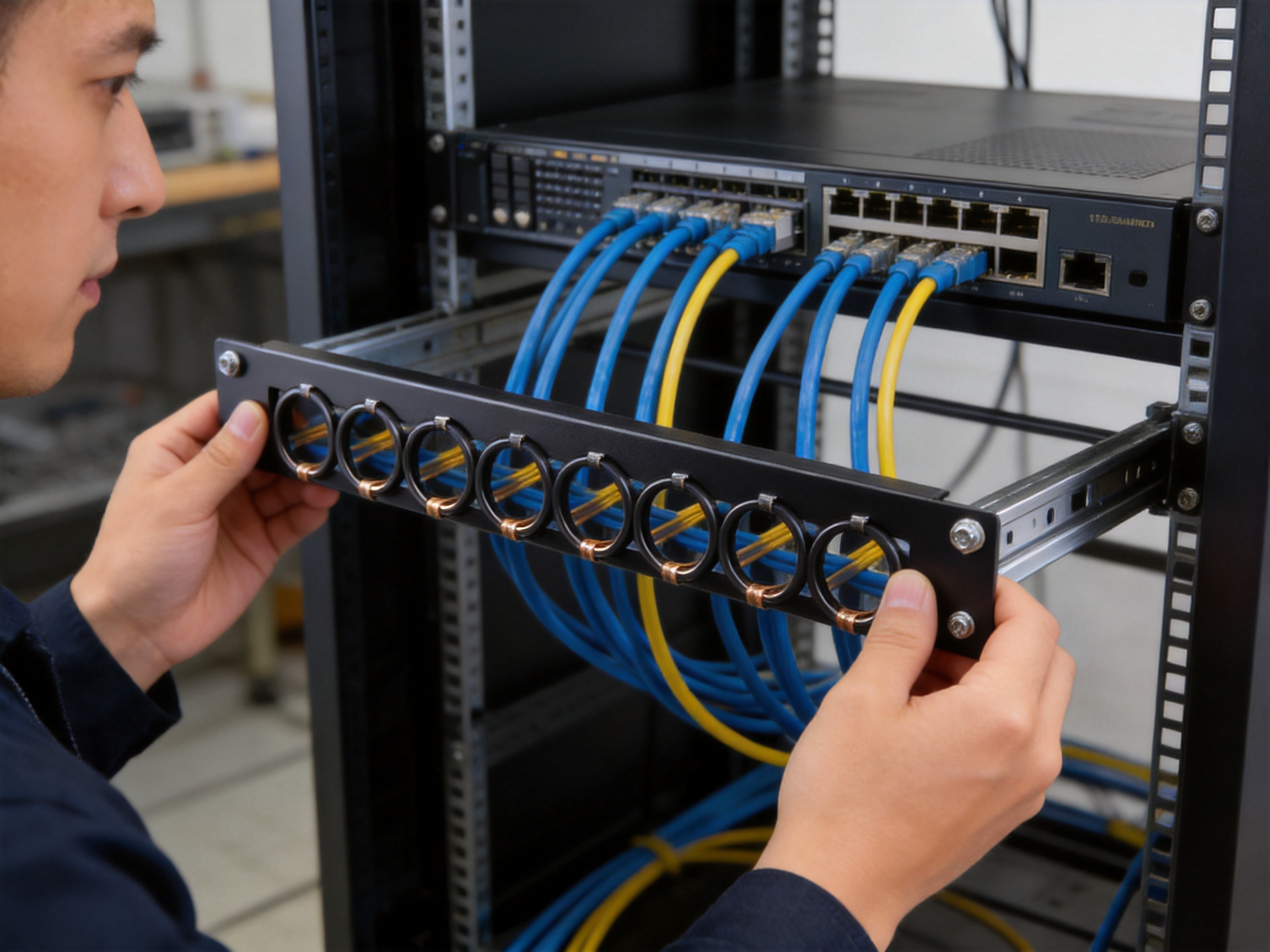
The SMT-3010-12P 1U12 Ring Cable Manager is designed for this purpose. Installed at the front of a standard 19-inch rack, cabinet, or compatible wall-mount enclosure, it provides a practical horizontal route for copper patch cords, equipment jumpers, and other network cables. Its ring-based design supports orderly cable distribution while helping maintain a suitable bending radius. The result is a cleaner, more manageable, and more serviceable cabling installation.
This article examines the construction, functions, installation value, cable capacity, environmental performance, quality considerations, and manufacturing strengths associated with this 1U12 ring cable manager. It also explains how the product can offer practical advantages compared with less structured or less adaptable cable-management alternatives.
1. The Role of Horizontal Cable Management in Structured Cabling
In a network rack, cable management is not simply a matter of appearance. Patch cords often connect patch panels to switches, routers, firewalls, servers, and other active equipment. Without a clear routing method, these cables can overlap, become difficult to trace, obstruct equipment access, and place unnecessary stress on connectors and cable assemblies.
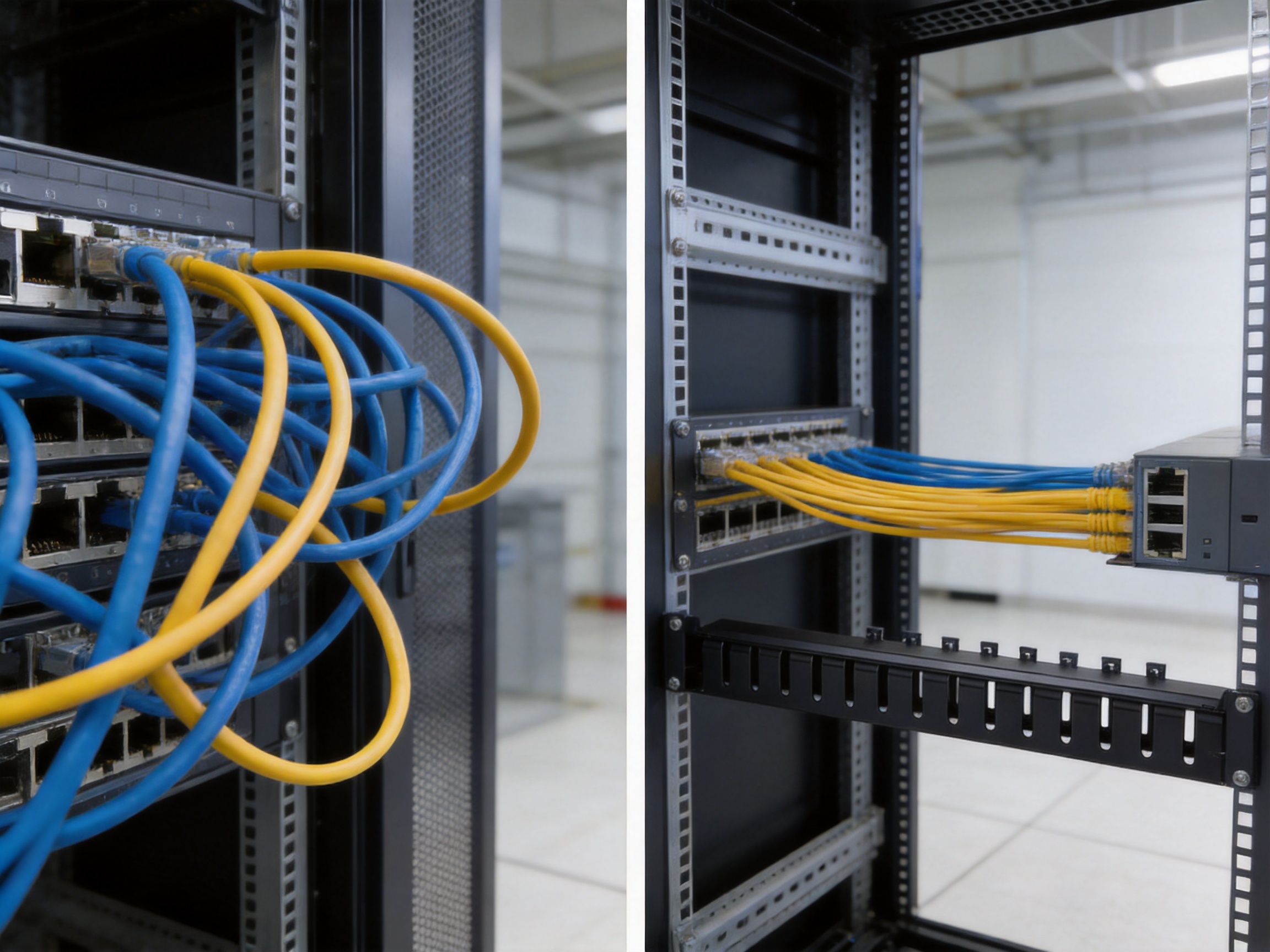
A horizontal cable manager creates a defined pathway across the front of the rack. It separates the cable-management function from the active equipment and allows installers to route cords in a controlled manner. This arrangement supports a more systematic relationship between patch panels and network devices, particularly in installations where multiple cable connections are made within the same rack unit area.
The SMT-3010-12P is configured as a 1U12 ring cable manager. The 1U format corresponds to a single rack unit in a standard 19-inch equipment rack, while the ring arrangement provides multiple cable-support points across the horizontal width. This design is suitable for data rooms, communication cabinets, network closets, equipment rooms, smart-building systems, and other locations where copper and fiber structured cabling components must be arranged neatly.
By providing a dedicated support structure, the product helps reduce the common problems associated with unmanaged cables. These problems may include excessive cable loops, blocked rack access, sharp cable bends, accidental pulling, disconnection during maintenance, and difficulty identifying individual connections. A well-organized rack also gives technicians a clearer working environment during testing, repair, relocation, and expansion.
2. Product Overview
The SMT-3010-12P 1U12 Ring Cable Manager is a front-mounted horizontal cable-management component for 19-inch rack systems. It is intended for patch cords and equipment jumpers and is designed to manage and protect cable components throughout their service life.
The product uses a sturdy metal bracket with a surface finished through electrostatic powder spraying. This construction provides a practical balance between mechanical strength, appearance, corrosion resistance, and manufacturing efficiency. The metal support structure is suitable for regular use in professional communications infrastructure, where components may be installed, removed, and adjusted repeatedly.
Its standard rack-mount format enables compatibility with 19-inch equipment racks, cabinets, and wall-mount systems that use the same mounting width. This compatibility is important for installers and distributors because it reduces the need for custom cabinet modifications and simplifies product selection for common structured cabling projects.
The product is also designed with installation efficiency in mind. A sturdy and easy-to-install cable manager can reduce the time required to prepare a rack and can help technicians produce a more consistent result across multiple cabinets. In large projects, even small improvements in installation speed can create meaningful savings in labor and commissioning time.
| Product Attribute | Specification or Function |
|---|---|
| Product model | SMT-3010-12P |
| Product type | 1U12 ring cable manager |
| Primary application | Horizontal management of patch cords and equipment jumpers |
| Mounting format | Standard 19-inch rack-mount design |
| Rack height | 1U |
| Maximum stated capacity | Up to 24 four-pair cables |
| Bracket material | Cold-rolled steel plate |
| Surface treatment | Electrostatic powder spraying |
| Environmental compliance | RoHS requirement |
| Operating temperature range | -25°C to +70°C |
| Humidity requirement | Up to 85%, subject to the stated product environmental conditions |
| Typical mounting locations | Equipment racks, cabinets, and compatible wall mounts |
3. Compact 1U Design for Efficient Rack Utilization
Rack space is a valuable resource. Every additional component must provide a practical function without consuming unnecessary vertical capacity. The 1U format of this cable manager allows horizontal cable organization to be integrated into the rack layout without requiring a large dedicated enclosure or a separate floor-standing structure.
Because it occupies one rack unit, the product can be positioned above or below patch panels, switches, servers, and other rack-mounted equipment. The final position depends on the cabinet design, the type of patching arrangement, and the preferences of the installation team. In each case, the manager provides a visible and accessible route for cables at the front of the rack.
A compact format is particularly useful in high-density network cabinets. In such installations, the installer must balance patch-panel capacity, switch placement, power distribution, ventilation, service clearance, and cable routing. A 1U manager can support an orderly front-of-rack layout while preserving space for critical active and passive components.
The 19-inch standard also provides an important advantage over improvised cable-support methods. Rather than attaching loose rings, adhesive clips, or non-standard brackets to a cabinet, installers can use a component designed for the rack interface. Standard mounting reduces uncertainty and helps achieve a consistent appearance from one cabinet to another.
For system integrators, distributors, and contractors, standard dimensions also simplify project planning. The product can be specified as part of a rack bill of materials without requiring a custom mounting strategy for each installation. This is especially valuable when several equipment cabinets are being deployed in different rooms or locations.
4. Ring-Based Cable Routing and Protection
The defining feature of the SMT-3010-12P is its ring-based cable-management arrangement. The rings guide cables across the front of the rack and provide individual support areas for organizing cable bundles. This approach is simple, flexible, and practical for structured cabling applications that require frequent moves and changes.
Ring cable managers are useful because they permit cables to be routed without forcing them into a rigid enclosed channel. Installers can place a group of patch cords through the rings, separate individual cables where necessary, and make adjustments as the network grows. This flexibility is important in environments where equipment is frequently upgraded or where port assignments change over time.
The open ring configuration also makes cables easier to access. A technician can identify, remove, or replace a patch cord without disassembling a covered front panel. This can shorten maintenance tasks and reduce the risk of disturbing unrelated connections. In active network environments, minimizing unnecessary handling is an important operational benefit.
At the same time, the rings provide more control than an unmanaged bundle. Cables remain supported at the front of the rack rather than hanging loosely from equipment ports. Proper support helps prevent excessive weight or pulling force from being transferred to connectors and port housings.
The cable manager is also intended to increase the bending radius of jumpers. Avoiding severe bends is important for preserving cable geometry and reducing mechanical stress. While the correct minimum bend radius always depends on the cable type and manufacturer’s instructions, a suitably arranged horizontal manager gives installers a better foundation for meeting those requirements.
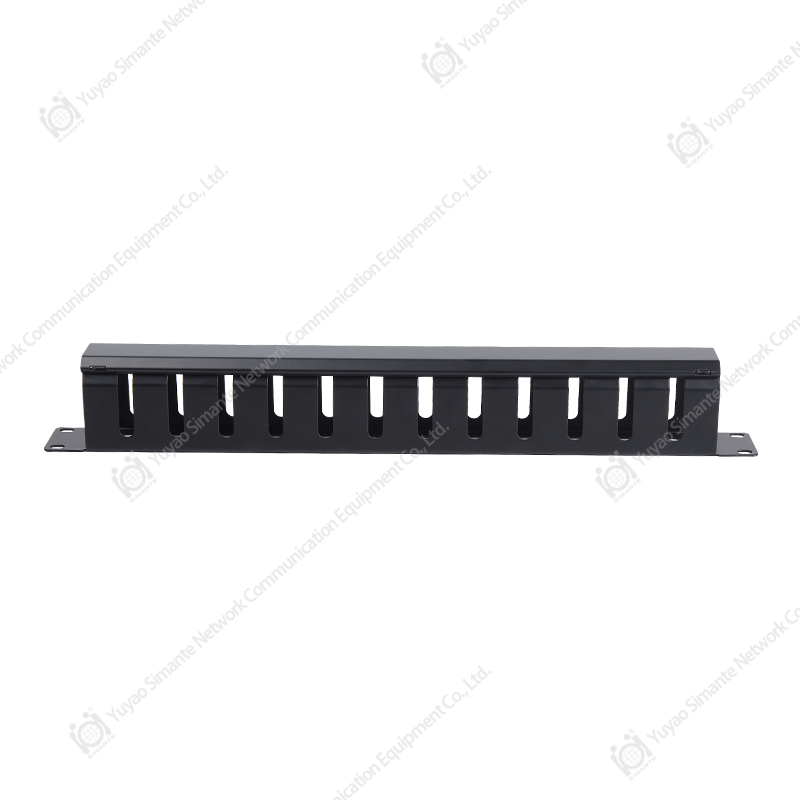
SMT-3010-12P 1U12 Ring Cable Manager
5. Capacity for Dense Copper Cabling
The stated capacity of the product is up to 24 four-pair cables. This capacity makes the manager appropriate for many copper structured cabling applications, including installations based on common twisted-pair patch cords. Actual capacity may vary according to cable diameter, connector size, routing preference, bundle arrangement, and applicable installation standards, but the stated figure provides a useful planning reference.
Capacity should not be considered only in terms of the maximum number of cables that can physically pass through the rings. Good cable management also requires sufficient room for identification, movement, inspection, and future changes. A manager that accommodates cables without crushing or tightly compressing them is more useful than one that is filled beyond a practical working level.
The product’s capacity supports organized grouping while retaining the ability to make adjustments. Installers can route patch cords from a panel to a switch, distribute them across the horizontal width, and maintain a visually clear connection path. This can be especially beneficial in cabinets serving multiple network zones or telecommunications outlets.
When planning a system, the installer should evaluate the complete cable path rather than relying on the manager alone. Cable lengths should be selected to avoid excessive loops, and bundles should not be tied so tightly that they restrict movement or compress the cable jacket. The cable manager provides the physical support, while installation workmanship determines the final performance of the rack layout.
In addition to supporting current connections, the capacity helps accommodate future movements and changes. Structured cabling systems often evolve as users, devices, and bandwidth requirements change. A manager with useful reserve capacity allows technicians to add or reroute cables without immediately replacing the cable-management component.
6. Advantages Compared with Less Suitable Alternatives
Many cable-management alternatives are available, including simple plastic clips, open trays, brush panels, closed ducts, vertical managers, and improvised support hardware. Each option may be useful in a particular situation, but a 1U12 ring manager offers a specific combination of front-of-rack access, standard mounting, compact size, and flexible cable routing.
Compared with loose cable ties or adhesive supports, a dedicated rack-mounted manager provides a more stable and repeatable installation. Adhesive supports may lose effectiveness over time because of temperature, dust, surface condition, or aging. Loose ties can also compress cables, make changes inconvenient, and create an untidy appearance. A metal rack-mounted structure avoids relying solely on adhesive attachment or disposable fastening methods.
Compared with a fully enclosed horizontal duct, an open ring design normally provides faster access to individual patch cords. Enclosed ducts can offer a clean appearance, but they may require the removal of covers when a technician needs to trace or replace a connection. The ring arrangement supports quick visual inspection and straightforward moves and changes.
Compared with a vertical cable manager, the 1U12 model is optimized for short horizontal connections between adjacent rack-mounted components. Vertical managers remain valuable for large cable volumes running along the sides of a cabinet, but they do not replace a horizontal support element where patch cords need to transition neatly between a panel and active equipment.
Compared with non-standard brackets, the 19-inch rack-mount format supports better compatibility and easier specification. Standardized mounting holes and dimensions make it more suitable for professional cabinets and structured cabling projects than general-purpose hardware that may require drilling, modification, or additional reinforcement.
The use of cold-rolled steel also provides a mechanical advantage over very light or fragile support materials. A strong bracket is less likely to deform during installation or routine service. The electrostatic powder-coated surface contributes to a durable finish and gives the component a consistent professional appearance.
7. Supporting Future Moves, Adds, and Changes
Network infrastructure is rarely static. A rack installed for a small office may later support additional workstations, wireless access points, cameras, access-control systems, servers, storage devices, or automation equipment. A cable-management product should therefore support change instead of making every change more difficult.
The SMT-3010-12P is designed with this requirement in mind. Its ring structure provides a flexible path for adding or rearranging patch cords. A technician can introduce a new connection into the existing route, remove an obsolete cord, or redistribute a bundle without rebuilding the entire front-of-rack arrangement.
Future readiness also improves documentation and troubleshooting. When cables follow a predictable horizontal path, technicians can compare physical connections with patch-panel labels, port maps, and network diagrams. This makes it easier to identify an incorrect connection or isolate a suspected fault.
A clean arrangement can also reduce the probability of accidental disconnection. Cables that are tangled or unsupported may be pulled when another cord is removed. With a defined cable route, the force applied during service is more likely to remain localized to the intended cable.
For data centers and enterprise environments, these advantages can contribute to lower maintenance disruption. Although cable management does not replace testing or documentation, it creates the physical conditions needed for those processes to work effectively.
8. Material Selection and Surface Treatment
The bracket is manufactured from cold-rolled steel plate. Cold-rolled steel is widely used for equipment-support applications because it can provide a stable surface, reliable forming characteristics, and suitable structural strength. For a compact rack-mounted component, the material offers an effective foundation for repeated installation and service.
Material selection affects several aspects of a cable manager’s performance. The bracket must support cable loads, maintain its shape during fastening, and tolerate ordinary handling in a cabinet. It must also provide a stable platform for the ring components and mounting hardware. A metal bracket is well suited to these requirements.
The surface is treated through electrostatic powder spraying. In this process, electrically charged powder is applied to the prepared metal surface and then cured to form a continuous finish. Compared with an untreated metal surface, a properly applied powder coating can provide improved resistance to routine abrasion and environmental exposure while producing a uniform appearance.
Surface consistency is important in professional network installations. Racks are often located in visible communications rooms, offices, industrial control areas, and commercial facilities. A consistent finish helps the cable manager integrate with other rack components and supports the overall impression of a carefully engineered system.
The coating also helps protect the steel substrate during storage, installation, and normal service. However, installers should avoid deep scratches, impact damage, or exposure to corrosive chemicals. Any installation should follow appropriate handling practices and the environmental limits specified for the product.
9. Environmental Performance and Compliance
The stated operating temperature range is -25°C to +70°C. This broad range supports use in many indoor communications environments and in equipment locations where temperatures may vary more than they would in a continuously conditioned office. The product is therefore suitable for a range of network cabinets, equipment rooms, and infrastructure areas when the complete installation is managed within the applicable environmental conditions.
The product information also specifies humidity performance of up to 85 percent under the stated conditions. Humidity should be controlled so that condensation does not form on metal or electrical equipment. Although the cable manager itself is a passive mechanical component, the surrounding rack may contain active networking equipment that requires careful environmental management.
The product is specified to meet RoHS requirements. Restriction of hazardous substances is an important consideration for modern electronic and communications supply chains. RoHS-related compliance supports responsible product selection for projects that require controlled material content and documentation.
Environmental suitability depends on the complete installation. The rack, cables, patch panels, switches, power equipment, and room conditions should all be reviewed together. The cable manager should not be exposed to corrosive gases, liquid chemicals, excessive dust, or conditions outside its specified range.
The environmental specifications also support project planning. Contractors and system designers can evaluate whether the product is appropriate for a particular communications room, industrial facility, or remote cabinet. Where conditions are unusually severe, additional enclosure protection or alternative materials may be required.
10. Manufacturing Strengths and Process Capability
A reliable cable-management product depends not only on its visible design but also on the manufacturing system behind it. Yuyao Simante Network Communication Equipment Co., Ltd. integrates design, development, sales, and service. This integrated structure enables product requirements to be reviewed across the entire lifecycle, from initial concept and tooling to production, inspection, packaging, and customer support.
The company has nearly two decades of service experience in network cabling solutions and optical fiber products. This experience is relevant because cable-management products are normally used as part of a larger structured cabling system. A manufacturer familiar with keystone jacks, patch panels, wall face plates, data sockets, and optical fiber products can better understand how a rack accessory must function in relation to other infrastructure components.
The company reports a research and development system intended to maintain quality stability from the design source. Design-source quality is important for products such as rack accessories because small dimensional errors can affect mounting, cable clearance, appearance, and installation efficiency. Reviewing these factors during product development helps reduce avoidable production and field issues.
The engineering team includes more than 10 engineers, supported by over 30 full-time technical personnel. Such technical resources can contribute to product updates, manufacturing improvement, tooling adjustment, quality analysis, and customization support. For buyers with specific rack layouts or packaging requirements, technical capacity can be an important supplier-selection criterion.
The factory operates 10 regular and customization production lines. This combination suggests the ability to support both standard products and customer-specific requirements. Standard products help maintain repeatability and delivery efficiency, while customization capability can assist customers with special packaging, labeling, color, material, or configuration needs when such modifications are technically appropriate.
Production equipment includes 10 fully automatic injection-molding machines, 20 semi-automatic injection-molding machines, and eight types of automatic assembly machines. Although the SMT-3010-12P uses a cold-rolled steel bracket, the broader equipment base reflects the company’s ability to manufacture a wider portfolio of network cabling and connectivity products. It also supports coordinated production of associated plastic and assembly components used across structured cabling systems.
The reported annual output exceeds nine million units. A production scale of this kind can support stable supply for distributors, contractors, original equipment customers, and project-based buyers. Volume capability is most valuable when it is combined with inspection discipline, process control, material consistency, and effective production scheduling.
11. Quality Control from Design to Finished Product
Quality control for a cable manager should cover more than appearance. The mounting structure must be dimensionally consistent, the bracket must be sufficiently rigid, the surface finish must be even, and the cable-support elements must remain secure during handling and service.
At the design stage, engineers can evaluate rack compatibility, cable capacity, cable access, bending-radius support, material selection, and assembly requirements. During production, attention should be given to steel plate forming, edge condition, coating adhesion, component assembly, and packaging protection.
Performance testing is also part of a reliable manufacturing approach. The company states that it uses performance testing to meet comprehensive customer requirements. Testing methods should be selected according to the product’s design and intended application. For a rack-mounted cable manager, relevant checks may include dimensional inspection, mounting fit, surface inspection, mechanical stability, component retention, and environmental review.
Consistent inspection is especially important for international supply. Products shipped to Europe, Australia, Africa, the Middle East, Southeast Asia, and other markets may need to meet different customer documentation, packaging, labeling, and quality expectations. A structured quality system helps support repeat orders and reduces variation between production batches.
For OEM and ODM customers, quality control also provides a foundation for product adaptation. A supplier that understands its materials, tooling, assembly processes, and inspection points is better positioned to evaluate whether a requested modification can be introduced without weakening the product or disrupting production consistency.
12. Installation Considerations
Before installation, verify that the cabinet or wall-mount enclosure is compatible with standard 19-inch rack equipment and has sufficient space for the 1U component. Confirm the position of nearby patch panels, switches, cable entry routes, power equipment, and other rack accessories.
Use the appropriate rack screws and fastening hardware for the cabinet. The manager should be mounted evenly, with the bracket seated correctly against the rack rails. Fasteners should be tightened securely but should not be overtightened to the point of damaging the finish or deforming the mounting area.
After mounting, route cables through the rings according to the planned connection layout. Avoid sharp bends, excessive pulling, and unnecessary crossing. Where cables are grouped, maintain a sensible bundle size and avoid compressing the jacket. Use labels and documentation that correspond to the patch-panel and equipment-port assignments.
When connecting cables, support the cable body rather than pulling on the connector. The cable manager is intended to help organize and protect cables, but careful handling remains necessary. The installer should also ensure that the cable route does not obstruct equipment ventilation, status indicators, removable modules, or service panels.
Once the rack is populated, inspect the finished installation from several angles. Check that the rings are not overloaded, cable loops are not excessive, connectors are fully seated, and the cable path permits future access. A final inspection at commissioning can prevent small routing problems from becoming maintenance difficulties later.
13. Packaging, Storage, and Supply Protection
The product is placed in a special blister bag and then packed in a cardboard box. Accessories are included in the packaging, and a label identifying the product model and quantity is applied to the upper-left area of the carton front. This packaging arrangement helps identify shipments during warehousing, distribution, and project receiving.
Clear product labeling is particularly useful when multiple rack accessories are ordered together. Cable managers may be supplied in several sizes or configurations, so model identification reduces the risk of selecting the wrong component during installation. Quantity labeling also helps warehouse teams verify incoming goods and prepare project deliveries.
The stated regular packing arrangement is 10 boxes per carton, with one product per inner box and 10 products per outer carton. Buyers should confirm the final packing details for a specific order, especially where customer-specified packaging is required.
Packaged products should be stored in a warehouse with an ambient temperature of -5°C to +30°C and relative humidity not exceeding 70 percent. The storage area should be free of acid, alkali, and other corrosive gases. The stated storage period is three years when the products are kept under the specified conditions.
Appropriate storage protects the steel bracket, powder-coated surface, accessories, labels, and packaging materials. Products should be kept away from direct moisture, chemical exposure, impact, and excessive stacking pressure. Proper inventory rotation is recommended even when the stated storage period is available.
14. Applications in Different Network Environments
The 1U12 ring cable manager can be used in office network cabinets where patch cords connect copper patch panels to Ethernet switches. In such environments, the product helps keep front-panel connections organized and makes moves and changes easier as users and work areas are added.
It is also suitable for small and medium-sized data rooms. Although larger data centers may require extensive vertical and overhead cable pathways, horizontal ring managers remain useful at the cabinet level. They support orderly transitions between individual rack-mounted components and help maintain a consistent front-of-rack appearance.
Telecommunications rooms can use the product to manage equipment jumpers and cross-connect connections. Its 19-inch format fits common cabinets and racks, while its open structure allows technicians to access individual cables during service operations.
Smart-home, building-automation, security, and industrial-control systems may also benefit from compact rack-based cable management. These systems often combine network switches, controllers, patch panels, gateways, and power equipment. A horizontal manager can help separate and organize the connections between these components.
System integrators can incorporate the product into copper and fiber structured cabling projects. The manager itself is a passive mechanical accessory, so the installer should select the correct cable type, bend-radius requirements, and separation practices for the complete system. When used with suitable patch cords and rack components, it contributes to a professional and maintainable installation.
15. Benefits for Contractors, Distributors, and OEM Customers
Contractors can benefit from a standard product that is easy to install and suitable for common 19-inch rack systems. Standardization simplifies training, purchasing, and installation procedures across multiple projects. A familiar product also enables installers to develop repeatable rack layouts and inspection checklists.
Distributors can benefit from a compact product with broad application potential. The 1U format, standard mounting, and horizontal cable-management function make it relevant to many structured cabling projects. The packaging and model labeling also support inventory control.
OEM and ODM customers may require customer-specified packaging, labels, or other product details. The company’s customization production lines and technical personnel provide a basis for discussing such requirements. Any customization should be reviewed for mechanical compatibility, production feasibility, compliance, and minimum-order conditions.
Project buyers may also value the company’s wider product portfolio. A supplier that can provide related network cabling and optical fiber components may simplify sourcing and improve coordination between product categories. Consolidated sourcing can reduce the administrative burden of managing multiple vendors, although buyers should always evaluate each product against the project’s technical requirements.
Export experience is another relevant consideration. The company maintains export activity in Europe, Australia, Africa, the Middle East, and Southeast Asia. Familiarity with international orders can support communication regarding specifications, packaging, documentation, delivery, and customer service.
16. Design Advantages in Daily Maintenance
The true value of cable management becomes especially clear after installation. During routine maintenance, technicians need to identify cables quickly, access connectors, replace defective cords, and verify port assignments. A horizontal ring manager creates a visible and accessible structure for these tasks.
Its open arrangement avoids unnecessary obstruction. Technicians can inspect the cable path without removing a large cover, and they can make a localized change instead of disturbing the entire bundle. This is useful when network downtime must be minimized.
A well-supported cable route can also improve the accuracy of visual troubleshooting. When patch cords are routed in a consistent direction and separated from unrelated cable paths, it becomes easier to follow a connection from one end to the other. This can reduce confusion during fault isolation.
Maintenance benefits also extend to cleaning and inspection. A less tangled rack gives technicians improved visibility of dust accumulation, loose hardware, damaged jackets, or labeling problems. Regular inspection is easier when the cable structure is clear.
The product does not eliminate the need for cable-management practices, but it makes those practices easier to implement. Correct labeling, suitable cable lengths, proper bend radii, and documented port assignments remain necessary for a high-quality network installation.
17. Selection Checklist for Buyers
Before selecting a 1U12 ring cable manager, buyers should confirm the rack width, available vertical space, cable type, expected cable quantity, and preferred cable-routing method. The product is intended for standard 19-inch equipment environments, but the actual cabinet should still be checked for mounting compatibility.
Buyers should also consider whether a horizontal ring manager is the best complement to the project’s vertical management and overhead or underfloor pathways. A complete system may require several management methods, with each component assigned to a particular section of the cable route.
Capacity planning should include current connections and anticipated growth. If the system is expected to expand, reserve space should be maintained rather than filling the rings to their practical limit on the first installation.
Environmental conditions should be compared with the stated temperature and humidity requirements. If the product will be installed in an area exposed to corrosive substances, persistent condensation, or unusual mechanical stress, the buyer should request a technical review before placing an order.
Finally, purchasers should clarify packaging, labeling, accessory requirements, inspection documentation, and delivery conditions. These details are particularly important for OEM, ODM, export, and large-scale project orders.
| Evaluation Area | Questions for the Buyer | Why It Matters |
|---|---|---|
| Rack compatibility | Is the cabinet or rack a standard 19-inch design? | Confirms mounting suitability. |
| Available space | Is one rack unit available in the planned position? | Prevents interference with other equipment. |
| Cable quantity | How many cables will be routed now and later? | Helps preserve practical reserve capacity. |
| Cable type | Are the patch cords copper, fiber, or a combination? | Supports correct routing and bend-radius planning. |
| Environmental conditions | Will temperature and humidity remain within specification? | Protects long-term product and system reliability. |
| Project requirements | Are custom labels, packaging, or accessories needed? | Allows manufacturing and logistics to be planned correctly. |
| Maintenance strategy | Will technicians need frequent moves and changes? | Confirms the value of an open, accessible design. |
18. Engineering and Production as a Combined Advantage
A product’s competitive value is shaped by both its design and the supplier’s ability to deliver it consistently. The SMT-3010-12P combines a practical standard format with a manufacturing organization capable of supporting network infrastructure products at scale.
From an engineering perspective, the product addresses several common rack-management requirements at the same time: standard 19-inch compatibility, compact 1U integration, front-of-rack access, flexible ring routing, support for a substantial number of four-pair cables, and improved jumper bending control.
From a production perspective, the company’s integrated design, development, manufacturing, testing, and service capabilities support a more coordinated supply process. Experienced engineers can work with production and quality personnel to resolve design or process questions. Technical staff can also assist with product updates and customer-specific requirements.
The manufacturing base, including automatic assembly and injection-molding equipment, supports the broader product family surrounding the cable manager. This is useful for customers seeking structured cabling components from a supplier with experience across multiple product categories rather than from a source focused on a single isolated accessory.
Stable annual production capacity can also support project continuity. Large network deployments may require repeat shipments over an extended period, and consistent product availability helps reduce the risk of substitutions that could produce visual or dimensional differences between cabinet installations.
19. Recommended Installation and Maintenance Practices
Installers should begin with a rack elevation drawing or equivalent layout plan. The drawing should identify patch panels, switches, cable managers, power-distribution equipment, blanking panels, and equipment requiring front access. Planning the layout before mounting components helps avoid congested or unnecessarily long cable routes.
Use cables of suitable length. Excessively long patch cords create loops that occupy space and make tracing more difficult, while cables that are too short may place stress on connectors. A practical cable length should allow the connection to reach its destination with a smooth route through the rings.
Maintain separation between different cable groups where required by the project. Copper data cables, fiber jumpers, power cords, and control wiring may have different routing or separation requirements. The cable manager should be used as part of the project’s complete cable pathway design.
Do not force more cables into the rings than the cable sizes and installation conditions reasonably permit. The stated capacity of up to 24 four-pair cables is a planning reference, not an instruction to compress every installation to its maximum physical limit.
During maintenance, remove or replace cables carefully and preserve labels. After a move or change, confirm the connection at both ends and update the network documentation. A clean cable manager delivers the greatest benefit when supported by disciplined labeling and record keeping.
20. Sustainability and Responsible Product Selection
RoHS compliance is one part of responsible product selection. Buyers may also consider the expected service life, reusability, packaging, repairability, and supply-chain consistency of the product. A durable cable manager that remains in service through multiple equipment upgrades can reduce the need for frequent replacement.
The ring design supports reuse because cables can be removed and rerouted without destroying the manager. This differs from some single-use adhesive or disposable support methods that must be replaced whenever the cable route changes.
The metal bracket and powder-coated finish are also suitable for a product intended for repeated installation and long-term rack service. At the end of its useful life, material handling should follow applicable local recycling and disposal requirements.
Efficient packaging can help protect products during transportation and storage. The specified blister-bag and carton arrangement is intended to reduce handling damage and keep accessories together. Customers with specific sustainability goals may discuss alternative packaging options with the manufacturer.
21. Frequently Asked Questions
What is the SMT-3010-12P 1U12 Ring Cable Manager used for?
It is used to provide horizontal cable management at the front of a rack. It supports and organizes patch cords or equipment jumpers and helps protect cables from loose routing, excessive pulling, and unsuitable bends.
Will it fit a standard 19-inch equipment rack?
Yes. The product is designed for standard 19-inch equipment racks, cabinets, and compatible wall-mount systems. The specific cabinet should still be checked to confirm that its mounting rails and available space are suitable.
How much cable can it accommodate?
The stated capacity is up to 24 four-pair cables. Actual working capacity depends on cable diameter, connector size, bundle arrangement, bend-radius requirements, and the amount of reserve space desired for future changes.
Does the product occupy one rack unit?
Yes. It is designed in a 1U format, allowing it to be integrated into a standard rack layout while preserving space for patch panels, switches, servers, and other equipment.
Why is the ring structure useful?
The ring structure gives cables a defined horizontal route while keeping them accessible. Technicians can add, remove, inspect, or rearrange individual patch cords without opening a large enclosed duct or disturbing the entire installation.
What material is used for the bracket?
The bracket is made from cold-rolled steel plate. Its surface receives electrostatic powder spraying, which provides a consistent finish and helps protect the metal during normal handling and service.
Can it be used in fiber installations?
It can be included in structured cabling systems that contain fiber equipment, but fiber jumpers have specific bend-radius and handling requirements. The installer should verify that the cable route and ring arrangement are suitable for the particular fiber assemblies being used.
What are the stated environmental conditions?
The stated temperature range is -25°C to +70°C. The product information specifies humidity of up to 85 percent under the stated conditions. Condensation, corrosive gases, liquids, and conditions outside the specification should be avoided.
Does the product meet RoHS requirements?
The product information states that the cable manager meets RoHS requirements. Buyers requiring formal compliance documents should request the relevant documentation for their order and destination market.
How is the product packaged?
The product is placed in a special blister bag and then packed in a cardboard box with its accessories. The carton carries model and quantity information. The regular packing arrangement is stated as 10 products per outer carton, subject to order confirmation.
Can customized packaging be requested?
The product information identifies customer-specified packaging as a note. Customers should discuss packaging, labeling, accessory, and order requirements with the manufacturer before production begins.
What type of company manufactures the product?
The manufacturer is a professional supplier of network cabling solutions and optical fiber products. Its capabilities include design, development, sales, service, injection molding, automatic assembly, customization, and performance testing.
Why is the manufacturer suitable for structured cabling projects?
The company has nearly 20 years of industry service, a team of engineers and technical personnel, multiple regular and customization production lines, and a product portfolio that includes keystone jacks, patch panels, wall face plates, data sockets, and other network cabling components.
22. Conclusion
The SMT-3010-12P 1U12 Ring Cable Manager provides a focused solution for horizontal cable organization in standard 19-inch racks, cabinets, and wall-mount systems. Its compact 1U design, ring-based routing structure, stated capacity of up to 24 four-pair cables, cold-rolled steel bracket, and electrostatic powder-coated surface make it suitable for a wide range of structured cabling environments.
The product’s main advantage is the practical balance between accessibility and control. Cables receive organized support without being enclosed in a difficult-to-access channel. This helps installers create neat rack layouts while retaining the flexibility required for future moves, additions, and changes.
Its value is further supported by the manufacturer’s broader capabilities. Integrated design and development, experienced engineering personnel, customization production lines, automatic equipment, performance testing, international supply experience, and a broad network-cabling portfolio provide a foundation for consistent product delivery and technical cooperation.
For contractors, distributors, system integrators, and OEM customers, the cable manager can serve as a dependable component in copper and fiber structured cabling projects. When selected according to rack dimensions, cable quantity, environmental conditions, and maintenance requirements, it can contribute to faster installation, improved cable protection, easier troubleshooting, and better long-term rack serviceability.
References
1. Product specification information for the SMT-3010-12P 1U12 Ring Cable Manager, including mounting, capacity, material, environmental, packaging, and storage requirements.
2. Structured cabling installation principles concerning rack organization, cable routing, bend-radius control, labeling, and moves, adds, and changes.
3. General engineering practices for 19-inch rack equipment, horizontal cable management, and telecommunications cabinet design.
4. RoHS-related product compliance principles for network communication equipment and structured cabling components.
5. Manufacturer-provided company information concerning design, development, manufacturing equipment, production lines, quality testing, customization, and international supply.