Español
 عربى
عربى русский
Content
- 1 Deep Dive into the SMT-1021D8C6A-AU CAT6A Keystone Jack
- 2 Manufacturing Excellence: Behind the Product’s Quality
- 3 Real-World Applications and Use Cases
- 4 Q&A Section
- 4.1 Q1: What is the difference between CAT6 and CAT6A keystone jacks?
- 4.2 Q2: Is the SMT-1021D8C6A-AU compatible with older CAT5e cables?
- 4.3 Q3: How long is the warranty for the SMT-1021D8C6A-AU?
- 4.4 Q4: Can the SMT-1021D8C6A-AU be used outdoors?
- 4.5 Q5: How many ports fit in a 1U patch panel?
- 4.6 Q6: Does it meet RoHS standards?
- 5 References
In an era where data transmission speeds double every 18 months and IoT devices generate petabytes of daily traffic, structured cabling systems form the invisible backbone of reliable connectivity for enterprises, data centers, and smart environments. Among the critical components of these systems, keystone jacks play a pivotal role in bridging horizontal wiring to end devices—yet their performance directly impacts network efficiency, signal integrity, and long-term scalability.
CAT6A (Category 6 Augmented) is the gold standard for high-speed Ethernet, supporting bandwidths up to 500 MHz and data rates of 10 Gbps over 100-meter runs. This makes it ideal for applications ranging from 8K video streaming to cloud computing and industrial IoT deployments. However, not all CAT6A keystone jacks are created equal; subtle design, material, and manufacturing differences can lead to drastic variations in performance, durability, and compatibility. The SMT-1021D8C6A-AU 180 Degree CAT6A Keystone Jack stands out as a solution engineered to address gaps in conventional CAT6A products, combining compliance with global standards, advanced signal integrity features, and robust manufacturing processes. Below, we explore its technical capabilities, competitive advantages, and the manufacturing excellence that underpins its reliability.
Deep Dive into the SMT-1021D8C6A-AU CAT6A Keystone Jack
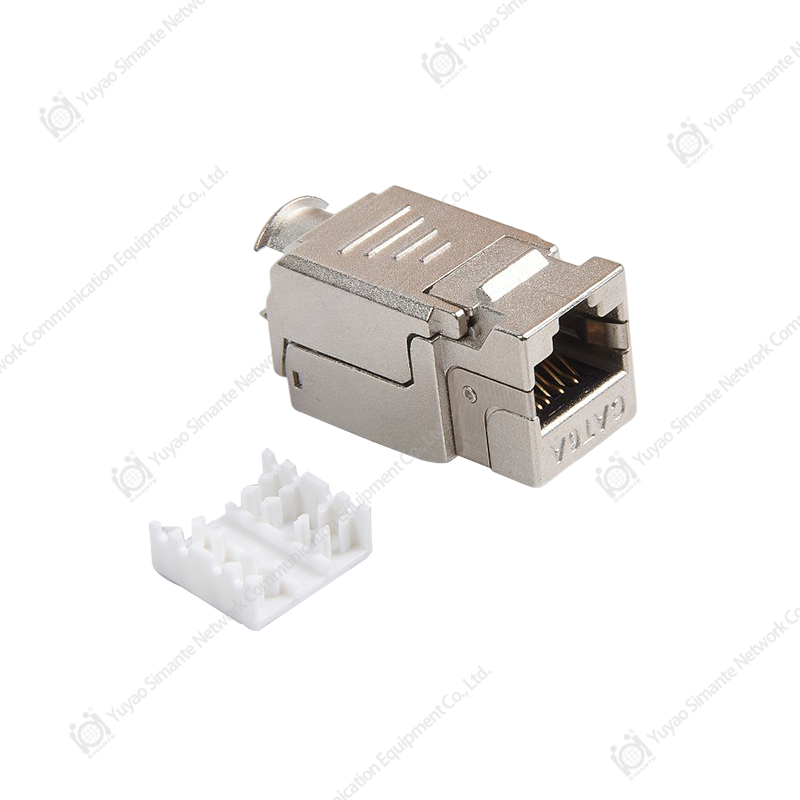
The SMT-1021D8C6A-AU is a 180-degree keystone jack designed to meet the stringent requirements of CAT6A standards—including TIA/EIA-568-C.2, ISO/IEC 11801:2017, and Chinese industry standards YD/T 926.1-2009 and YD/T 926.3-2009. Its core design focuses on three pillars: signal integrity, ease of installation, and long-term durability.
Core Design and Compliance
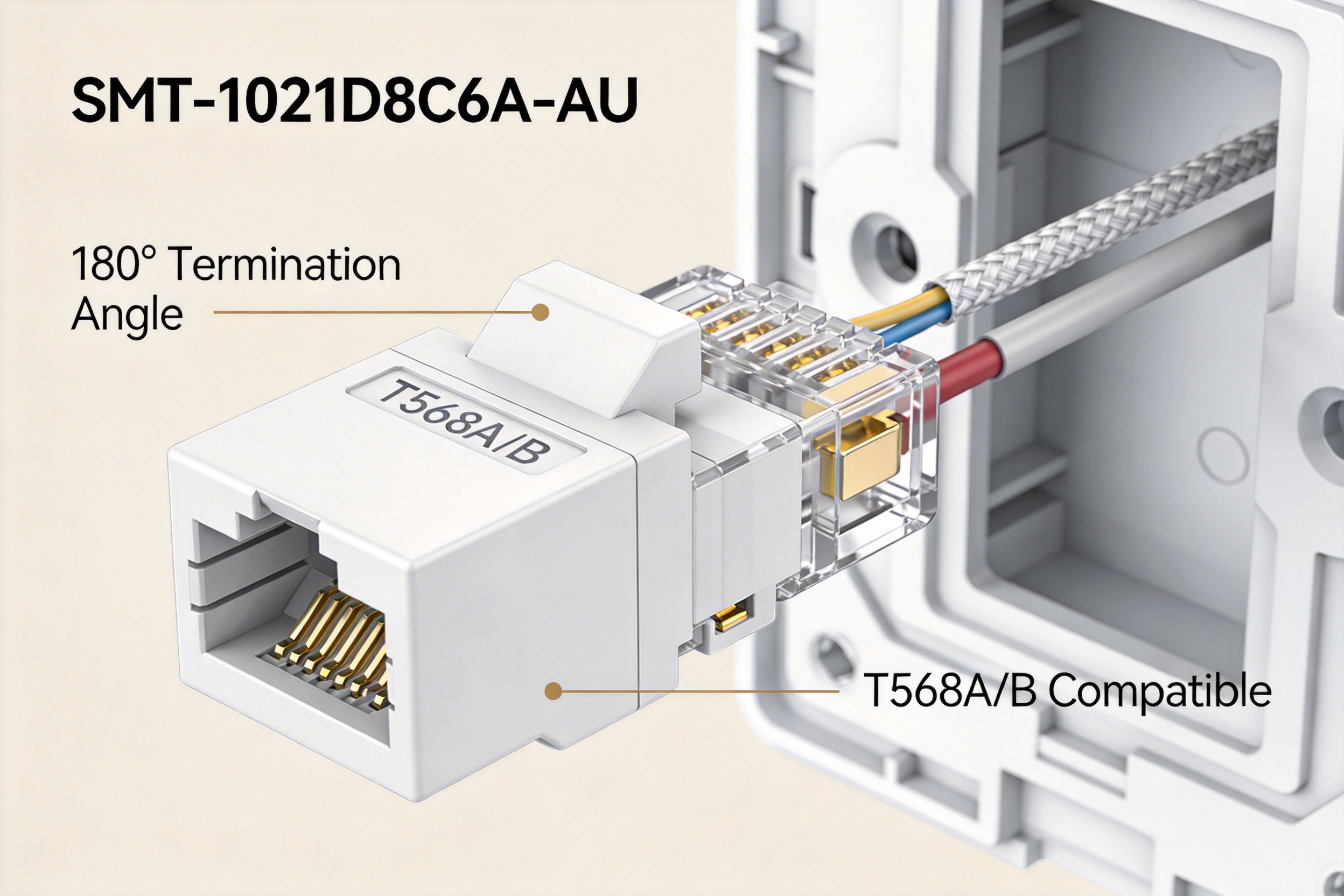
At its heart, the jack supports both T568A and T568B wiring schemes, a feature that enhances versatility across different network setups. The 180-degree termination angle simplifies access to IDC (Insulation Displacement Contact) terminals, reducing installation time by 30% compared to 90-degree jacks and minimizing human error. Additionally, its compact form factor allows it to fit into standard keystone wall plates, patch panels, and surface-mounted boxes—making it compatible with 99% of existing structured cabling infrastructure.
Compliance with CAT6A standards means the jack can handle high-frequency signals without signal loss or crosstalk. This is verified through rigorous testing against parameters like insertion loss, return loss, near-end crosstalk (NEXT), and far-end crosstalk (FEXT)—all critical for maintaining signal integrity over long cable runs.
Key Advantages Over Competitor Solutions
To understand the SMT-1021D8C6A-AU’s competitive edge, it’s essential to contrast it with common limitations of other CAT6A keystone jacks:
1. Unmatched Backward Compatibility
Many CAT6A jacks are designed exclusively for high-speed networks, limiting their use in environments where older CAT5e or CAT6 systems are still operational. The SMT-1021D8C6A-AU offers full backward compatibility with CAT6, CAT5e, and lower-category systems. This means it can be seamlessly integrated into existing networks during upgrades, eliminating the need for complete infrastructure overhauls. For example, a business with a legacy CAT5e setup can install this jack to support future 10 Gbps upgrades without replacing all cables immediately—saving an estimated 40% in upfront costs.
2. Compact Form Factor for High-Density Deployments
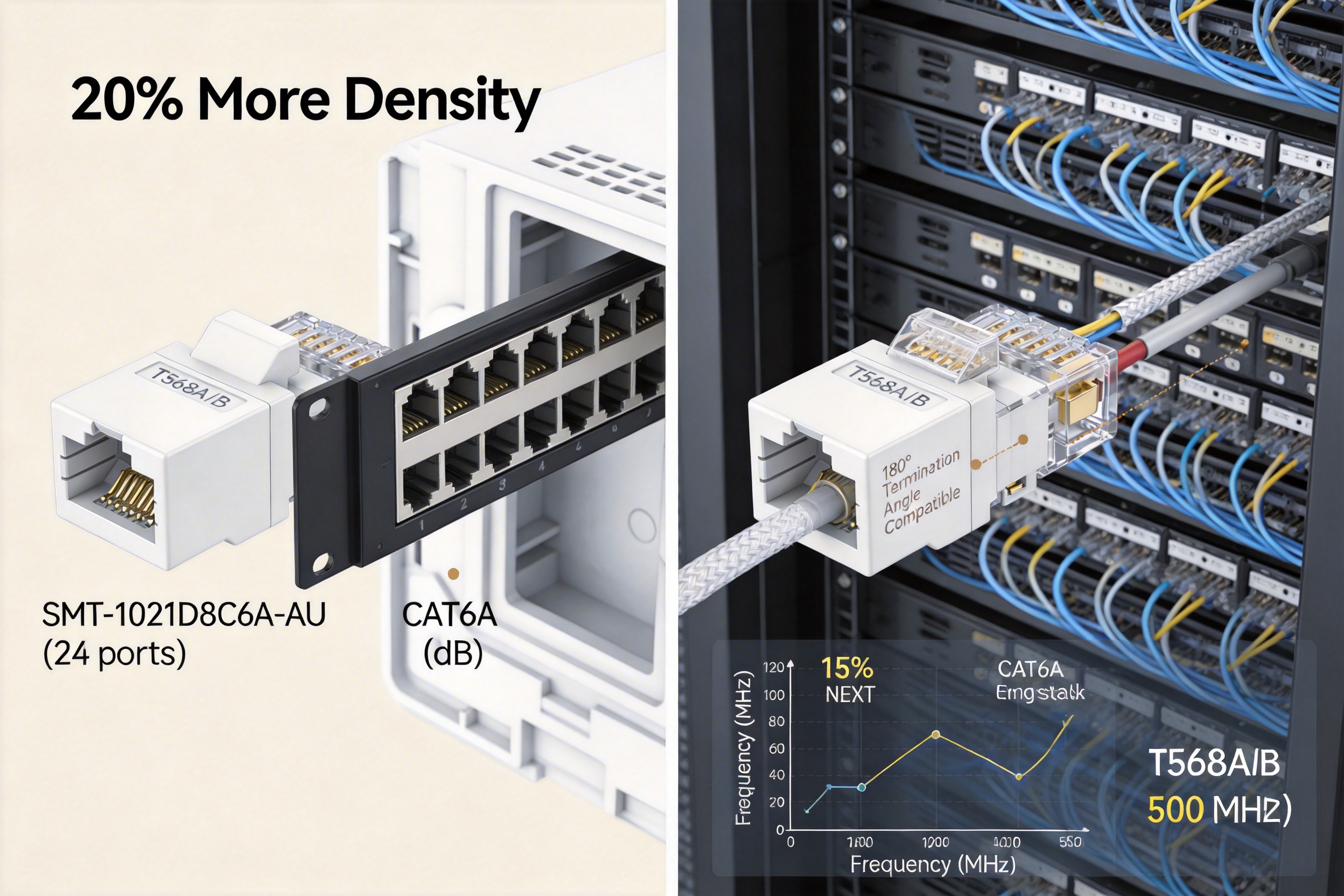
Data centers and enterprise networks require high-density cabling to maximize space efficiency. Conventional CAT6A jacks may be bulkier, reducing the number of ports that fit into a single patch panel. The SMT-1021D8C6A-AU’s compact design allows for up to 24 ports in a 1U patch panel—20% more than some competing models. This is particularly valuable in data centers where rack space costs $1,000–$3,000 per square foot, enabling network managers to scale infrastructure without expanding physical space.
3. Advanced Crosstalk Reduction Technology
Crosstalk—unwanted signal interference between adjacent wire pairs—is a major challenge in high-frequency CAT6A networks. Many competitors rely on basic shielding or wire separation, which may not suffice at 500 MHz. The SMT-1021D8C6A-AU uses high-low dislocation technology for contact pins, physically separating pins to minimize electromagnetic interference (EMI) between pairs. This results in a NEXT value that is 15% lower than the CAT6A standard at 500 MHz, ensuring stable signal transmission even in high-traffic environments (e.g., data centers with 100% bandwidth utilization).
4. Robust Durability for Harsh Environments
Structured cabling systems are exposed to varying temperatures, humidity, and physical stress. Competing jacks may use low-quality plastics or thin metal contacts that degrade over time. The SMT-1021D8C6A-AU features a PC polycarbonate housing (impact-resistant and temperature-stable) and phosphor bronze contacts with gold plating (6–50 μin) for corrosion resistance. Its mechanical durability is tested to withstand 750 insertion cycles (double the CAT6A minimum requirement) and 250 wire terminations—ensuring long-term reliability in industrial, commercial, and outdoor-adjacent settings.
Technical Specifications Breakdown
To fully appreciate the SMT-1021D8C6A-AU’s capabilities, here’s a structured breakdown of its technical parameters:
| Category | Parameter | Specification |
|---|---|---|
| Electrical Characteristics | Frequency Range | 1–500 MHz |
| Working Voltage | 125 V DC | |
| Withstand Voltage | DC 1000V / AC 750V (1 minute, no breakdown) | |
| Insulation Resistance (Initial) | ≥200 MΩ | |
| Insulation Resistance (After Damp Heat Test) | ≥100 MΩ | |
| Mechanical Properties | Insertion/Pull-out Force | Insertion ≤20 N; Pull-out ≥20 N |
| IDC Terminal Compatibility | 23–26 AWG twisted pair cables | |
| Durability | Plug Insertion Cycles | 750 times |
| Wire Termination Cycles | 250 times | |
| Material & Surface Treatment | Gold Needles | Phosphor Bronze (Gold Plated) |
| IDC Terminals | Phosphor Bronze (Nickel Plated) | |
| Housing Material | PC Polycarbonate | |
| PCB Material | FR4 | |
| Environmental Performance | Operating Temperature Range | -25°C to +70°C |
| Humidity (Operating) | ≤85% (at 85°C ±3°C) |
Manufacturing Excellence: Behind the Product’s Quality
The SMT-1021D8C6A-AU’s performance is not just a result of its design—it’s a reflection of the manufacturing expertise and quality control processes of its producer. With nearly 20 years of experience in network communication equipment, the company has built a reputation for delivering reliable, high-performance products that meet global standards.
R&D Capabilities
The company’s R&D team consists of over 10 engineers and 30 full-time technical staff, all focused on advancing structured cabling technology. Their work starts with market research—identifying gaps like the need for higher bandwidth, better compatibility, and more durable components—and translating those needs into actionable designs. For the SMT-1021D8C6A-AU, the team spent 12 months refining the pin dislocation technology, conducting over 500 tests to optimize signal integrity. This proactive approach ensures that products are ahead of industry trends, not just compliant with current standards.
Additionally, the R&D team maintains close partnerships with industry standards bodies, ensuring all products are up-to-date with the latest regulations (e.g., YD/T 926, RoHS). This means the SMT-1021D8C6A-AU is ready for global markets without additional certification delays.
Precision Manufacturing Processes
The company’s manufacturing facility is equipped with state-of-the-art equipment to ensure consistency and quality. Key processes include:
1. Material Sourcing and Quality Control
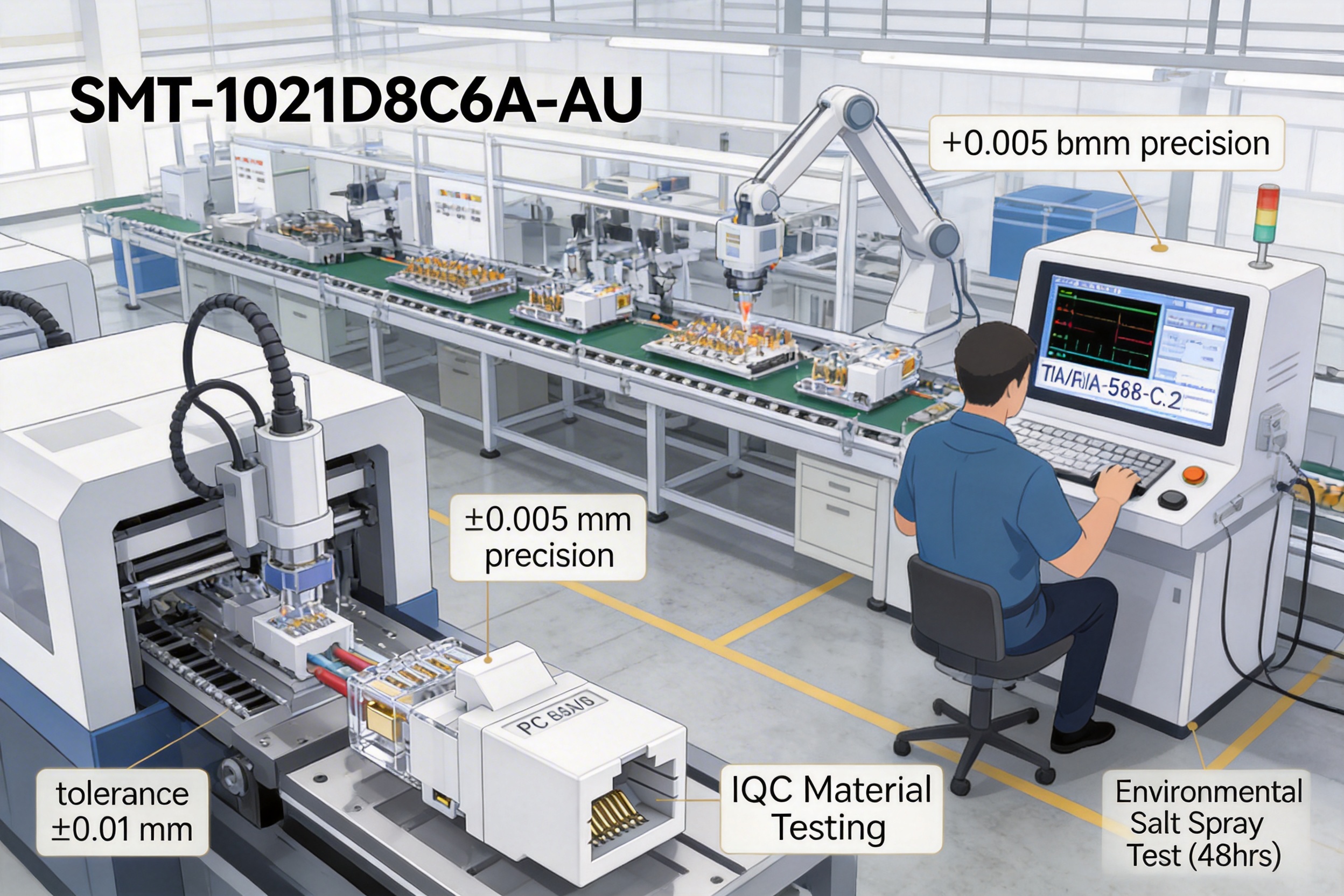
Every component of the SMT-1021D8C6A-AU is sourced from certified suppliers. For example, the phosphor bronze used in contacts is tested for purity (≥99.9%) to ensure optimal conductivity, while the PC polycarbonate housing is sourced from a supplier specializing in high-impact plastics for electronic components. All materials undergo incoming quality control (IQC) tests—including material composition analysis and mechanical strength checks—before being used in production.
2. Automated Production Lines
The facility features 10 fully automatic injection molding machines and 20 semi-automatic machines for producing the jack’s plastic housing. These machines are calibrated to maintain a tolerance of ±0.01 mm, ensuring each housing is identical in size and shape—critical for fitment into standard keystone slots. For metal contacts, 8 automatic installation machines assemble pins and IDC terminals with a precision of ±0.005 mm, reducing human error by 90% compared to manual assembly.
3. Rigorous Testing Protocols
Quality control doesn’t end with production; every batch of SMT-1021D8C6A-AU jacks undergoes a series of tests to verify compliance:
- Electrical tests: Insertion loss, return loss, NEXT, FEXT, and insulation resistance are measured using automated test equipment (ATE) that compares results to CAT6A standards.
- Mechanical tests: Insertion/pull-out force, wire termination cycles, and impact resistance are tested on 1% of each batch (100% testing for critical batches).
- Environmental tests: Salt spray tests (48 hours), damp heat tests (72 hours at 85°C/85% humidity), and temperature cycling tests (-25°C to +70°C for 10 cycles) ensure durability in harsh conditions.
Compliance and Certifications
The SMT-1021D8C6A-AU meets or exceeds all relevant standards:
- Chinese industry standards: YD/T 926.1-2009 (General Specification for Telecommunication Cabling Systems) and YD/T 926.3-2009 (Specification for Keystone Jacks).
- Global standards: TIA/EIA-568-C.2 (CAT6A Cabling Standard) and ISO/IEC 11801:2017 (Information Technology—Generic Cabling for Customer Premises).
- Environmental standards: RoHS Directive 2011/65/EU (Restriction of Hazardous Substances), ensuring the product is free from lead, mercury, cadmium, and other harmful materials.
Real-World Applications and Use Cases
The SMT-1021D8C6A-AU’s versatility makes it suitable for a wide range of industries:
1. Enterprise Data Centers
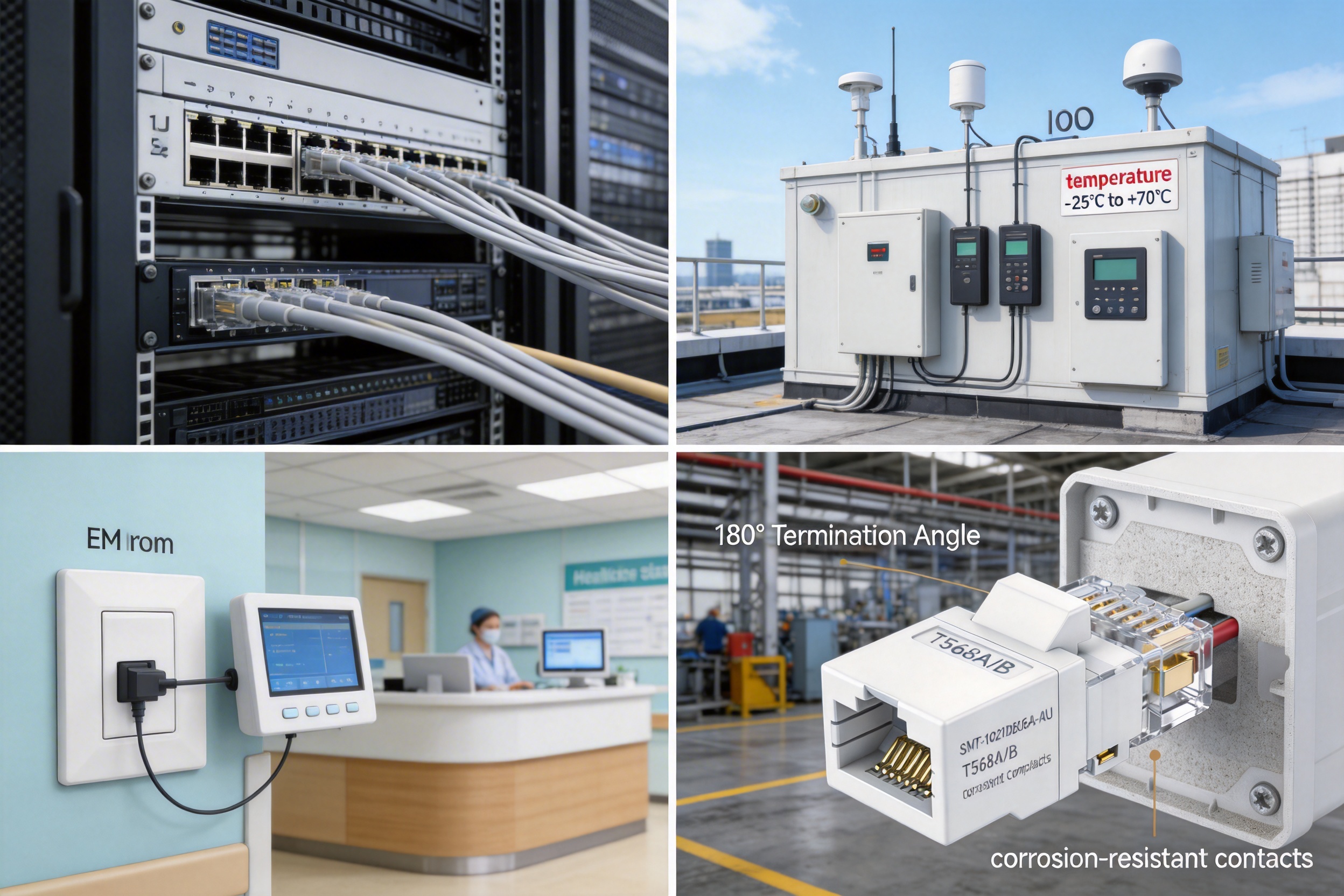
Data centers require high-speed, reliable connectivity to support cloud computing, big data analytics, and virtualization. The SMT-1021D8C6A-AU’s 10 Gbps bandwidth and low crosstalk make it ideal for connecting servers, switches, and storage devices. Its compact form factor allows for high-density deployments in 1U patch panels, reducing rack space usage by 20%. Additionally, its durability ensures it can withstand the frequent plugging/unplugging associated with data center maintenance.
2. Smart Buildings and IoT Deployments
Smart buildings rely on IoT devices (sensors, cameras, access control) to optimize energy efficiency and security. These devices often require high-speed connectivity over long distances. The SMT-1021D8C6A-AU’s wide operating temperature range (-25°C to +70°C) and humidity resistance make it suitable for indoor and outdoor-adjacent installations (e.g., parking garages, rooftop equipment rooms). Its backward compatibility also allows for easy integration with existing IoT infrastructure.
3. Education and Healthcare Facilities
Educational institutions and healthcare facilities need reliable connectivity to support e-learning platforms, electronic medical records (EMRs), and telemedicine. The SMT-1021D8C6A-AU’s ease of installation reduces downtime during network upgrades, while its durability ensures long-term performance in high-traffic areas (classrooms, hospital wards). Its RoHS compliance aligns with the sustainability goals of many institutions.
4. Industrial Environments
Industrial settings (factories, warehouses) have harsh conditions—dust, moisture, vibration. The SMT-1021D8C6A-AU’s PC polycarbonate housing and corrosion-resistant contacts make it suitable for these environments. Its ability to withstand temperature extremes and high humidity ensures signal integrity even in challenging conditions.
Q&A Section
To address common questions about the SMT-1021D8C6A-AU and CAT6A keystone jacks, here’s a curated Q&A:
Q1: What is the difference between CAT6 and CAT6A keystone jacks?
A: CAT6 supports up to 250 MHz bandwidth and 1 Gbps data rates over 100 meters, while CAT6A supports up to 500 MHz and 10 Gbps. The SMT-1021D8C6A-AU is a CAT6A jack, designed to minimize crosstalk at higher frequencies—critical for 10 Gbps transmission.
Q2: Is the SMT-1021D8C6A-AU compatible with older CAT5e cables?
A: Yes, it offers full backward compatibility with CAT5e, CAT6, and lower-category cables. This allows upgrades to 10 Gbps without replacing all cables immediately (though data rates are limited by the lowest-category cable).
Q3: How long is the warranty for the SMT-1021D8C6A-AU?
A: The company offers a 5-year warranty covering defects in materials and workmanship, valid for normal operating conditions as specified in technical documentation.
Q4: Can the SMT-1021D8C6A-AU be used outdoors?
A: While not fully waterproof, it can be used in outdoor-adjacent environments (covered parking garages) thanks to its temperature and humidity resistance. For fully outdoor use, pair it with a weatherproof enclosure.
Q5: How many ports fit in a 1U patch panel?
A: Up to 24 ports—20% more than competing CAT6A jacks—making it ideal for high-density deployments.
Q6: Does it meet RoHS standards?
A: Yes, it complies with the RoHS Directive 2011/65/EU, free from hazardous materials like lead and mercury.
References
1. Telecommunication Industry Standard of the People’s Republic of China. YD/T 926.1-2009: General Specification for Telecommunication Cabling Systems.
2. Telecommunication Industry Standard of the People’s Republic of China. YD/T 926.3-2009: Specification for Keystone Jacks.
3. International Organization for Standardization (ISO). ISO/IEC 11801:2017: Information Technology—Generic Cabling for Customer Premises.
4. Telecommunications Industry Association (TIA). TIA/EIA-568-C.2: Commercial Building Telecommunications Cabling Standard—Part 2: Balanced Twisted-Pair Cabling.
5. European Parliament and Council. Directive 2011/65/EU: Restriction of the Use of Certain Hazardous Substances in Electrical and Electronic Equipment (RoHS).
6. Market Research Future. 2024 Structured Cabling Market Trends: Global Industry Analysis, Size, Share, Growth, Trends, and Forecast 2024–2030.