Español
 عربى
عربى русский
Content
In the era of digital transformation, reliable network connectivity is the backbone of modern businesses, data centers, and smart environments. Structured cabling systems form the foundation of this connectivity, and patch panels are critical components that organize, manage, and protect network connections. Among the various patch panel options, CAT5E shielded models stand out for their ability to support high-speed data transmission while mitigating electromagnetic interference (EMI) and radio frequency interference (RFI). This article explores the key features, advantages, manufacturing excellence, and technical specifications of a leading CAT5E shielded patch panel, highlighting how it addresses the evolving needs of network infrastructure.
Understanding CAT5E Shielded Patch Panels
CAT5E (Category 5 Enhanced) is a widely adopted cabling standard that supports data transmission speeds up to 1 Gbps at frequencies up to 250 MHz. Unlike unshielded twisted pair (UTP) cables, shielded twisted pair (STP) cables and their associated patch panels include a metallic shield that reduces EMI/RFI. This shielding is particularly crucial in environments with high electrical noise, such as industrial settings, data centers with dense equipment, or buildings near power lines.
A patch panel acts as a central hub for network connections, allowing technicians to terminate horizontal cables from work areas or equipment rooms and connect them to patch cords leading to switches or other network devices. The shielded design of the CAT5E patch panel ensures that signal integrity is maintained, minimizing data loss, errors, and downtime—critical factors for businesses relying on uninterrupted network access.
Key Features of the CAT5E Shielded Patch Panel
The CAT5E shielded patch panel under discussion integrates several innovative features that enhance its performance and usability:
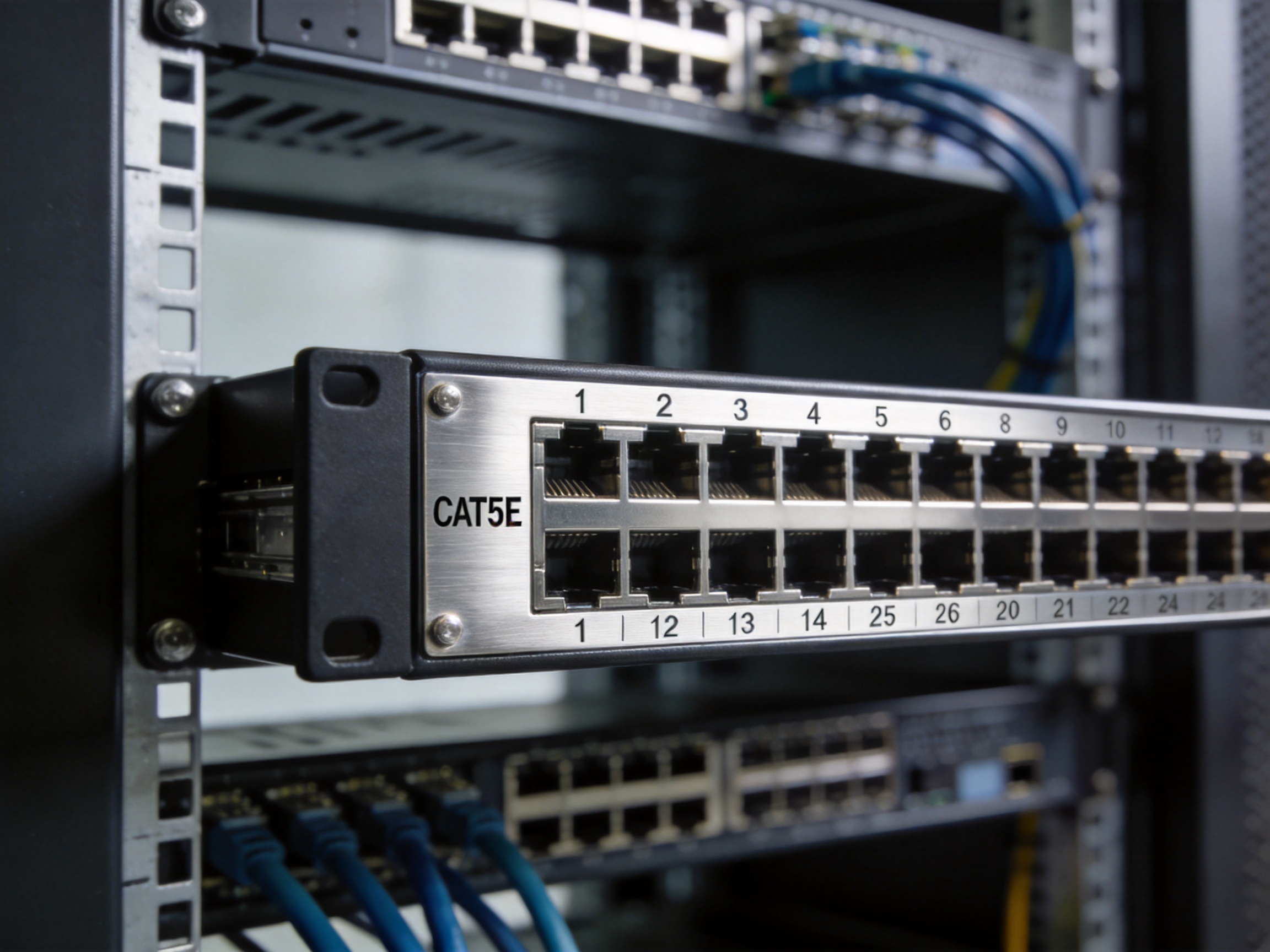
19-Inch Rack Mount Standard: Designed to fit standard 19-inch equipment racks, cabinets, and wall mounts, this patch panel offers easy integration into existing or new network infrastructure. Its sturdy construction ensures stability, even in high-density setups.
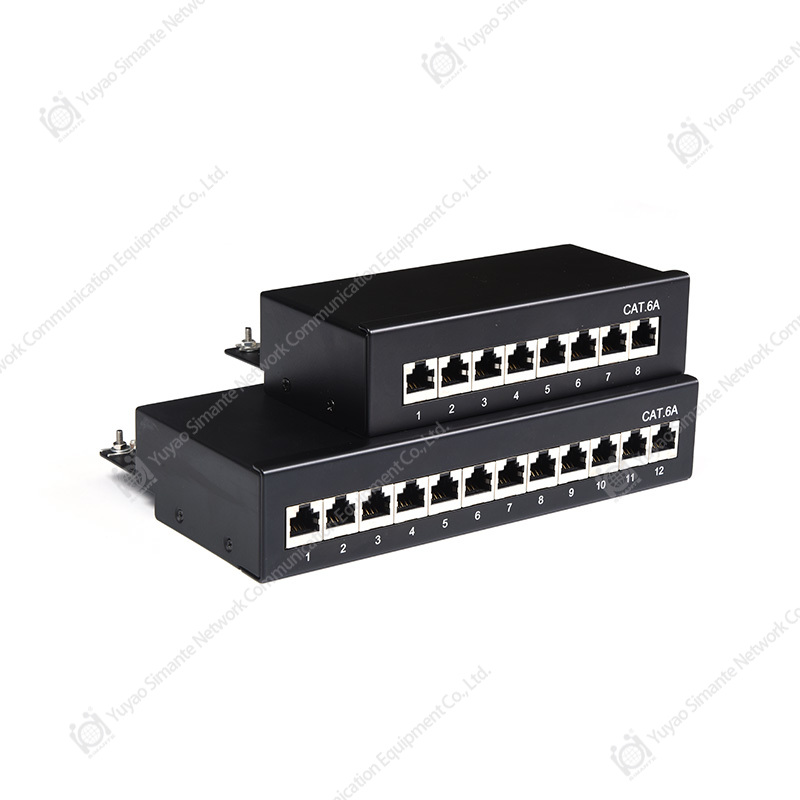
24 Port Labeling: Each of the 24 front ports is clearly labeled, simplifying port identification and reducing the time required for installation and troubleshooting. This feature is especially valuable in large networks where quick access to specific connections is essential.
Integrated Cable Manager: The rear of the patch panel includes a cable manager that guides cables to termination points, preventing tangling and ensuring neat, organized wiring. This not only improves aesthetics but also simplifies future maintenance and upgrades.
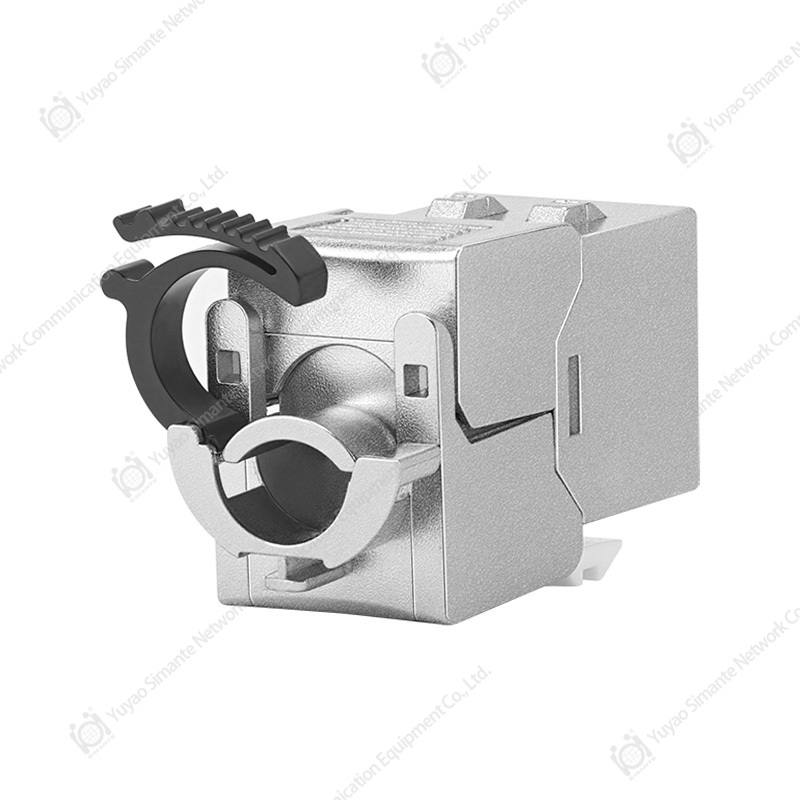
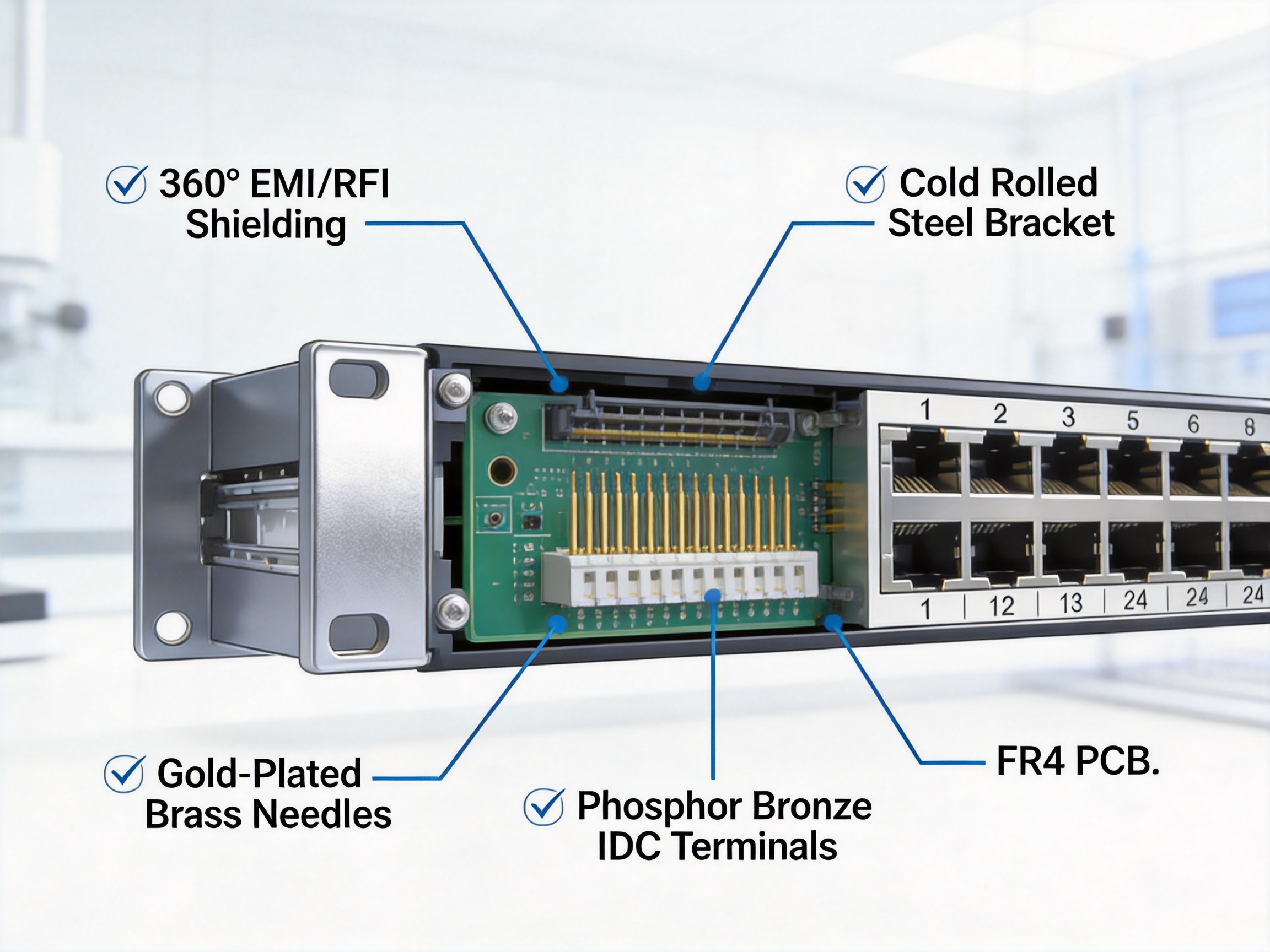
360-Degree Shielding: A full 360-degree all-round shielding shell protects against EMI/RFI, ensuring signal integrity in noisy environments. This is a significant upgrade from partial shielding solutions, which leave gaps that can compromise performance.
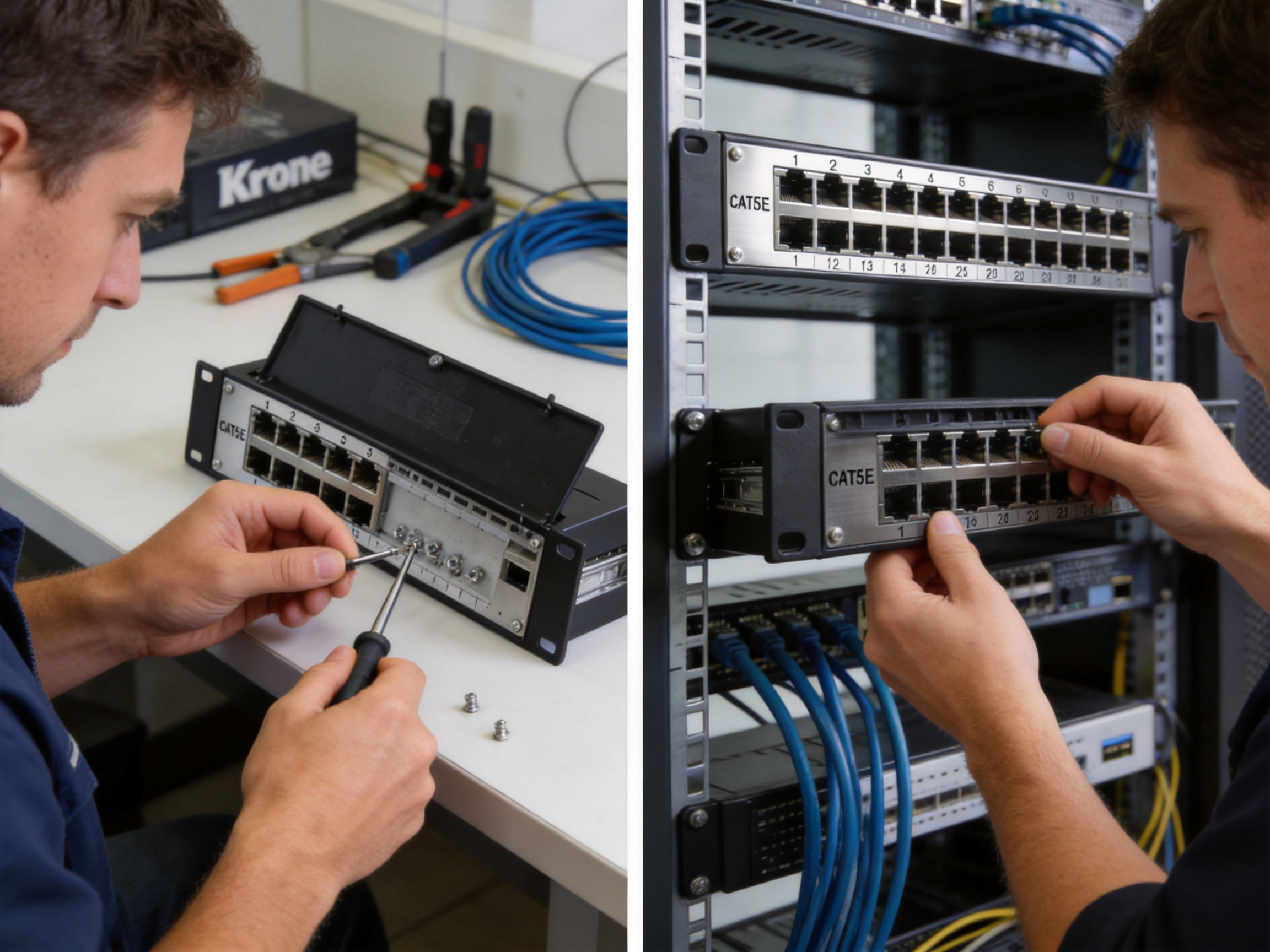
Non-Screw Rear Cover: The shielding cover’s rear panel uses a non-screw design, enabling quick and easy installation without the need for tools or the risk of losing small hardware. This feature reduces labor time and increases efficiency during setup.
ROHS Compliance: The product meets ROHS standards, meaning it is free from hazardous substances like lead, mercury, and cadmium. This compliance aligns with global environmental regulations and makes the product suitable for markets with strict sustainability requirements.
Krone Tool Compatibility: The patch panel supports the Krone tool IDC (Insulation Displacement Contact) wiring method, a widely used and reliable termination technique that ensures secure, low-resistance connections. This compatibility means technicians do not need specialized tools, reducing training and equipment costs.
Advantages Over Competitor Solutions
To understand the value of this CAT5E shielded patch panel, it is essential to compare it with common competitor offerings:
Full vs. Partial Shielding: Many competitor patch panels use partial shielding, which leaves gaps in protection against EMI/RFI. This can lead to signal degradation in high-noise environments. The 360-degree shielding of this panel eliminates these gaps, ensuring consistent performance even in challenging settings.
Non-Screw vs. Screw Rear Covers: Most competitors rely on screw-fastened rear covers, which require tools and time to install. The non-screw design of this panel reduces installation time by up to 50% and eliminates the risk of lost screws, which can delay projects.
Clear Labeling vs. Vague Markings: Some competitors use minimal or unclear port labels, leading to errors during termination. The explicit labeling of this panel reduces human error, lowering the risk of network downtime due to incorrect connections.
Integrated Cable Manager vs. Separate Accessories: Many competitors require separate cable managers to be purchased and installed, increasing costs and complexity. The integrated cable manager of this panel simplifies setup and ensures optimal cable organization from the start.
ROHS Compliance vs. Non-Compliance: A growing number of markets (including the EU, US, and Asia) require products to meet ROHS standards. Non-compliant competitor products may be restricted from these markets, making this panel a more future-proof choice.
Krone Tool Compatibility vs. Proprietary Tools: Some competitors use proprietary termination tools, which are expensive and require specialized training. The Krone tool compatibility of this panel leverages widely available tools, reducing operational costs for network operators.
Advanced Manufacturing Processes & Company Strengths
The superior performance of this CAT5E shielded patch panel is a direct result of the manufacturer’s advanced manufacturing processes and unwavering commitment to quality. Here’s a closer look at the company’s strengths:
Robust R&D Capabilities: The manufacturer employs over 10 engineers and 30 full-time technical staff who focus on designing products for quality at the source. This means that every component is tested and optimized during the design phase, ensuring stability and reliability before production begins. The R&D team also stays abreast of industry trends, ensuring that products meet the latest standards and customer needs.
State-of-the-Art Production Lines: The factory is equipped with 10 regular and customization production lines, 10 fully automatic injection molding machines, 20 semi-automatic injection molding machines, and 8 automatic installation machines. These machines ensure consistent, high-quality production with minimal human error. The automatic injection molding machines produce plastic components (PC polycarbonate, PBT) with precise dimensions, while the automatic installation machines assemble connectors and terminals with high accuracy.
Rigorous Quality Control: Every product undergoes a multi-stage quality control process, including:
- Electrical testing: Verifying frequency range, working voltage, withstand voltage, near-end crosstalk attenuation, and insulation resistance.
- Mechanical testing: Checking insertion/pull force, connector connection device strength, and IDC terminal clamping force.
- Environmental testing: Assessing performance under extreme temperatures (-25°C to +70°C), high humidity (≤85%), and salt spray (48-hour test to ensure corrosion resistance).
- Durability testing: Measuring the number of insertions (750 times) and wire terminations (250 times) to ensure long-term reliability.
Premium Material Selection: The manufacturer uses only high-quality materials to ensure performance and durability:
- Bracket: Cold rolled steel with plastic spraying (sturdy, corrosion-resistant).
- Gold needles: Brass with gold plating (3-50U thickness) for excellent conductivity and corrosion resistance.
- IDC terminals: Phosphor bronze with nickel plating (high spring force, reliable contact).
- Plastic components: PC polycarbonate and PBT (heat-resistant, impact-resistant).
- PCB: FR4 (high dielectric strength, stable at high temperatures).
OEM/ODM Capabilities: The company offers OEM (Original Equipment Manufacturer) and ODM (Original Design Manufacturer) services, allowing customers to customize products to their specific needs. This flexibility has made the company a preferred partner for businesses worldwide.
Global Reach: The manufacturer exports products to Europe, Australia, Africa, the Middle East, and Southeast Asia, maintaining a stable export volume. This global presence ensures that the company understands the diverse needs of customers across different markets and can adapt its products accordingly.
Technical Specifications Deep Dive
The CAT5E shielded patch panel meets and exceeds industry standards, as outlined in the following technical specifications:
Electrical Characteristics
- Frequency range: 1–250 MHz (supports 1 Gbps data transmission).
- Working voltage: 125 V (safe for standard network applications).
- Withstand voltage: DC 1000 V (AC 750 V) for 1 minute without breakdown or arcing (ensures safety in high-voltage environments).
- Near-end crosstalk attenuation: ≥2.5 dB (minimizes signal interference between adjacent wires).
- Insulation resistance: Initial value ≥100 MΩ; after constant damp heat test ≥100 MΩ (maintains insulation even in humid conditions).
Mechanical Properties
- Insertion force: ≤20 N (easy to insert patch cords).
- Pull-out force: ≥20 N (ensures secure connections).
- Connector connection device strength: 50 N for 60±5 seconds (resists accidental disconnection).
- IDC terminal clamping: Compatible with 23–26 AWG twisted pair cables (supports standard network cables).
Durability
- Plug and socket insertions: 750 times (long service life).
- Wire terminations: 250 times (reliable for multiple reconfigurations).
Environmental Performance
- Temperature range: -25°C to +70°C (operates in extreme climates).
- Humidity: ≤85% (at 85°C±3°C) (resists moisture damage).
- Salt spray test: 48 hours (complies with corrosion resistance standards; salt solution concentration 5±0.1% mass percentage, pH 6.5–7.2 at 35±2°C).
Material & Surface Treatment
- Metal: Cold rolled steel (bracket), brass gold plated (gold needles), phosphor bronze nickel plated (IDC terminals).
- Non-metal: PC polycarbonate, PBT (plastic components); FR4 (PCB).
- Gold plating thickness: 3–50 U (optimal conductivity and durability).
Packaging & Storage
- Packaging: Special blister bag → cardboard box → outer carton (10 boxes per carton, 1 per box → 10 units total).
- Storage: Warehouse with temperature -5°C to +30°C, relative humidity ≤70%, no corrosive gases (storage period: 3 years).
Below is a summary table of the key technical specifications:
| Parameter Category | Parameter Name | Specification | Compliance Standard |
|---|---|---|---|
| Electrical | Frequency Range | 1–250 MHz | YD/T 926.1-2009 |
| Electrical | Working Voltage | 125 V | YD/T 926.3-2009 |
| Electrical | Withstand Voltage | DC 1000V (AC750V) 1min | IEC 60603-7 |
| Mechanical | Insertion Force | ≤20 N | YD/T 926.1-2009 |
| Mechanical | Pull-out Force | ≥20 N | YD/T 926.3-2009 |
| Durability | Plug Insertions | 750 times | Internal Quality Standard |
| Environmental | Temperature Range | -25°C to +70°C | YD/T 926.1-2009 |
| Environmental | Salt Spray Test Duration | 48 hours | ASTM B117 |
| Compliance | ROHS | Compliant | 2011/65/EU |
Application Scenarios
The CAT5E shielded patch panel is versatile and suitable for a wide range of application scenarios:
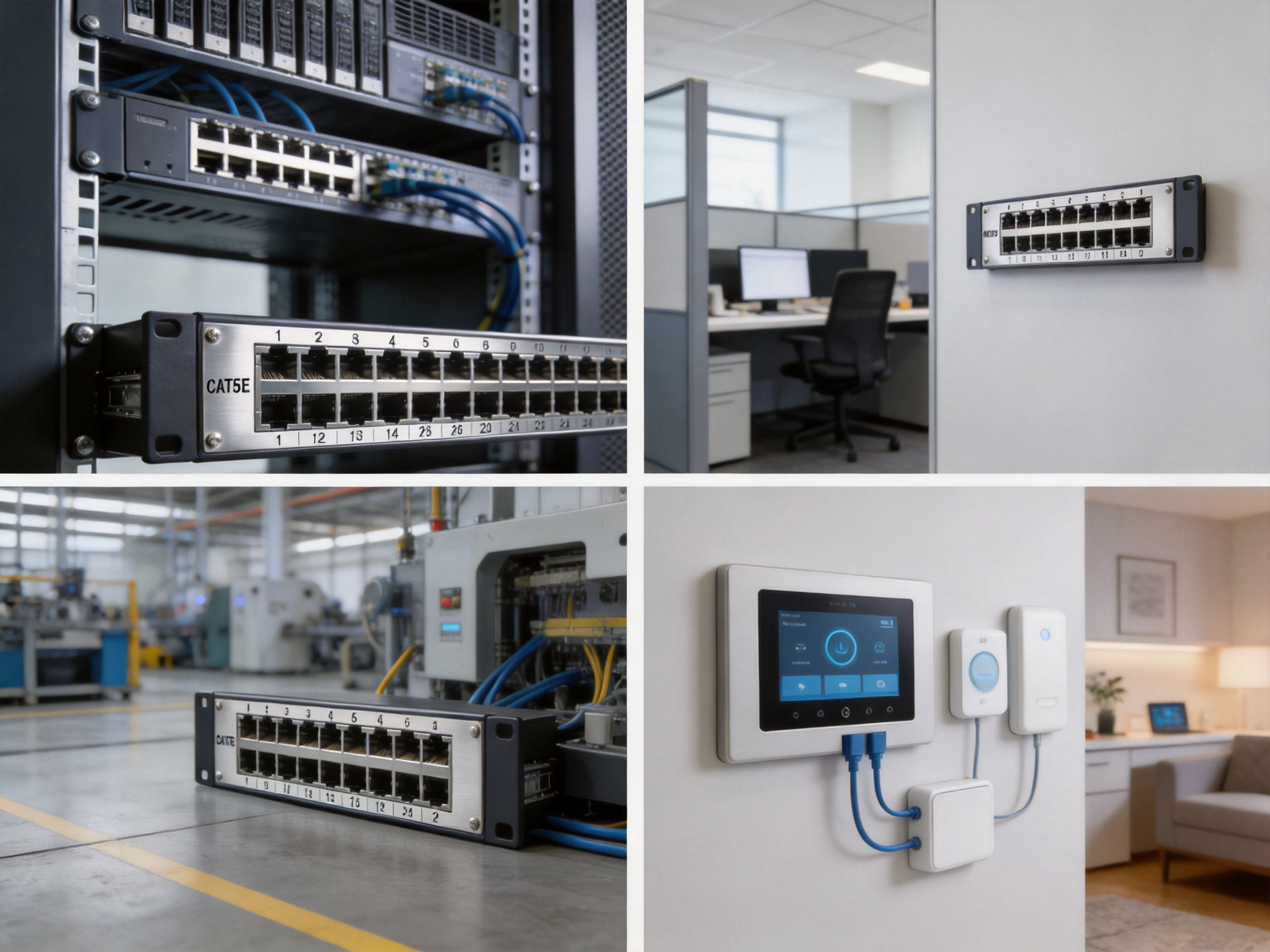
Data Centers: In data centers with dense network equipment, the shielded design prevents EMI from adjacent servers and switches, ensuring consistent 1 Gbps performance.
Office Buildings: For office environments with multiple workstations, the 24-port design and clear labeling simplify network management, while the shielded design reduces interference from office electronics (e.g., printers, copiers).
Industrial Settings: Industrial facilities often have high levels of electrical noise from machinery. The 360-degree shielding of this panel ensures reliable data transmission in these harsh environments.
Smart Homes: As smart home devices become more common, the patch panel provides a centralized hub for connecting IoT devices, ensuring stable connectivity and protecting against interference from household appliances.
Automation Equipment: In manufacturing plants with automation systems, the patch panel supports reliable communication between sensors, controllers, and other equipment, reducing downtime and improving efficiency.
Vertical Trunk & Horizontal Wiring Subsystems: The patch panel is designed to cross-connect vertical trunk lines and horizontal wiring subsystems, making it ideal for building-wide network infrastructure.
Q&A Section
To address common questions about the CAT5E shielded patch panel, here’s a detailed Q&A:
Q1: What is the maximum data transmission speed supported by this patch panel?
A1: The patch panel supports CAT5E standards, which enable data transmission speeds up to 1 Gbps at frequencies up to 250 MHz. This makes it suitable for most modern network applications, including video conferencing, cloud computing, and file transfers.
Q2: Does this patch panel comply with global environmental standards?
A2: Yes, the product meets ROHS standards (2011/65/EU), which restrict the use of hazardous substances like lead, mercury, and cadmium. This compliance makes it suitable for markets in the EU, US, and other regions with strict environmental regulations.
Q3: How long does the product’s storage period last?
A3: When stored in the recommended conditions (temperature -5°C to +30°C, relative humidity ≤70%, no corrosive gases), the product has a storage period of 3 years. This ensures that unused panels remain in good condition for future use.
Q4: Can the patch panel be used with Krone tools?
A4: Yes, the patch panel supports the Krone tool IDC wiring method, which is widely used in the network cabling industry. This compatibility means technicians do not need to purchase specialized tools, reducing operational costs.
Q5: What is the salt spray test duration for this product?
A5: The product undergoes a 48-hour salt spray test, which is longer than the minimum requirement for many industry standards. This ensures that the panel is resistant to corrosion, making it suitable for outdoor or coastal environments.
Q6: Does the company offer OEM/ODM services?
A6: Yes, the manufacturer provides OEM and ODM services, allowing customers to customize the patch panel’s design, labeling, or packaging to meet their specific needs. This flexibility is ideal for businesses looking to brand the product or adapt it to unique requirements.
Q7: What is the insertion force requirement for the patch panel’s connectors?
A7: The insertion force is ≤20 N, which ensures that patch cords can be inserted easily without requiring excessive force. The pull-out force is ≥20 N, ensuring that connections remain secure during use.
Q8: What materials are used for the patch panel’s bracket?
A8: The bracket is made of cold rolled steel with plastic spraying. This material is sturdy, corrosion-resistant, and able to withstand the weight of connected cables and equipment.
Conclusion
The CAT5E shielded patch panel represents a significant advancement in structured cabling technology, combining innovative features, superior performance, and rigorous quality control. Its 360-degree shielding, non-screw rear cover, clear labeling, and Krone tool compatibility set it apart from competitor solutions, making it an ideal choice for businesses and organizations seeking reliable, efficient network connectivity.
Backed by a manufacturer with advanced R&D capabilities, state-of-the-art production lines, and a commitment to quality, this patch panel meets the highest industry standards and is suitable for a wide range of application scenarios. Whether used in data centers, office buildings, industrial settings, or smart homes, it provides the reliability and performance needed to support modern network infrastructure.
References
1. YD/T 926.1-2009: General Specification for Telecommunication Cabling Systems (China Communications Industry Standard).
2. YD/T 926.3-2009: Sub-standard for Telecommunication Cabling Systems (Horizontal Wiring) (China Communications Industry Standard).
3. IEC 60603-7: Connectors for Telecommunications and Data Processing Equipment (International Electrotechnical Commission).
4. ROHS Directive 2011/65/EU: Restriction of Hazardous Substances in Electrical and Electronic Equipment (European Union).
5. ASTM B117: Standard Practice for Operating Salt Spray (Fog) Apparatus (American Society for Testing and Materials).