Español
 عربى
عربى русский
Content
- 1 Product Overview
- 2 Key Product Specifications
- 3 Category 6 Performance for Modern Networks
- 4 Installer-Friendly 90 Degree Termination
- 5 Material Quality and Contact Reliability
- 6 Mechanical Durability for Daily Network Operation
- 7 Electrical Safety and Insulation Performance
- 8 Environmental Compliance and Long-Term Stability
- 9 Compatibility and System Integration
- 10 Advantages Over Ordinary Competitor Products
- 11 Advanced Manufacturing Strength Behind the Product
- 12 Quality Control From Design to Delivery
- 13 Applications in Structured Cabling Projects
- 14 Why the 90 Degree Design Matters
- 15 Importance of T568A and T568B Support
- 16 Packaging, Storage, and Supply Reliability
- 17 OEM and ODM Value for Global Customers
- 18 Comparison With Lower-Grade Alternatives
- 19 Best Practices for Installation
- 20 Q&A Section
- 20.1 What is the main use of the 90 Degree Cat6 Keystone Jack 110 IDC?
- 20.2 Why is Category 6 performance important?
- 20.3 What is the benefit of the 90-degree design?
- 20.4 Does the jack support both T568A and T568B wiring?
- 20.5 Can this Cat6 keystone jack be used with Cat5e systems?
- 20.6 What cable sizes can the IDC terminal accept?
- 20.7 How durable is the RJ45 interface?
- 20.8 What materials are used in the product?
- 20.9 Is the product environmentally compliant?
- 20.10 What makes this product stronger than many competitor keystone jacks?
- 20.11 Can the product be used in modular patch panels?
- 20.12 Is customized packaging available?
- 21 Conclusion
- 22 References
- 23 Product: SMT-1013H8C6(B) 90 Degree Cat6 Keystone Jack 110 Idc
In modern buildings, data cabling is no longer a hidden utility that can be treated as an afterthought. It is a critical infrastructure layer supporting office networks, industrial automation, security systems, wireless access points, smart home applications, cloud-based services, and high-density communication environments. A single weak connection point can reduce channel performance, increase maintenance costs, and compromise the reliability of an entire network. For this reason, the quality of the keystone jack used at the work area outlet, patch panel, or modular distribution frame is essential.
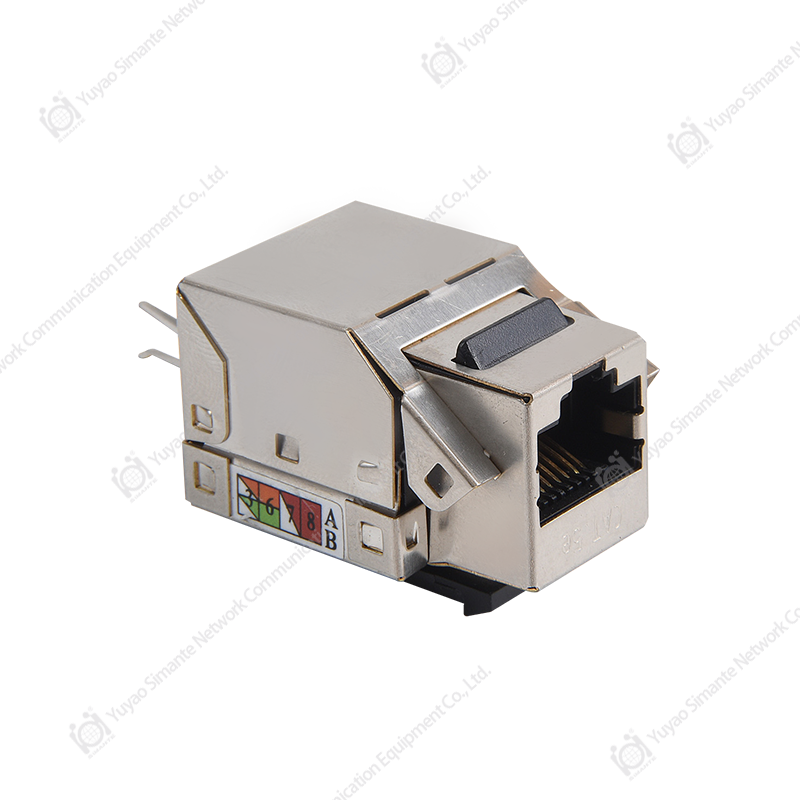
The SMT-1013H8C6(B) 90 Degree Cat6 Keystone Jack 110 IDC is designed for Category 6 copper structured cabling systems and provides a compact, standards-based, and installer-friendly termination solution. It supports transmission performance up to 250 MHz, follows T568A and T568B wiring sequences, and is engineered for stable electrical and mechanical performance in demanding communication environments. Its 90-degree termination structure, RJ45 interface, IDC connection system, clear wire sequence marking, and modular embedded design make it suitable for professional data cabling projects where accuracy, repeatability, and long-term dependability are required.
This product belongs to the copper system category and is used mainly in horizontal cabling and work area connection points. It connects horizontal twisted-pair cables with terminal equipment, patch cords, or adapter interfaces. In practical applications, it can be installed in faceplates, surface boxes, modular patch panels, and other structured cabling accessories. Its backward compatibility with Cat5e and lower categories also allows it to be used in renovation projects where old and new cabling components may coexist.
Compared with ordinary keystone jacks that may focus only on basic connectivity, this Cat6 keystone jack emphasizes signal integrity, installation efficiency, environmental compliance, durability, and manufacturing consistency. These advantages are especially important for contractors, distributors, system integrators, and OEM/ODM customers who need stable quality across large-volume deployments.
SMT-1013H8C6(B) 90 Degree Cat6 Keystone Jack 110 Idc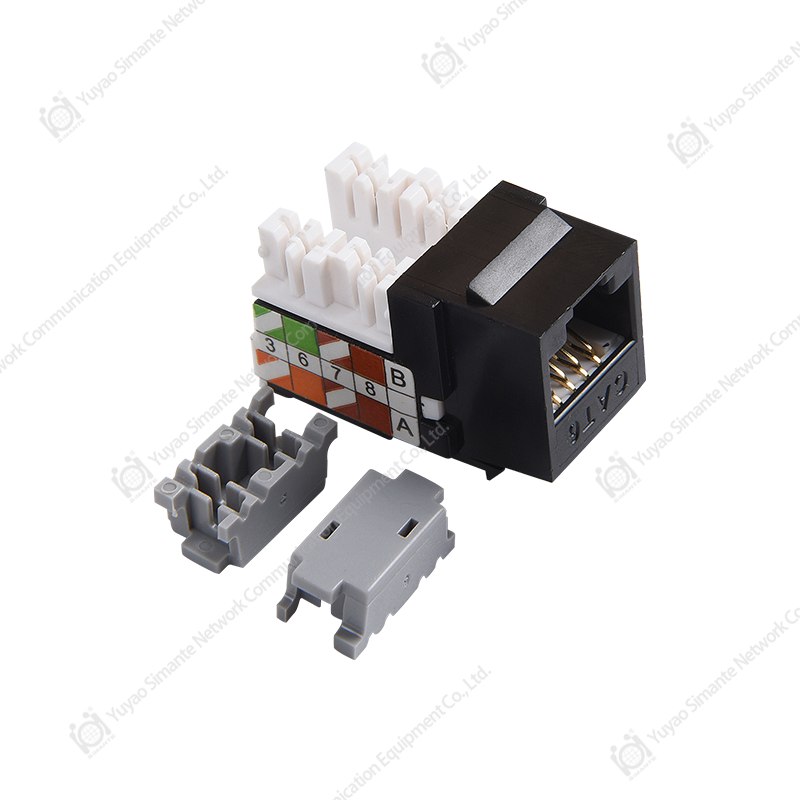
Product Overview
The SMT-1013H8C6(B) 90 Degree Cat6 Keystone Jack 110 IDC is a Category 6 RJ45 modular jack designed to meet the performance requirements of high-speed Ethernet and structured cabling systems. It is suitable for communication socket connections between equipment areas and work areas, especially in office buildings, data rooms, commercial facilities, residential smart cabling projects, educational institutions, and automation environments.
The product adopts an embedded modular design, allowing it to be installed into compatible distribution frames or faceplates. This modular concept gives installers flexibility because the same jack can be used in multiple installation scenarios. For example, it can be mounted in a wall outlet for end-user access, inserted into a patch panel to form a modular distribution frame, or used in customized cabling assemblies according to project needs.
The 90-degree structure is particularly useful where cable routing space is limited. In many installations, cable management behind a faceplate or inside a cabinet can be difficult when the cable exits straight from the rear. A 90-degree orientation helps the cable bend more naturally, reduces stress on the conductor pairs, and contributes to neater cable arrangement. This can improve both installation quality and long-term reliability.
Its termination method combines an RJ45 jack for patch cord connection with an IDC terminal for horizontal cabling. The IDC section accepts 23 to 26 AWG twisted-pair cables, which covers the common conductor sizes used in Category 6 and other copper structured cabling projects. The contact pins use high-low staggered technology, helping reduce near-end crosstalk and supporting stable signal transmission at higher frequencies.
Key Product Specifications
| Item | Specification | Practical Benefit |
|---|---|---|
| Product Type | 90 Degree Cat6 Keystone Jack 110 IDC | Suitable for work area outlets and modular patch panels |
| Transmission Category | Category 6 | Supports high-speed structured cabling up to 250 MHz |
| Wiring Sequence | T568A and T568B | Compatible with common international cabling practices |
| Frequency Range | 1 to 250 MHz | Meets Cat6 channel and permanent link requirements |
| Working Voltage | 125 V | Suitable for standard communication cabling use |
| Withstand Voltage | DC 1000 V or AC 750 V for 1 minute | Provides strong dielectric reliability without breakdown or arcing |
| Insulation Resistance | Initial value at least 100 MΩ | Helps maintain electrical isolation and signal quality |
| IDC Compatibility | 23 to 26 AWG twisted pair | Compatible with common horizontal copper cables |
| RJ45 Insertion Durability | 750 mating cycles | Supports repeated patch cord connection and disconnection |
| IDC Termination Durability | 250 terminations | Allows reliable field termination and service operations |
| Contact Material | Phosphor bronze with gold plating | Improves conductivity, corrosion resistance, and contact stability |
| IDC Terminal Material | Phosphor bronze with nickel plating | Ensures strong conductor grip and durable termination |
| Housing Material | PC polycarbonate | Provides mechanical strength and dimensional stability |
| PCB Material | FR4 | Supports stable electrical characteristics and reliable construction |
| Operating Temperature | -25°C to +70°C | Suitable for varied installation environments |
| Environmental Compliance | RoHS compliant | Meets modern environmental and material safety expectations |
Category 6 Performance for Modern Networks
Category 6 cabling is widely used because it offers a strong balance between performance, cost, and installation practicality. It is commonly deployed for Gigabit Ethernet and can support higher-speed applications over shorter distances when the full channel is properly designed. However, Category 6 performance is not determined by cable alone. Every component in the channel, including keystone jacks, patch panels, patch cords, and connectors, must maintain controlled impedance, minimize crosstalk, and preserve pair geometry.
The SMT-1013H8C6(B) supports a frequency range from 1 to 250 MHz, which aligns with Category 6 transmission requirements. The internal contact arrangement and PCB design help maintain signal balance and reduce performance degradation at the connection point. This is important because the connector interface is one of the most sensitive areas in a copper cabling link. Poor contact geometry, inconsistent plating, weak IDC grip, or inaccurate termination can create reflections, return loss problems, and near-end crosstalk.
The high-low dislocation technology used in the contact pins helps improve crosstalk performance by controlling the physical relationship between conductive paths. In high-frequency copper transmission, even small layout differences can affect signal quality. By engineering the contact system instead of relying on generic connector geometry, the product offers a practical performance advantage over lower-grade jacks that may pass basic continuity checks but fail to provide stable Cat6 margin in the field.
For contractors and network owners, this means fewer troubleshooting issues after installation. A cable run that passes certification on the first test saves labor, protects project schedules, and reduces the risk of callbacks. In large installations involving hundreds or thousands of ports, a reliable jack can make a significant difference in total project cost.
Installer-Friendly 90 Degree Termination
Installation efficiency is a major factor in structured cabling projects. A product may have excellent laboratory specifications, but if it is difficult to terminate consistently in the field, real-world performance can suffer. The 90 Degree Cat6 Keystone Jack 110 IDC is designed to make termination easier, faster, and more accurate.
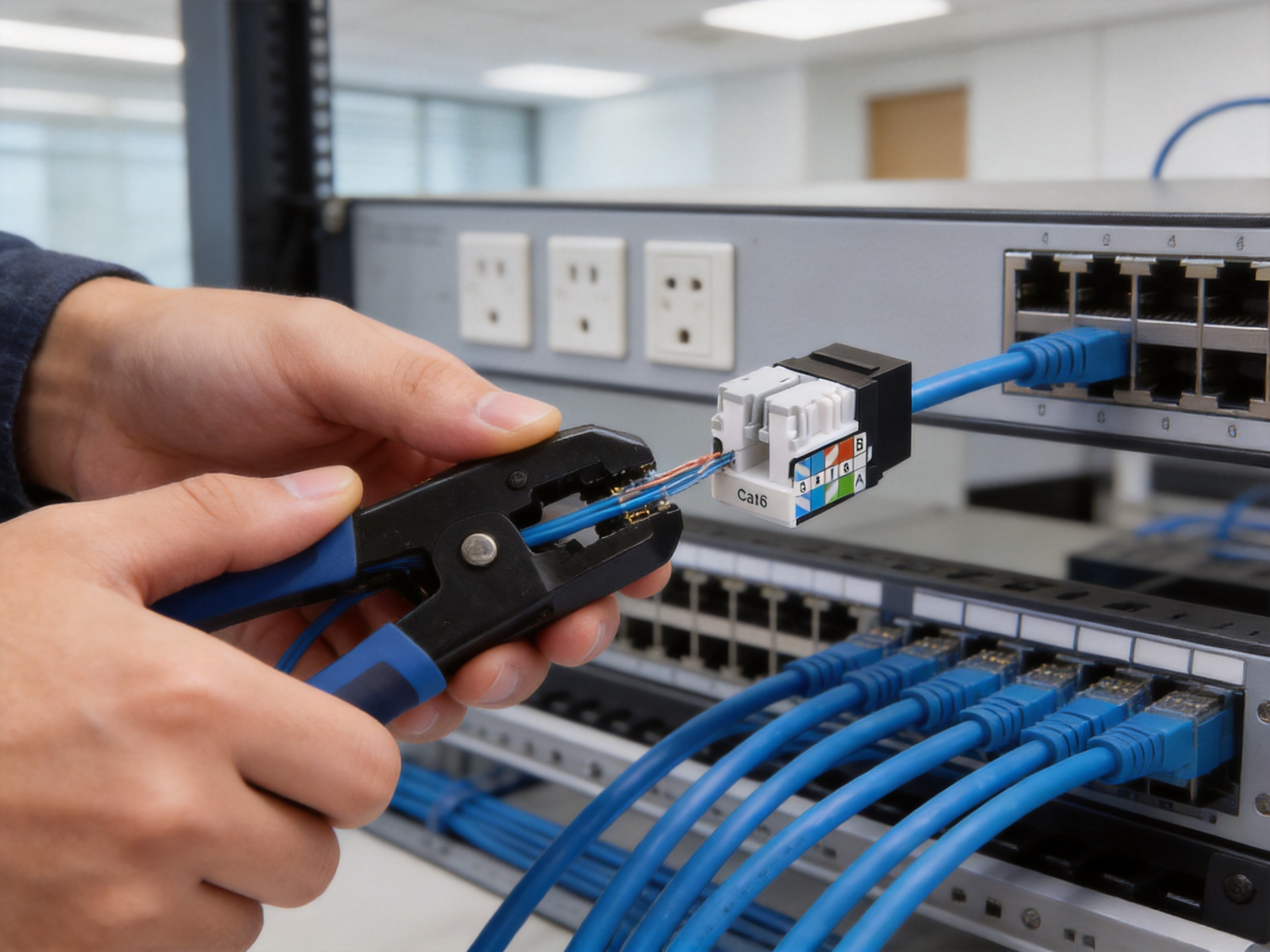
The compact housing is suitable for tight spaces, while the 90-degree cable entry helps installers manage cable bends behind wall plates, floor boxes, and patch panels. Cable bend radius is important because excessive bending or twisting can disturb pair geometry and degrade transmission performance. By supporting more natural cable routing, the product helps protect the integrity of the horizontal cable after termination.
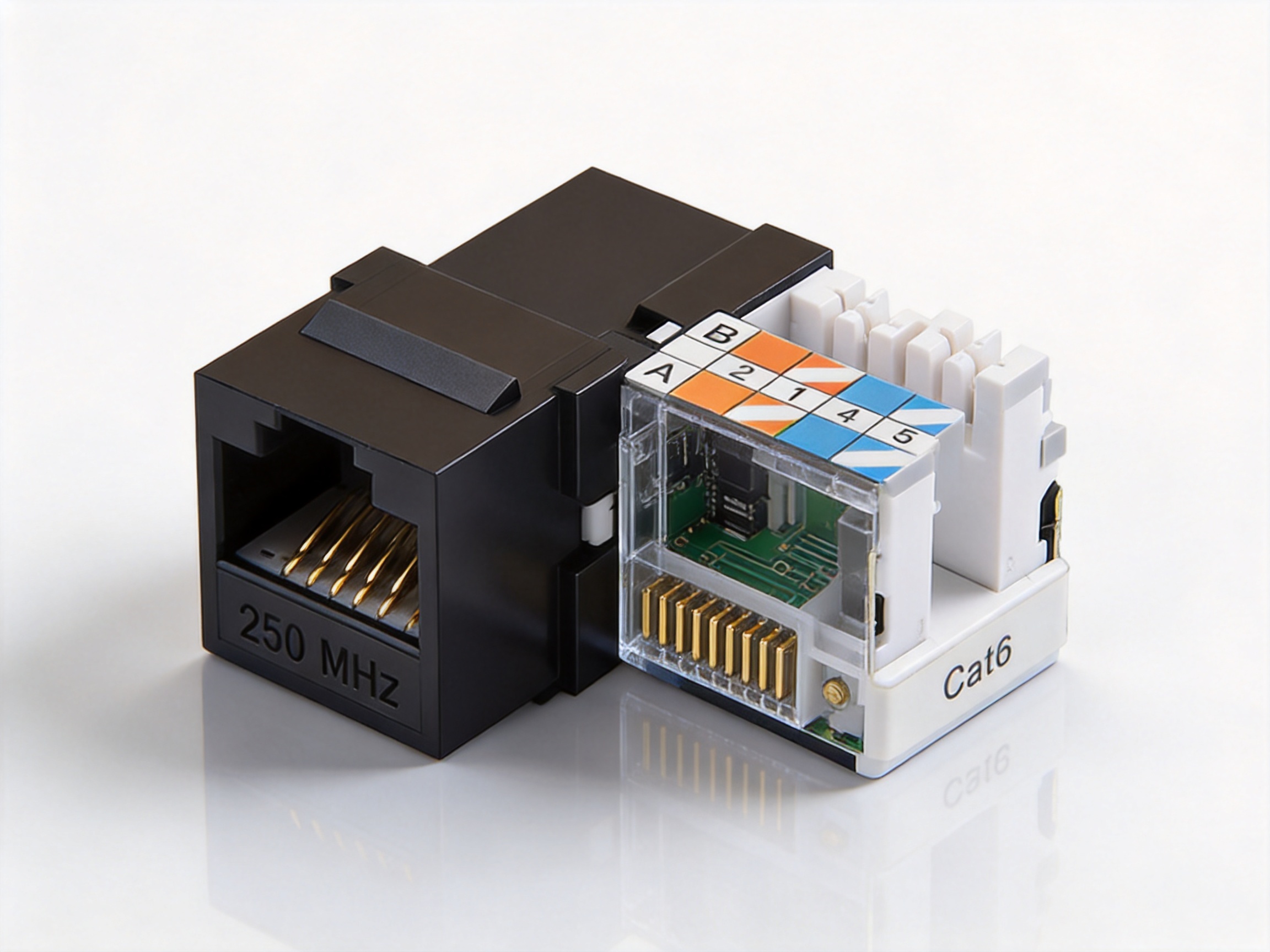
The universal wire sequence label is clearly marked on the module card wire area. This helps installers identify the correct conductor placement for both T568A and T568B wiring schemes. Clear labeling reduces termination errors, especially in projects where multiple technicians work simultaneously or where installation conditions are not ideal. Inaccurate wiring can lead to split pairs, reversed pairs, or failed certification tests. A visible and intuitive label is therefore not a minor detail; it is a quality feature that improves job-site reliability.
The 110 IDC termination style is familiar to professional installers and supports efficient punch-down operations. The IDC contact cuts through the conductor insulation and creates a gas-tight electrical connection with the copper conductor. A well-designed IDC terminal maintains strong mechanical grip while preserving electrical performance. The specified compatibility with 23 to 26 AWG twisted pair makes the jack suitable for a broad range of cable constructions used in commercial and residential cabling.
Material Quality and Contact Reliability
The long-term performance of a keystone jack depends heavily on material selection. The SMT-1013H8C6(B) uses phosphor bronze for the gold needle contacts and phosphor bronze with nickel plating for the IDC terminals. Phosphor bronze is valued in communication connectors because it combines electrical conductivity, elasticity, fatigue resistance, and corrosion resistance. These properties allow the contact springs to maintain stable pressure after repeated insertions and removals.
The RJ45 contact area is gold plated, with a gold plating thickness range of 3 to 50 microinches. Gold plating is used because it resists oxidation and provides a stable low-resistance interface. In network communication, unstable contact resistance can result in intermittent connections, packet loss, or inconsistent performance. A plated contact system improves reliability, especially in environments where ports are used frequently or exposed to variable humidity.
The IDC terminals use nickel-plated phosphor bronze. Nickel plating provides corrosion resistance and mechanical durability, while the phosphor bronze base maintains spring performance. This is important because IDC terminals must bite into the conductor and hold it securely over time. Loose conductor retention can cause signal intermittency or complete link failure, particularly if cables are moved during maintenance.
The plastic housing is made from PC polycarbonate. PC material is commonly chosen for network components because it offers good impact resistance, dimensional stability, and heat resistance. For modular jacks, dimensional stability is especially important because small deformation can affect fitment in faceplates or patch panels. A precise housing also helps maintain the alignment of the RJ45 plug interface and internal contacts.
The PCB is made from FR4, a widely used glass-reinforced epoxy laminate known for mechanical strength and stable electrical insulation. In a Cat6 connector, the PCB is not simply a structural part; it helps define the signal path. A stable PCB material supports consistent performance across production batches.
Mechanical Durability for Daily Network Operation
In many workplaces, network ports are not installed once and left untouched forever. Patch cords may be connected and removed during equipment changes, workstation moves, maintenance activities, network upgrades, and troubleshooting. The product is rated for 750 plug-and-socket insertion cycles, which provides a strong durability foundation for repeated use.
The insertion force is specified at not more than 20 N, while the pull-out force is not less than 20 N. This balance is important. If insertion force is too high, users may struggle to connect patch cords, and the jack or faceplate may be stressed. If pull-out force is too low, patch cords may disconnect too easily. The specified mechanical performance supports secure but practical connection.
The connector connection device can withstand 50 N for 60 ± 5 seconds, demonstrating mechanical robustness under applied force. This helps ensure that the jack can tolerate normal handling, installation pressure, and service conditions. In real projects, components may experience pulling, pushing, or accidental stress. A mechanically weak jack can crack, loosen, or fail, creating hidden risks after installation.
The IDC termination durability of 250 wire terminations is also valuable. While most ports are terminated once, field conditions sometimes require rework, testing, relocation, or maintenance. A terminal system with higher durability allows technicians to perform necessary service without immediately compromising the jack. This is an advantage over lower-cost connectors that may be intended only for single-use termination and become unreliable after rework.
Electrical Safety and Insulation Performance
Although structured cabling is primarily a low-voltage communication system, electrical safety and insulation performance remain important. The SMT-1013H8C6(B) has a working voltage of 125 V and withstands DC 1000 V or AC 750 V for one minute without breakdown or arcing. This dielectric strength indicates that the insulation system is robust and that the connector can maintain separation between conductive elements under test stress.
The insulation resistance has an initial value of at least 100 MΩ and remains at least 100 MΩ after constant damp heat testing. High insulation resistance helps prevent leakage currents and supports signal integrity. In humid environments, inferior materials may absorb moisture or allow insulation resistance to drop, which can affect performance. By maintaining insulation resistance after damp heat exposure, the product demonstrates better reliability under environmental stress.
These electrical characteristics provide confidence for installations in varied environments, including buildings with seasonal humidity changes, equipment rooms with heat accumulation, and work areas where ports may remain in use for many years. While a keystone jack is small, its electrical stability plays a major role in the overall link quality.
Environmental Compliance and Long-Term Stability
Modern procurement increasingly requires products to meet environmental and material safety standards. The SMT-1013H8C6(B) meets RoHS requirements, making it suitable for projects where restricted hazardous substances must be controlled. This is important for international distribution, public-sector projects, corporate sustainability policies, and OEM customers selling into regulated markets.
The product is designed for an operating temperature range from -25°C to +70°C and humidity conditions up to 85% at 85°C ± 3°C. This wide environmental range supports use in many indoor communication environments and some controlled industrial spaces. Network components may be installed in ceiling spaces, wall cavities, cabinets, or equipment rooms where temperature can vary significantly from normal office conditions. A wider tolerance range helps improve reliability.
The product also includes salt spray test considerations. The salt solution concentration, pH range, atomization conditions, and recommended duration of 48 hours reflect attention to corrosion resistance. While most keystone jacks are used indoors, corrosion resistance is still relevant in coastal regions, humid climates, industrial areas, or logistics environments where products may encounter moisture during storage and transportation.
Packaging and storage controls further protect product quality. The jacks are placed into special blister bags and then into cardboard boxes, with labels indicating model and quantity. Standard packing includes 10 boxes per carton, 50 pieces per box, and 500 pieces per carton. Storage conditions recommend an ambient temperature from -5°C to +30°C, relative humidity not more than 70%, and no acid, alkali, or corrosive gas in the surrounding air. A three-year storage period under appropriate conditions supports distributor inventory management and project planning.
Compatibility and System Integration
One of the strongest advantages of this Cat6 keystone jack is its compatibility with standard structured cabling designs. It supports both T568A and T568B wiring sequences, allowing it to fit the wiring policy used by the installer, consultant, or end customer. This flexibility is essential because regional practices and project specifications may differ. A jack that supports only one wiring method could create unnecessary limitations.
The product is backward compatible with Cat5e and lower categories of systems. This does not mean that it transforms lower-category cable into Cat6 cable, but it does mean it can physically and electrically support mixed environments where older cabling standards are present. For renovation projects, phased upgrades, or budget-controlled installations, backward compatibility can simplify inventory and reduce confusion.
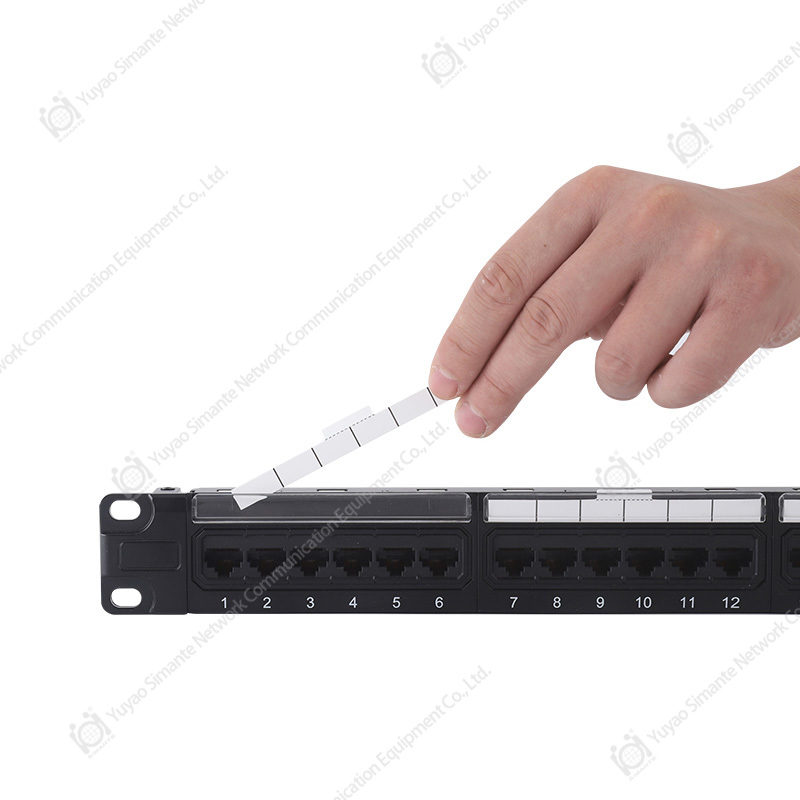
The embedded design allows the module to be installed on a distribution frame to form a modular distribution frame. Modular patch panels are popular because they allow installers to configure port counts, replace individual modules, and manage different connector types more flexibly. If a port is damaged or needs to be changed, a modular system can reduce repair time compared with a fixed integrated panel.
The inter-matching relationship recommends use with connectors of the same standard series. This is good cabling practice because components designed to the same category and standard are more likely to deliver consistent channel performance. In professional projects, using matched jacks, patch panels, and patch cords helps maintain performance margin and supports easier certification.
Advantages Over Ordinary Competitor Products
In a competitive market, many keystone jacks may look similar from the outside. However, meaningful differences appear in internal design, material quality, termination convenience, performance margin, and manufacturing consistency. The SMT-1013H8C6(B) provides several practical advantages over ordinary competitor products.
First, it uses a Category 6 design with a 1 to 250 MHz frequency range and high-low staggered contact technology to help reduce near-end crosstalk. Some low-cost jacks are built to resemble Cat6 components but may not provide stable performance under certification testing, especially when installed in large quantities. A jack engineered for signal integrity provides better assurance.
Second, the product combines a compact structure with 90-degree cable management. Straight-back connectors may create cable strain in shallow boxes or crowded patch panels. Excessive bending can reduce transmission quality and shorten service life. The 90-degree format gives installers a more practical routing option and improves the finished appearance of the installation.
Third, clear universal wire sequence labeling helps reduce field errors. In real-world installation, labor cost is often higher than component cost. A jack that helps technicians terminate correctly the first time can deliver financial value beyond its unit price. Reduced rework, fewer failed tests, and faster installation make the product more competitive for contractors.
Fourth, the use of phosphor bronze contacts, gold plating, nickel-plated IDC terminals, PC polycarbonate housing, and FR4 PCB materials demonstrates a balanced approach to durability and electrical reliability. Cheaper products may use lower-grade metals, thinner plating, less stable plastics, or inconsistent PCB materials. These shortcuts may not be visible immediately but can lead to premature failures.
Fifth, the product is supported by professional manufacturing capabilities, stable quality control, and large-scale production capacity. Consistency is a critical advantage. A sample may perform well, but large projects require thousands of pieces to perform uniformly. Manufacturing strength determines whether quality can be repeated batch after batch.
Advanced Manufacturing Strength Behind the Product
The manufacturer behind this product is a professional producer of network cabling solutions and optical fiber products, integrating design, development, sales, and service. With nearly 20 years of service experience, the company understands both product engineering and customer application requirements. This experience is reflected in the practical details of the keystone jack, from its termination structure to its material choices and packaging method.
The company maintains a mature research and development system, which helps guarantee quality stability from the design source. More than 10 engineers and over 30 full-time technical personnel contribute to product development, quality improvement, and product updates. This technical foundation is important because structured cabling components require more than simple molding and assembly. They require electrical design, material control, tooling accuracy, process discipline, and performance verification.
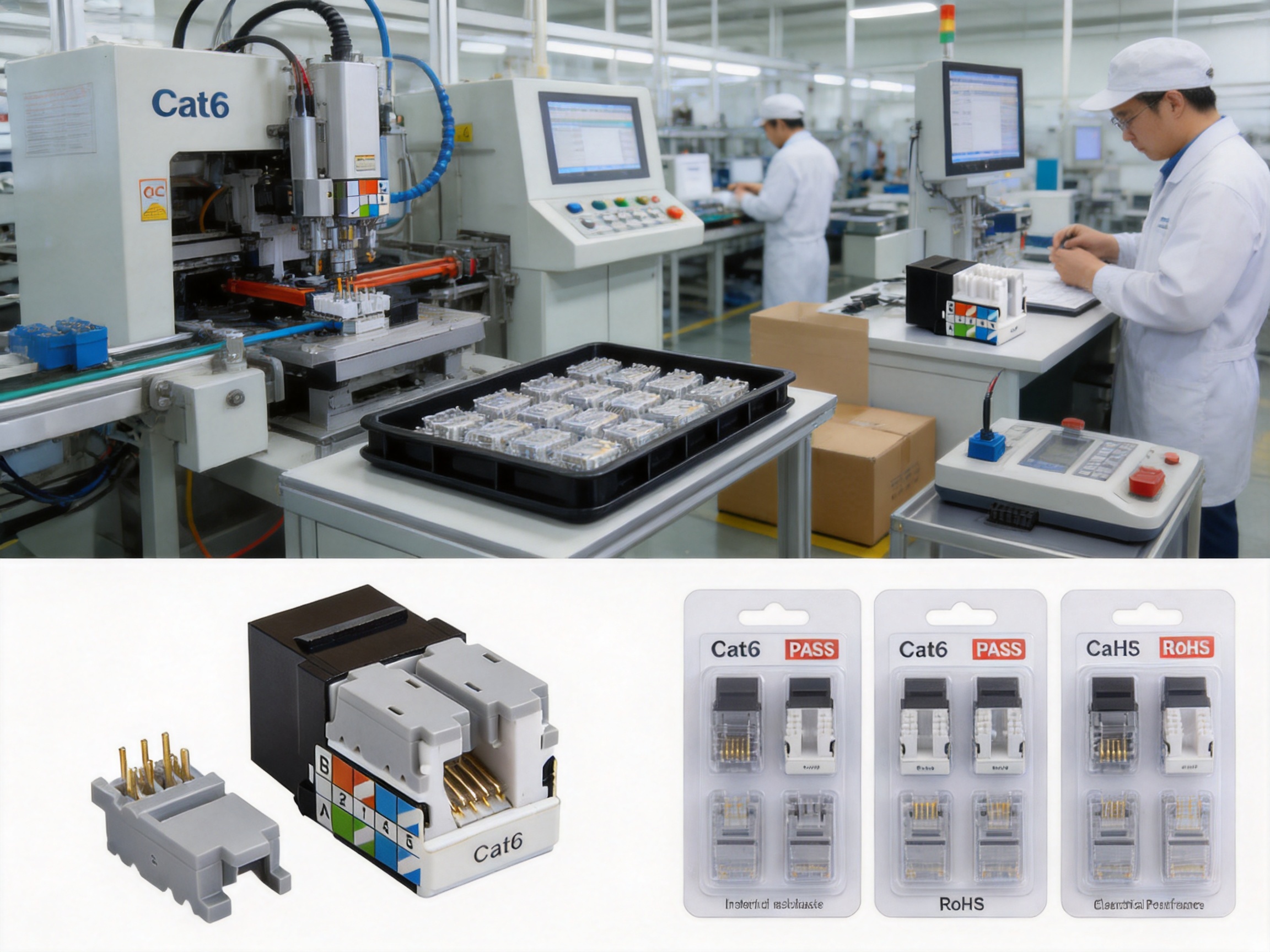
The factory has 10 regular and customized production lines, 10 fully automatic injection molding machines, 20 semi-automatic injection molding machines, and 8 automatic installation machines. These manufacturing resources support stable annual output of more than 9 million pieces. High output capacity benefits distributors and project buyers because it supports timely delivery, repeat orders, and large-scale project supply.
Automatic and semi-automatic manufacturing processes improve consistency. In connector production, dimensional tolerances, contact alignment, and assembly pressure must be carefully controlled. Manual variation can cause inconsistent performance. By using automatic installation machines and controlled molding processes, the company can reduce variation and improve repeatability.
The company also supports OEM and ODM projects, which is valuable for customers who require private labeling, customized packaging, special configurations, or project-specific product adjustments. Its experience in export markets, including Europe, Australia, Africa, the Middle East, and Southeast Asia, indicates familiarity with different customer expectations, quality requirements, and packaging practices.
Quality Control From Design to Delivery
Quality in a keystone jack begins before production. The product must be designed to comply with relevant structured cabling standards, including general and sub-standard specifications such as YD/T 926.1-2009 and YD/T 926.3-2009. Standards-based design helps ensure that the component can be used as part of a professional cabling system rather than functioning only as a simple connector.
During material selection, the manufacturer chooses metals and plastics suitable for communication applications. Phosphor bronze, gold plating, nickel plating, PC polycarbonate, and FR4 are not random choices; they are selected because they support electrical performance, mechanical durability, and environmental stability. Material consistency is essential for repeatable product quality.
Injection molding quality affects the fit and finish of the jack. If the plastic shell is warped, oversized, undersized, or brittle, it may not lock properly into faceplates or patch panels. The manufacturer’s injection molding capability enables better control over housing dimensions and surface quality. Automatic assembly further helps ensure that contacts, PCB components, and terminal parts are positioned correctly.
Performance testing is also important. Customers often require comprehensive testing for products, especially when buying for high-end markets. The manufacturer’s focus on good performance testing supports reliability expectations and helps maintain quality stability. In structured cabling, testing may include visual inspection, mechanical checks, contact reliability, insulation resistance, dielectric strength, and transmission-related performance verification.
Packaging control protects finished products during storage and shipment. The use of special blister bags, inner boxes, cartons, and model/quantity labels reduces handling damage and supports inventory accuracy. For international shipments and distributor stocking, reliable packaging is part of overall product quality.
Applications in Structured Cabling Projects
The SMT-1013H8C6(B) is suitable for a wide range of structured cabling environments. In commercial office buildings, it can be installed at work area outlets to connect computers, IP phones, printers, access points, and other network equipment. Its Cat6 performance supports the bandwidth requirements of modern workplaces where video conferencing, cloud applications, and large file transfers are common.
In data rooms and telecommunications rooms, the jack can be used with modular patch panels. Modular patching allows easier network management and future expansion. When ports are clearly arranged and reliably terminated, maintenance becomes faster and less error-prone.
In educational institutions, the product can support classrooms, laboratories, libraries, dormitories, and administrative networks. Schools and universities often require durable cabling components because ports may be used heavily and must withstand frequent changes in equipment layout.
In smart home and residential cabling systems, the compact 90-degree design is useful in wall boxes and distribution enclosures. As homes increasingly include smart TVs, wireless access points, surveillance cameras, home offices, and automation systems, reliable wired cabling remains valuable. A Cat6 keystone jack provides a future-ready connection point.
In industrial and automation equipment environments, stable communication infrastructure is necessary for control systems, monitoring, and connected devices. While environmental conditions should be considered carefully, the product’s operating temperature range and durable material design provide advantages in controlled industrial installations.
Why the 90 Degree Design Matters
At first glance, the angle of a keystone jack may seem like a simple mechanical preference. In practice, the 90-degree structure can influence cable management, installation speed, and long-term link stability. Horizontal cables should not be sharply bent, crushed, or forced into awkward positions after termination. When a cable is pushed into a shallow box behind a straight-back connector, pair deformation may occur near the termination point.
A 90-degree design helps direct the cable along a more controlled path. This reduces stress on the termination and can improve the neatness of the installation. Neater cable routing also makes future maintenance easier. Technicians can identify cables more quickly, avoid accidental pulling, and maintain better separation between cables when needed.
In patch panel applications, rear cable management is often crowded. A 90-degree termination may help organize cables along the rear management bar or routing direction. This is particularly useful in cabinets where depth is limited or where many cables enter from a specific side. Better routing reduces clutter and can improve airflow around active equipment.
Compared with competitor products that use bulkier housings or less flexible cable entry designs, this compact 90-degree jack can provide a cleaner installation experience. The benefit is not only aesthetic; it directly supports cabling best practices.
Importance of T568A and T568B Support
T568A and T568B are the two common wiring schemes used for RJ45 twisted-pair cabling. Both can support network performance when applied consistently throughout the channel. The choice may depend on regional standards, customer preference, existing infrastructure, or project specification.
The product’s support for both wiring sequences gives installers flexibility. This is valuable in mixed or renovation environments where existing ports may already use one scheme. It also helps distributors reduce inventory complexity because one jack can serve projects requiring either wiring method.
The clearly marked universal wiring label helps ensure that conductors are placed in the correct positions. This is especially important because twisted-pair color codes can be confused when cables are terminated quickly or under poor lighting conditions. A clear label reduces the chance of crossed wires and split pairs.
For project managers, fewer wiring errors mean fewer certification failures and fewer delays. For end users, correct wiring means more stable network performance. For installers, clear labeling means easier training and more consistent results across teams.
Packaging, Storage, and Supply Reliability
Professional cabling projects require predictable supply and secure packaging. The product is packaged in special blister bags, then placed into cardboard boxes with accessories. Labels indicating model and quantity are affixed to the carton, helping warehouses, distributors, and installers manage stock accurately.
The standard packing quantity is 50 pieces per box, 10 boxes per carton, and 500 pieces per carton. This packing method is convenient for project distribution. Installers can take a box to the job site without opening an entire carton, while distributors can calculate inventory by carton, box, or piece.
Recommended storage conditions include an ambient temperature from -5°C to +30°C, relative humidity not more than 70%, and air free from acid, alkali, and other corrosive gases. When stored properly, the product has a storage period of three years. These conditions help preserve metal plating, plastic housing quality, packaging integrity, and overall product readiness.
Supply reliability is strengthened by the manufacturer’s stable production capacity. With annual output exceeding 9 million pieces and multiple production lines, the company can support both standard orders and customized projects. For customers managing long-term programs, this capacity reduces the risk of supply interruption.
OEM and ODM Value for Global Customers
Many buyers in the networking industry require more than standard products. Distributors may need private branding, customized packaging, or market-specific documentation. System integrators may need consistent products across multiple projects. Equipment suppliers may need keystone jacks integrated into broader cabling kits. OEM and ODM support is therefore an important advantage.
The manufacturer’s experience with OEM and ODM projects allows customers to create customized solutions without building their own production infrastructure. This can include packaging specified by the customer, product labeling, color or accessory adjustments where feasible, and coordinated supply for regional markets. Such flexibility helps customers differentiate their offerings while relying on an experienced production base.
The company’s export experience in Europe, Australia, Africa, the Middle East, and Southeast Asia also supports global business needs. Different regions may have different expectations for documentation, packaging durability, labeling, and product consistency. A manufacturer familiar with export requirements can reduce communication friction and improve order execution.
For customers seeking a long-term supplier, technical capability and manufacturing scale are as important as price. A low price may be attractive for a single order, but long-term value comes from consistent quality, responsive service, stable delivery, and continuous product improvement. The company’s engineering team, technical personnel, production equipment, and testing focus provide this foundation.
Comparison With Lower-Grade Alternatives
Lower-grade keystone jacks may be acceptable for temporary or low-speed applications, but they can become a source of hidden cost in professional cabling systems. A poorly designed connector may pass a simple continuity test but fail Cat6 certification. It may have weak IDC contacts that loosen over time, inconsistent plastic molding that causes poor fitment, or inferior plating that oxidizes and increases contact resistance.
The SMT-1013H8C6(B) addresses these risks through a combination of design and manufacturing controls. Its Cat6 frequency support, high-low contact arrangement, clear labeling, durable contact materials, and controlled housing structure all contribute to field reliability. The product is not positioned merely as a commodity connector; it is a performance component within a structured cabling system.
Competitors may also lack sufficient production capacity or quality consistency. When products are sourced from unstable manufacturing environments, different batches may vary in fit, color, termination force, or test performance. This can create difficulties for distributors and installers. A manufacturer with established production lines and automated equipment is better positioned to deliver consistent batches.
Another advantage is the balance between performance and practicality. Some high-performance connectors may be expensive or difficult to terminate, while cheap connectors may be easy to buy but unreliable. This Cat6 keystone jack offers professional-grade features while remaining suitable for large-volume installation.
Best Practices for Installation
To obtain the best performance from the keystone jack, installers should follow structured cabling best practices. The cable jacket should be stripped carefully without damaging conductor insulation. Pair twists should be maintained as close as possible to the IDC termination point. Excessive untwisting can increase crosstalk and reduce performance margin.
The correct T568A or T568B wiring sequence should be selected according to the project specification and applied consistently across both ends of the link. Conductors should be seated firmly in the IDC slots using an appropriate punch-down tool. After termination, excess conductor ends should be trimmed cleanly if not automatically cut by the tool.
Cables should be routed without sharp bends, crushing, or excessive tension. The 90-degree design helps, but installers should still respect the cable manufacturer’s minimum bend radius. Cable ties should not be tightened so strongly that they deform the cable jacket or pair geometry.
After installation, each link should be tested according to the project’s required standard. Certification testing verifies performance parameters and helps identify termination errors before the network becomes operational. Using a reliable jack improves the likelihood of passing, but proper installation remains essential.
Q&A Section
What is the main use of the 90 Degree Cat6 Keystone Jack 110 IDC?
It is used to connect horizontal twisted-pair cabling with work area outlets, patch panels, distribution frames, or terminal equipment through an RJ45 interface. It is suitable for structured cabling systems in offices, data rooms, smart homes, schools, commercial buildings, and controlled industrial environments.
Why is Category 6 performance important?
Category 6 performance supports transmission frequencies up to 250 MHz and is widely used for high-speed Ethernet networks. A Cat6-rated jack helps preserve signal integrity and reduces problems such as crosstalk, return loss, and unstable connections when used as part of a properly installed Cat6 channel.
What is the benefit of the 90-degree design?
The 90-degree design helps route the cable more naturally in tight spaces, reducing stress on the termination point and improving cable management behind faceplates or patch panels. This can protect cable geometry and support cleaner installations.
Does the jack support both T568A and T568B wiring?
Yes. The jack supports both T568A and T568B wiring sequences, and the wire sequence label is clearly marked to help installers terminate accurately and quickly.
Can this Cat6 keystone jack be used with Cat5e systems?
Yes. It is backward compatible with Cat5e and lower-category systems. However, the final channel performance depends on all components in the link, including cable, patch cords, patch panels, and installation quality.
What cable sizes can the IDC terminal accept?
The IDC terminal is designed for 23 to 26 AWG twisted-pair cable, covering common conductor sizes used in structured copper cabling.
How durable is the RJ45 interface?
The plug-and-socket interface is rated for 750 insertion cycles, making it suitable for repeated patch cord connection and disconnection during normal network operation and maintenance.
What materials are used in the product?
The contact pins use phosphor bronze with gold plating, the IDC terminals use phosphor bronze with nickel plating, the housing uses PC polycarbonate, and the PCB uses FR4 material. These materials support durability, conductivity, corrosion resistance, and stable electrical performance.
Is the product environmentally compliant?
Yes. The product meets RoHS requirements, making it suitable for projects where environmental material control is required.
What makes this product stronger than many competitor keystone jacks?
Its advantages include Cat6 transmission support, high-low contact dislocation technology for reduced near-end crosstalk, compact 90-degree cable routing, clear wiring labels, durable plated contacts, strong IDC termination, reliable materials, and support from a manufacturer with advanced production equipment and large-scale quality-controlled output.
Can the product be used in modular patch panels?
Yes. Its embedded modular design allows installation on distribution frames to form modular patch panels, giving installers flexibility in system layout and maintenance.
Is customized packaging available?
The product information notes that customer-specified packaging can be supported. This is useful for OEM, ODM, distributor, and project-based supply requirements.
Conclusion
The SMT-1013H8C6(B) 90 Degree Cat6 Keystone Jack 110 IDC is a compact, reliable, and installation-friendly component for professional copper structured cabling systems. It supports Category 6 transmission requirements, follows both T568A and T568B wiring sequences, and provides backward compatibility with Cat5e and lower-category systems. Its 90-degree design improves cable routing, while the IDC termination system enables efficient connection to 23 to 26 AWG twisted-pair cables.
The product’s advantages come from a combination of engineering and manufacturing strength. High-low dislocated contact technology helps reduce near-end crosstalk, while phosphor bronze contacts, gold plating, nickel-plated IDC terminals, PC polycarbonate housing, and FR4 PCB material contribute to long-term reliability. Mechanical durability, insulation resistance, dielectric strength, RoHS compliance, and environmental tolerance further support professional deployment.
Behind the product is a manufacturer with nearly 20 years of experience in network cabling solutions and optical fiber products. With a mature R&D system, more than 10 engineers, over 30 full-time technical personnel, multiple production lines, automatic and semi-automatic injection molding equipment, automatic installation machines, and annual output exceeding 9 million pieces, the company can provide stable quality and reliable supply for global customers.
For contractors, distributors, OEM/ODM buyers, and network infrastructure planners, this Cat6 keystone jack offers more than basic connectivity. It provides a practical balance of performance, durability, installation efficiency, and manufacturing consistency. In structured cabling, every connection matters, and a dependable keystone jack is one of the simplest ways to improve the reliability of the entire network.
References
ANSI/TIA-568, Commercial Building Telecommunications Cabling Standard.
ISO/IEC 11801, Information Technology Generic Cabling for Customer Premises.
YD/T 926.1-2009, General Specification for Telecommunication Cabling Systems.
YD/T 926.3-2009, Sub-Specification for Telecommunication Cabling Components.
IEC 60603-7 Series, Connectors for Electronic Equipment and RJ45 Interface Requirements.
RoHS Directive, Restriction of Hazardous Substances in Electrical and Electronic Equipment.