Español
 عربى
عربى русский
Content
- 1 Product Overview
- 2 Key Technical Data
- 3 Why CAT6A Shielded Connectivity Matters
- 4 Toolless Termination as a Competitive Advantage
- 5 Shielding Design and EMC Protection
- 6 Electrical Reliability and Signal Integrity
- 7 Mechanical Durability for Real Installations
- 8 Material Selection and Surface Treatment
- 9 Environmental Performance and Storage Reliability
- 10 Application Scenarios
- 11 Advantages Over Conventional and Competing Products
- 12 Manufacturing Strength Behind the Product
- 13 Quality Control and Testing Philosophy
- 14 Integration with Structured Cabling Systems
- 15 Installation Considerations
- 16 Procurement Value for Distributors, Contractors, and OEM Customers
- 17 Company Capability and Global Service Perspective
- 18 Long-Term Cost Benefits
- 19 Recommended Use and Best Practices
- 20 Frequently Asked Questions
- 20.1 What is the main purpose of this CAT6A toolless shielded male connector?
- 20.2 Does the connector support both T568A and T568B wiring?
- 20.3 Why is the toolless design important?
- 20.4 What cable sizes can be used with the IDC terminal?
- 20.5 How does the 360-degree shielding shell improve performance?
- 20.6 Is the connector suitable for 10 Gigabit Ethernet?
- 20.7 What materials are used in the connector?
- 20.8 What is the rated durability of the connector?
- 20.9 Does the product meet environmental requirements?
- 20.10 Can the product be supplied for OEM or ODM projects?
- 21 Conclusion
- 22 References
- 23 Product: SMT-3012T8C6A-FTP CAT6A Toolless Shielded Male Connector
In modern network infrastructure, every termination point matters. A single connector can determine whether a cabling channel delivers stable 10 Gigabit Ethernet performance or becomes a hidden source of attenuation, crosstalk, electromagnetic interference, and service interruptions. The SMT-3012T8C6A-FTP CAT6A Toolless Shielded Male Connector is designed for professional structured cabling environments that require high transmission performance, fast installation, dependable shielding, and long-term mechanical durability. As networks expand into data centers, intelligent buildings, industrial control systems, security systems, smart homes, and automation environments, installers and system integrators increasingly need components that are not only compliant with Category 6A performance expectations but also practical in real field conditions.
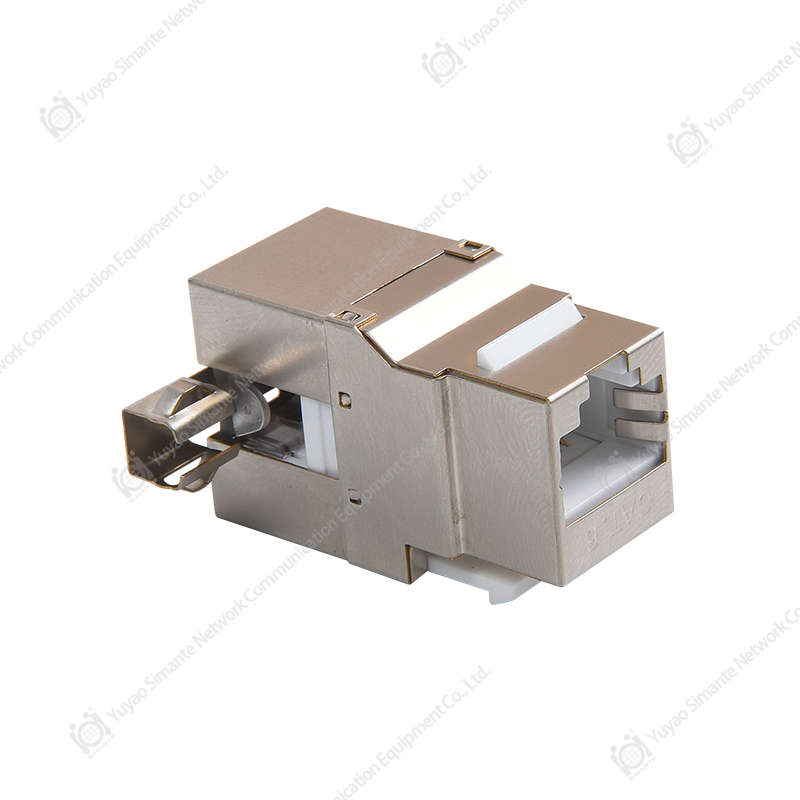
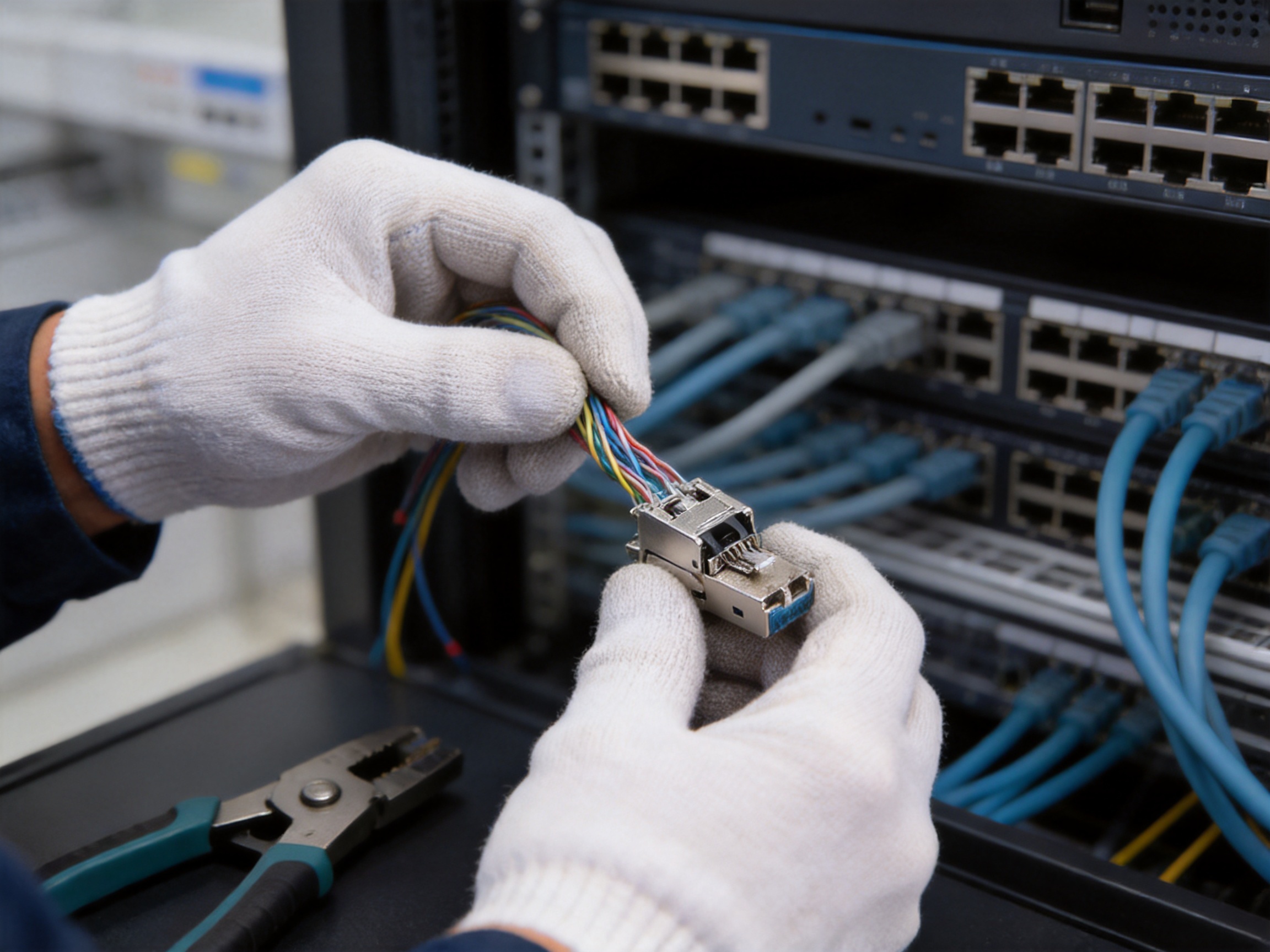
This product is a shielded CAT6A male connector engineered for copper structured cabling systems. It supports high-frequency transmission up to 500 MHz and is suitable for 10 Gigabit Ethernet cabling channels when used with compatible CAT6A shielded cables, patch panels, outlets, adapters, and network equipment. Its toolless termination structure helps reduce installation time, simplify on-site assembly, and improve termination consistency. The 360-degree shielding shell is designed to help control electromagnetic interference, while the compact structure supports clean cable routing in equipment rooms, cabinets, work areas, and cross-connection points.
Unlike conventional connectors that may require specialized crimping tools, excessive handling, or complicated assembly steps, this toolless shielded male connector is made for efficient field termination. It allows technicians to terminate compatible 23 to 26 AWG twisted-pair cables with a practical IDC clamping mechanism. The connector follows T568A and T568B wiring sequences, allowing integration into common structured cabling designs. Its clearly marked wiring identification supports accurate pair placement, helping reduce wiring errors that can lead to failed tests, rework, or unstable network links.
For buyers, distributors, contractors, and OEM customers, the value of a connector is not limited to electrical specifications. It also includes manufacturing consistency, material selection, production control, packaging reliability, and the ability of the supplier to support customized requirements. Yuyao Simante Network Communication Equipment Co., Ltd. brings nearly two decades of experience in network cabling solutions and optical fiber products, with mature design, development, production, testing, and service capabilities. The company’s structured manufacturing system, engineering team, injection molding capability, automated assembly equipment, and stable export experience strengthen the quality foundation behind this product.
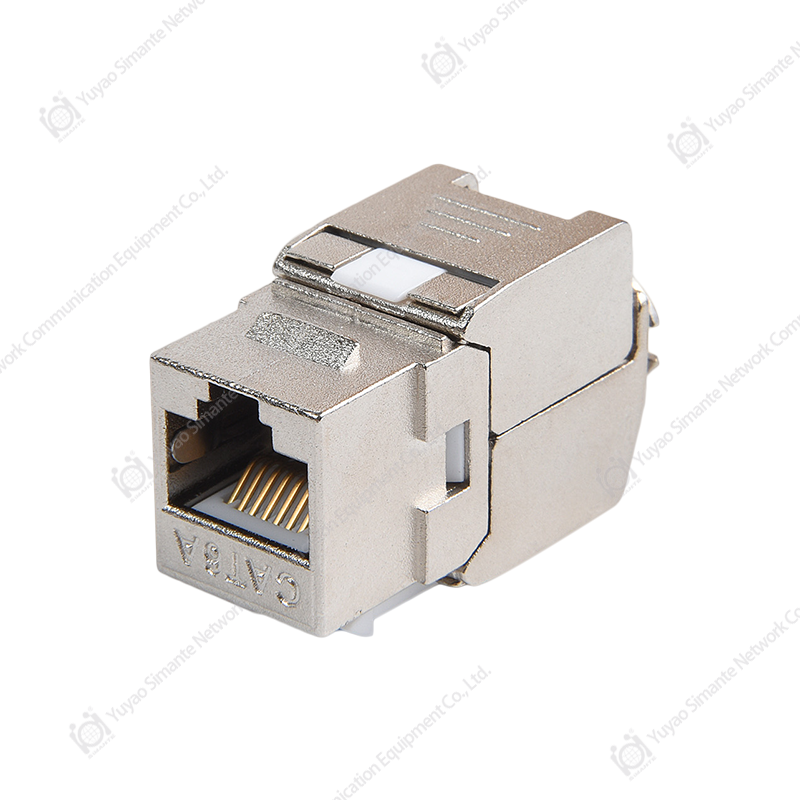
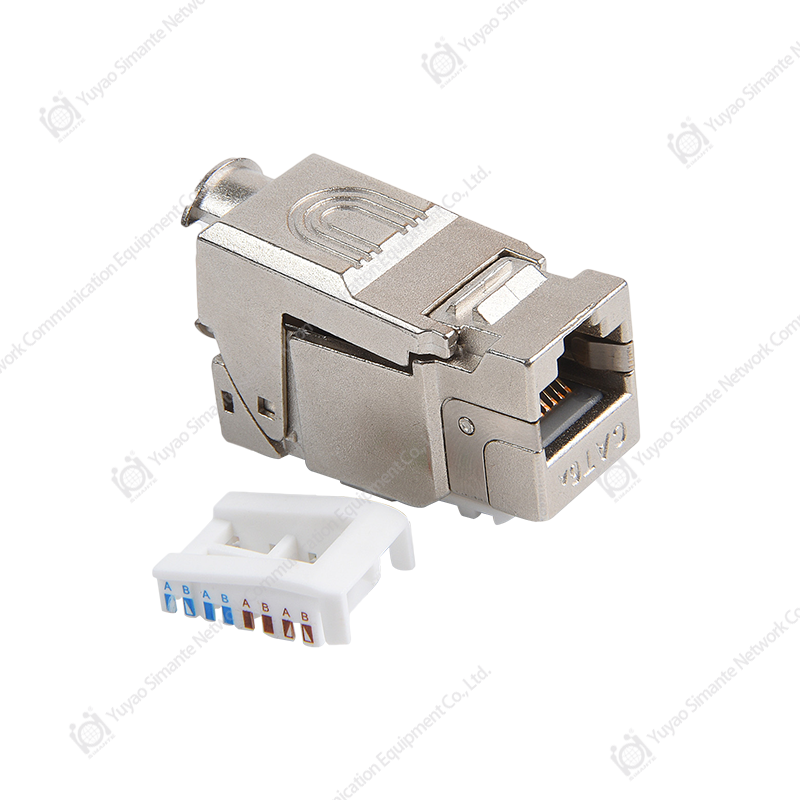
SMT-3012T8C6A-FTP CAT6A Toolless Shielded Male Connector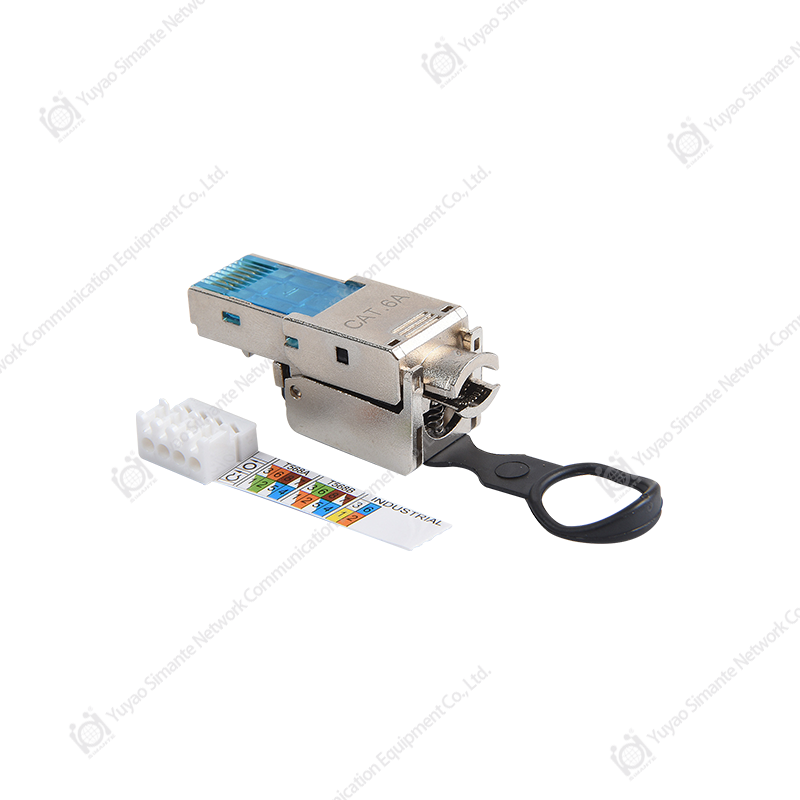
Product Overview
The SMT-3012T8C6A-FTP CAT6A Toolless Shielded Male Connector is intended for high-performance copper cabling applications where stable transmission and shielding integrity are essential. It belongs to the male connector category and is suitable for structured cabling systems used between equipment areas and work areas, as well as in horizontal cabling and cross-connection environments. Its compact shape makes it useful in installations where space is limited, while its shielded body helps protect signal integrity in electrically complex environments.
CAT6A cabling is widely used where networks require higher bandwidth, lower crosstalk, and better support for 10GBASE-T. Compared with lower-category components, CAT6A products must handle higher frequency ranges and tighter performance requirements. This connector is designed to meet Category 6A transmission needs and supports a frequency range of 1 to 500 MHz. When installed correctly with matching cables and components, it contributes to the stability and reliability of the complete channel.
The product is designed around tool-free termination. In field conditions, installers may need to complete many terminations in a short time. Traditional terminations can be slowed by tool dependency, inconsistent pressure, or complex assembly sequences. A toolless design can improve efficiency because the installer does not need to rely on a dedicated punch-down or crimping process for every termination. This helps reduce labor intensity and supports more standardized installation results.
The connector uses an RJ45 interface for equipment connection and an IDC structure for cable termination. The IDC terminal is suitable for 23 to 26 AWG twisted-pair cables, which makes it compatible with common copper cabling used in shielded CAT6A installations. The wiring sequence supports both T568A and T568B, giving installers flexibility based on project standards, customer requirements, or existing cabling layouts.
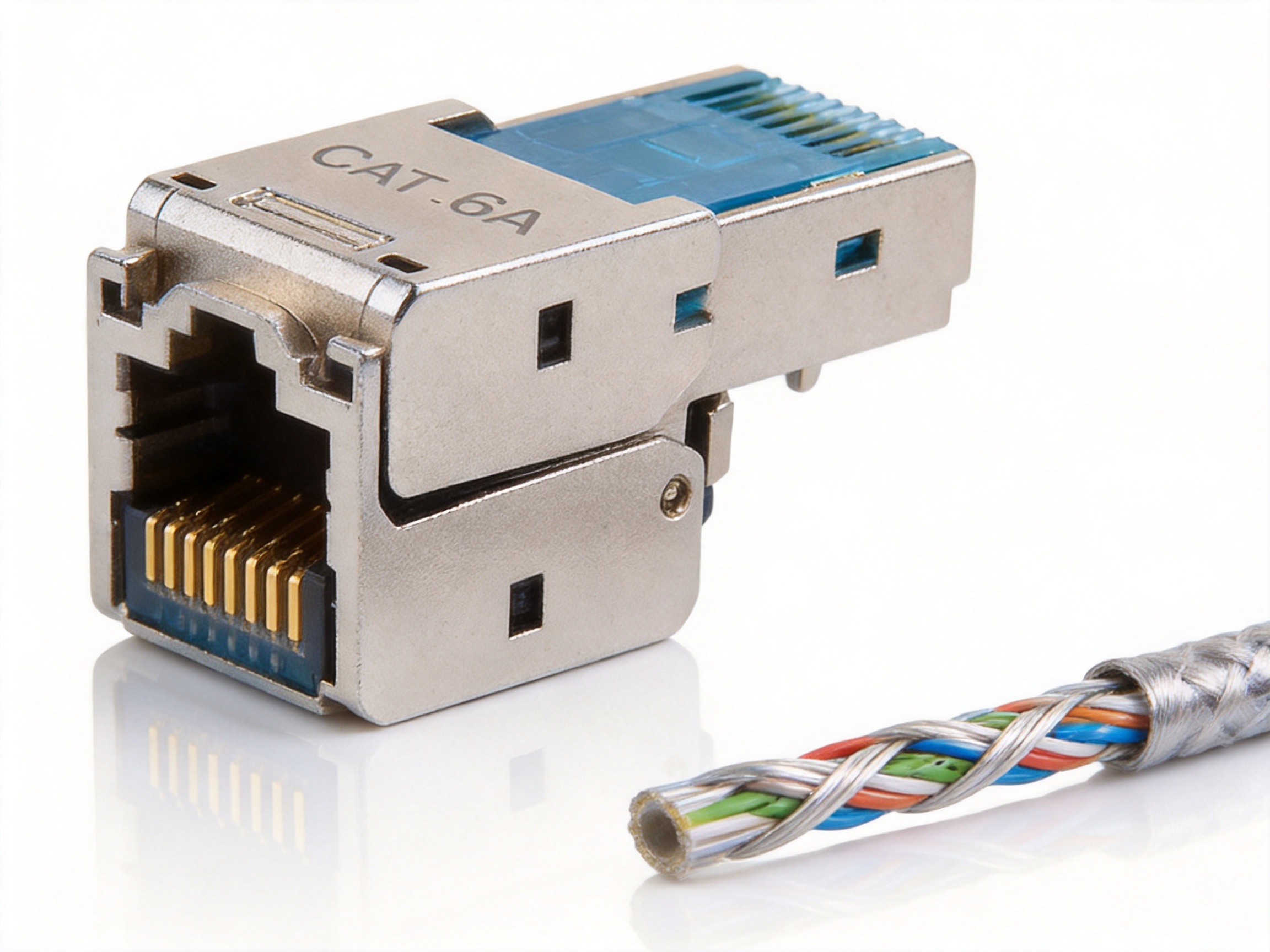
Another important feature is the all-round shielding shell. Electromagnetic compatibility is increasingly important because communication cables are often installed near power lines, control equipment, lighting systems, elevators, wireless devices, and industrial machinery. A 360-degree shielding design helps reduce external interference and helps maintain shield continuity when properly connected with shielded cable. The rear cover uses a non-screw fixing structure, making installation faster and reducing the risk of losing screws or applying uneven fastening pressure.
Key Technical Data
The following table summarizes core product features and performance parameters. These values are important for engineering evaluation, procurement comparison, and project specification.
| Item | Specification | Practical Value |
|---|---|---|
| Product Type | CAT6A toolless shielded male connector | Supports high-performance copper structured cabling applications |
| Transmission Category | Category 6A | Suitable for high-speed network channels including 10 Gigabit Ethernet applications when properly installed |
| Frequency Range | 1 to 500 MHz | Meets high-frequency requirements of CAT6A systems |
| Wiring Sequence | T568A and T568B | Flexible installation for different project standards |
| Termination Method | Toolless IDC termination | Improves installation speed and reduces tool dependency |
| Compatible Cable Size | 23 to 26 AWG twisted-pair cable | Works with common structured cabling cable sizes |
| Shielding | 360-degree shielded shell | Helps prevent electromagnetic interference and supports shield continuity |
| Working Voltage | 125 V | Supports typical communication cabling electrical requirements |
| Withstand Voltage | DC 1000 V or AC 750 V for 1 minute without breakdown or arcing | Indicates strong insulation safety margin |
| Insulation Resistance | Initial value at least 200 MΩ; after damp heat test at least 100 MΩ | Supports stable long-term electrical reliability |
| Plug and Socket Durability | 750 insertion cycles | Suitable for repeated equipment connection and maintenance |
| Wire Termination Durability | 250 termination cycles | Provides dependable mechanical performance during installation and service |
| Operating Temperature | -25°C to +70°C | Useful for diverse installation environments |
| Environmental Compliance | ROHS requirements | Supports responsible material control and international project expectations |
Why CAT6A Shielded Connectivity Matters
As enterprise networks carry more data, the performance margin of cabling infrastructure becomes increasingly important. Applications such as cloud access, video conferencing, IP surveillance, Wi-Fi access point backhaul, building automation, industrial monitoring, and edge computing can create high traffic density across copper networks. CAT6A cabling provides a strong balance between performance, cost, and deployment familiarity. However, CAT6A performance depends on every component in the channel, including connectors, cables, patch panels, outlets, and patch cords.
A weak connector can introduce impedance mismatch, poor pair geometry, excessive untwist, inadequate contact pressure, or incomplete shielding. These problems may not be obvious during visual inspection, but they can appear during certification testing or long-term network operation. Poor connectors can cause near-end crosstalk, return loss, intermittent disconnections, packet retransmission, or lower link stability. A properly engineered connector helps preserve pair alignment and contact reliability from the cable termination point to the RJ45 interface.
Shielding is especially important in environments with electromagnetic noise. In an office building, interference may come from lighting systems, power cables, elevators, air-conditioning equipment, or adjacent communication cables. In an industrial environment, interference may come from motors, inverters, welding equipment, programmable logic controllers, and power distribution systems. A shielded connector, when installed with shielded cable and properly bonded grounding practices, contributes to a more protected transmission path.
This CAT6A toolless shielded male connector is built for such environments. The metal shielding shell surrounds the connector structure to help reduce electromagnetic influence. The design supports 360-degree shielding coverage, which is more effective than partial shielding approaches because it minimizes weak points where interference could enter the signal path. For projects where reliability and compliance testing matter, this design offers a practical advantage.
Toolless Termination as a Competitive Advantage
One of the strongest advantages of this connector is its toolless termination design. Installation efficiency has a direct impact on project cost. In large cabling projects, technicians may terminate hundreds or thousands of cable ends. Any component that reduces time per termination while maintaining performance can produce significant labor savings. A toolless connector also reduces dependence on specialized crimping tools, which may vary in condition, calibration, or operator skill.
Traditional connectors often require several steps: preparing the cable, arranging the conductors, inserting them into a load bar, trimming them, inserting the assembly into a plug body, crimping the plug, and verifying the mechanical result. If the cable is shielded, additional steps may be required to position the foil, drain wire, or braid. Mistakes in any of these steps can reduce performance. A toolless IDC design simplifies the process by allowing the conductors to be seated and terminated through the connector’s built-in mechanism.
This simplification is valuable because field conditions are rarely ideal. Installers may work in crowded racks, above ceilings, under floors, inside wall boxes, or in industrial cabinets. Lighting may be limited, access may be restricted, and time pressure may be high. A connector that is easier to handle and faster to terminate reduces the chance of installation fatigue and wiring errors. The clearly marked color label for general line sequence further improves accuracy.
Compared with many competitor products, the toolless structure of this connector offers a practical combination of speed and reliability. Some low-cost field-termination plugs may save material cost but require more manual alignment or provide weaker shield closure. Others may perform well electrically but require more complex assembly. This product balances performance, shield design, mechanical durability, and installation convenience, making it suitable for professional use rather than only occasional repairs.
Shielding Design and EMC Protection
Electromagnetic compatibility, often called EMC, is a key consideration in modern cabling. The higher the frequency and data rate, the more sensitive the system becomes to installation quality and external noise. CAT6A systems operating up to 500 MHz need stable pair geometry, reliable contact interfaces, and effective shielding where shielded systems are specified. A connector with incomplete shielding can become a weak point in an otherwise shielded channel.
The SMT-3012T8C6A-FTP uses a 360-degree all-round shielding shell. This design helps prevent electromagnetic interference from entering the connector area and helps reduce the possibility of signal leakage. In shielded cabling, continuity between cable shield and connector shield is essential. The connector’s metal shell helps create a consistent protective path when installed correctly with compatible shielded cable and appropriate grounding practices.
The rear cover uses a non-screw design. This is not merely a convenience feature; it also supports installation consistency. Screw-based designs can be over-tightened, under-tightened, or assembled unevenly. Small screws may be lost at the job site, and repeated installation can damage threads. A non-screw fixing structure can improve speed and reduce mechanical variability. For installers working inside racks or cabinets, this is a meaningful advantage.
The use of quality metal and plated contact materials also contributes to shielding and electrical performance. The gold needle is brass with gold plating, while the IDC terminal uses nickel-plated phosphor bronze. These material choices support electrical conductivity, corrosion resistance, contact elasticity, and long-term reliability. The connector also uses engineering plastics such as PC polycarbonate and PBT, selected for mechanical strength, dimensional stability, and suitability for communication components.
Electrical Reliability and Signal Integrity
Electrical performance is at the center of connector value. The product is designed for a frequency range of 1 to 500 MHz, matching CAT6A requirements. Its working voltage is 125 V, and its withstand voltage reaches DC 1000 V or AC 750 V for one minute without breakdown or arcing. These specifications indicate that the connector is built with a strong insulation structure and suitable material separation.
Insulation resistance is another important indicator. The connector offers an initial insulation resistance of at least 200 MΩ, and after a constant damp heat test, insulation resistance remains at least 100 MΩ. This matters because network components may be installed in environments where humidity changes over time. Good insulation resistance helps reduce leakage current and supports stable transmission performance.
Near-end crosstalk attenuation is specified at at least 2.5 dB. Crosstalk control depends on internal geometry, pair arrangement, termination quality, and the interaction between cable and connector. In high-speed Ethernet applications, crosstalk is one of the most important performance risks. Poor conductor alignment or excessive pair untwist can degrade transmission quality. The connector’s structured termination system helps maintain more controlled termination behavior than improvised or low-grade connector designs.
Insertion and pull-out force are also important for network reliability. The insertion force is not more than 20 N, and the pull-out force is not less than 20 N. This means the connector is designed to be easy enough to insert while still maintaining a secure connection. The connection device can withstand 50 N for 60 ± 5 seconds, supporting dependable mechanical retention. These values matter in environments where cables may be moved, serviced, or exposed to vibration.
Mechanical Durability for Real Installations
A connector is not useful if it performs well only in a laboratory but fails in the field. Real installations involve handling, bending, insertion, removal, maintenance, and environmental stress. This product is designed with practical durability in mind. The plug and socket insertion durability is rated for 750 cycles, which supports repeated connection and disconnection during equipment upgrades, maintenance, or testing. The wire termination durability is rated for 250 cycles, indicating a strong IDC structure.
The connector’s mechanical construction combines metal support, plated contact components, and high-performance plastics. Brass gold-plated contacts help maintain stable electrical contact over repeated insertion cycles. Phosphor bronze IDC terminals provide spring properties and reliable conductor clamping. PC and PBT plastic materials support strength, heat resistance, and dimensional stability. FR4 PCB material contributes to structural and electrical stability within the connector assembly.
Low-cost competitor connectors may use thinner metal, less consistent plating, weaker plastic, or simplified shell structures. These shortcuts can reduce immediate cost but often increase long-term failure risk. A connector used in a structured cabling system should remain stable for many years. Replacing a failed connector inside a ceiling, wall, cabinet, or production line can cost far more than the initial price difference. A durable connector is therefore a better total-cost choice.
The compact shape of this connector is another mechanical advantage. Cabling density continues to increase in cabinets and equipment rooms. Bulky connectors can make cable management difficult, block neighboring ports, or create stress at the connection point. A compact toolless shielded connector helps maintain neat routing and reduces physical conflict in dense installations.
Material Selection and Surface Treatment
The performance of a connector depends greatly on material selection. This product uses a combination of metal and non-metallic materials selected for communication performance, mechanical life, and environmental resistance. The bracket is made from cold-rolled steel with plastic spraying, offering strength and corrosion protection. The gold needle is made from brass with gold plating, supporting conductivity and oxidation resistance. The IDC wire terminal is nickel-plated phosphor bronze, suitable for reliable conductor contact and repeated mechanical stress.
Gold plating thickness is specified in the range of 3 to 50 microinches, depending on configuration or requirement. Gold plating is important because RJ45 contacts are repeatedly inserted and removed, and contact surfaces must resist oxidation. Better plating helps maintain stable contact resistance over time. In professional networks, stable contact resistance supports lower signal loss and fewer intermittent faults.
The non-metallic materials include PC polycarbonate and PBT. PC provides strong impact resistance and dimensional stability, while PBT is commonly used in electrical components because of its mechanical strength, heat resistance, and insulation properties. The PCB material is FR4, a widely used glass-reinforced epoxy laminate known for stable electrical and mechanical behavior.
Surface treatment is not only cosmetic. It affects corrosion resistance, contact reliability, and product life. The product’s salt spray test conditions define a controlled evaluation using sodium chloride solution at a concentration of 5 ± 0.1 percent, pH value between 6.5 and 7.2 before atomization, and a recommended continuous atomization duration of 48 hours. These environmental tests help evaluate resistance to corrosive influence, especially for products used in humid or coastal regions.
Environmental Performance and Storage Reliability
The product is designed for an operating temperature range from -25°C to +70°C. This range supports use in many indoor network environments and some demanding installation locations. Relative humidity performance is specified at not more than 85 percent under stated temperature conditions. These characteristics are important for installations in regions with seasonal humidity changes, equipment rooms with variable climate control, or buildings where cabling pathways pass through different environmental zones.
ROHS compliance is also noted. For international customers, environmental compliance is no longer optional. Many public projects, enterprise procurement programs, and regional regulations require components that restrict hazardous substances. ROHS compliance helps buyers integrate this connector into projects with environmental and regulatory expectations.
Packaging and storage are part of product reliability. The connector is packaged in a special blister bag and then placed into a cardboard box with accessories. Labels indicate the product model and quantity. Regular packing is ten boxes per carton, one piece per box, and ten pieces per carton. Proper packaging protects the product from damage during transportation and storage, while clear labeling supports warehouse management and distribution accuracy.
Storage conditions are specified as an ambient temperature from -5°C to +30°C, relative humidity not more than 70 percent, and air free from corrosive gases such as acid or alkali. The storage period is three years under suitable conditions. These details show that the product is considered not only as an electrical component but also as a supply-chain item that must remain reliable from factory to installation site.
Application Scenarios
This CAT6A toolless shielded male connector can be used in many structured cabling scenarios. In equipment rooms, it can support connection between network equipment, patching components, adapters, and shielded horizontal cabling. In work areas, it can be used where field-terminated shielded male connectors are needed for direct equipment connection. In intelligent buildings, it can support network links for wireless access points, IP cameras, access control devices, building automation controllers, and data terminals.
In data-intensive offices, the connector helps support high-speed desktop and backbone links. As more organizations move to cloud-based applications and high-definition communication, network access points must handle more bandwidth. CAT6A cabling provides room for growth, and reliable connectors help protect that investment.
In industrial environments, shielded connectors are especially valuable. Factories may contain high levels of electrical noise from motors, variable-frequency drives, robotics, welding machines, and control cabinets. A shielded connector helps improve link stability when used as part of a properly designed shielded cabling system. The product’s mechanical strength and durable materials also support demanding conditions.
In security and surveillance systems, stable data transmission is essential. IP cameras, especially high-resolution models, can generate large volumes of video traffic. Network instability can cause frame loss, recording gaps, or delayed monitoring. A CAT6A shielded connector can help maintain reliable transmission for camera networks, particularly in electrically noisy or long-route installations.
In smart home and automation systems, cabling infrastructure must support a growing number of connected devices. Reliable connectors reduce troubleshooting and maintenance. Because the toolless design is easier to install, it is also suitable for customized installation projects where technicians must adapt to site-specific cable lengths and equipment layouts.
Advantages Over Conventional and Competing Products
The first major advantage is installation speed. Toolless termination can reduce the time required for each connector compared with conventional crimping or punch-down processes. In competitive tendering, installation labor is a major cost factor. A connector that supports faster and more consistent termination can help contractors complete projects efficiently and reduce rework.
The second advantage is shielding integrity. Some competing connectors claim shielded performance but rely on partial metal coverage or weak contact between the cable shield and connector shell. This product uses a 360-degree shielding shell design intended to help prevent EMC interference. In demanding networks, shielding continuity can be the difference between a certified channel and a problematic one.
The third advantage is mechanical reliability. With 750 insertion cycles and 250 wire termination cycles, the connector is designed for repeated use and maintenance. Low-grade connectors may loosen, deform, or lose contact quality after repeated handling. This product uses brass gold-plated contacts, nickel-plated phosphor bronze IDC terminals, engineering plastics, and FR4 material to support stable mechanical and electrical behavior.
The fourth advantage is compatibility with common installation standards. Support for T568A and T568B wiring sequences makes the connector adaptable to different regional and project requirements. Compatibility with 23 to 26 AWG twisted-pair cables makes it suitable for many shielded copper cabling installations.
The fifth advantage is environmental consideration. ROHS compliance, salt spray evaluation, damp heat insulation resistance, and defined storage conditions demonstrate a more complete quality approach. Buyers increasingly want products that are stable not only at delivery but throughout transportation, warehousing, installation, and operation.
The sixth advantage is manufacturing support. The product is backed by an experienced manufacturer with strong production capacity, engineering resources, testing capabilities, and OEM or ODM service experience. Competitors may sell similar-looking connectors, but consistent production quality depends on tooling control, material verification, process discipline, and testing systems. These factors are especially important for distributors and project buyers who need repeatable quality across large orders.
Manufacturing Strength Behind the Product
Yuyao Simante Network Communication Equipment Co., Ltd. is a professional manufacturer of network cabling solutions and optical fiber products. The company integrates design, development, sales, and service, providing a complete support system for structured cabling customers. With nearly twenty years of industry service, the company has accumulated practical knowledge in copper cabling, optical fiber components, product customization, export requirements, and customer project support.
The company’s manufacturing strength begins with research and development. More than ten engineers and more than thirty full-time technical personnel contribute to product design, quality improvement, process optimization, and product updates. This technical team helps ensure that product quality is considered from the design stage rather than corrected only after mass production. For a connector, small design details such as conductor path, shell fit, contact pressure, latch structure, and plastic tolerance can strongly affect performance. Engineering involvement is therefore essential.
Production capacity is another important advantage. The factory operates ten regular and customized production lines, ten fully automatic injection molding machines, twenty semi-automatic injection molding machines, and eight sets of automatic assembly equipment. This manufacturing base supports stable annual output of more than nine million pieces. Large and stable capacity is important for customers who require consistent supply, batch delivery, or customized packaging.
Injection molding capability is especially relevant to connector quality. Plastic parts in an RJ45 connector must maintain tight dimensional tolerances. If the plastic body is too loose, contacts may shift or shielding may not close correctly. If it is too tight, assembly may become difficult or conductors may be damaged. Fully automatic and semi-automatic injection molding equipment allows the company to control plastic part production and respond to different product models and customization needs.
Automated assembly equipment also improves consistency. Manual assembly can introduce variation in contact positioning, shell closing, or component alignment. Automation helps stabilize repetitive operations and supports higher production efficiency. Combined with skilled technical personnel and quality inspection, automated processes contribute to more reliable mass production.
Quality Control and Testing Philosophy
A high-performance connector requires more than a good design. It requires controlled materials, accurate tooling, stable molding, careful assembly, and meaningful testing. The company emphasizes quality stability from the design source and maintains high requirements for product quality because it serves high-end markets. This approach is important for CAT6A components, where minor inconsistencies can affect transmission performance.
Quality control begins with material selection. Metal parts must meet conductivity, elasticity, and plating requirements. Plastic materials must provide proper insulation, strength, and heat resistance. PCB material must maintain stable properties. Incoming material inspection helps prevent poor-quality raw materials from entering production.
Process control follows. Injection molding must maintain temperature, pressure, cooling, and dimensional stability. Contact forming and plating must be controlled. Assembly must ensure that each part is positioned correctly. Toolless connector mechanisms must open, close, and clamp conductors reliably. Shielding shells must fit properly and maintain intended contact paths.
Testing completes the quality loop. Electrical tests evaluate insulation resistance, withstand voltage, and signal behavior. Mechanical tests evaluate insertion force, pull-out force, connection device strength, plug durability, and termination durability. Environmental tests such as damp heat and salt spray evaluate reliability under stress. These tests help confirm that the product can perform beyond simple visual appearance.
For customers, this quality system reduces risk. A connector that looks acceptable but lacks stable testing can cause field failures. A properly tested connector gives distributors, installers, and end users greater confidence. When products are installed in walls, ceilings, cabinets, or mission-critical networks, reliable quality matters much more than the lowest unit price.
Integration with Structured Cabling Systems
This connector is part of a larger structured cabling system. It should be used with compatible CAT6A shielded cables, patch panels, keystone jacks, adapters, and patch cords. The user material notes that it is used with connectors of the same standard series. This matching relationship is important because channel performance depends on the entire link, not one part alone.
Structured cabling normally includes entrance facilities, equipment rooms, backbone cabling, telecommunications rooms, horizontal cabling, consolidation points, work-area outlets, and patching hardware. A shielded male connector may be used where direct equipment connection or field termination is required. Its compatibility with T568A and T568B makes it suitable for both new installation and retrofit work.
In a horizontal wiring subsystem, the connector can help connect cable runs to devices or intermediate hardware. In an equipment connection scenario, it can support connection to switches, routers, servers, media converters, industrial Ethernet devices, or adapters. In cross-connection hubs, it can support flexible wiring arrangements when used with the appropriate mating products.
Installers should still follow best practices. Cable preparation should avoid excessive untwist of pairs. Shielded cable should be prepared so the shield makes proper contact with the connector shell. Bend radius should be respected. The connector should be matched with the cable type and diameter. Grounding and bonding should follow the project’s shielded cabling design. Certification testing should be performed for professional installations.
Installation Considerations
Although the connector is toolless, correct installation technique remains important. The installer should first confirm the cable category, conductor size, shield type, and wiring sequence. The cable jacket should be stripped carefully without damaging insulation or shield layers. Pair twist should be preserved as close as possible to the termination point. Conductors should be arranged according to the selected T568A or T568B sequence.
The IDC structure should clamp the conductors firmly. Correct conductor seating is essential for stable contact. The rear shielding cover should be closed properly so that the shielded shell provides full coverage. Because the rear cover is non-screw, installation is faster, but the installer should still verify that the cover is fully locked. After assembly, the connector should be visually inspected for conductor alignment, shell closure, latch function, and cable strain relief.
Network testing is recommended after installation. At minimum, continuity and wire map testing should be performed. For professional CAT6A projects, certification testing should evaluate parameters such as insertion loss, return loss, near-end crosstalk, power sum crosstalk, propagation delay, delay skew, and alien crosstalk where applicable. A quality connector contributes to these results, but installation quality and cable matching are equally important.
The connector’s compact shape helps in dense areas, but cable management should still avoid excessive tension. The pull-out force specification indicates mechanical retention, but cables should not be used to support equipment weight or be pulled sharply. Proper cable routing, labeling, and strain relief support long-term system reliability.

Procurement Value for Distributors, Contractors, and OEM Customers
For distributors, the product offers a combination of technical performance and market practicality. CAT6A shielded connectivity continues to grow in demand as customers upgrade from CAT5e and CAT6 systems. A toolless shielded male connector is a useful item for project installers, maintenance teams, and customized network deployments. Clear specifications, reliable packaging, and manufacturer support make it easier to promote and supply.
For contractors, the main value is installation efficiency and reduced rework. Toolless termination saves time, and clear wiring labels help reduce mistakes. Mechanical durability and shielding design support successful testing and customer satisfaction. In competitive projects, contractors need components that are easy to install but still meet performance expectations. This connector is designed for that balance.
For OEM and ODM customers, the manufacturer’s customization capabilities are important. The company undertakes OEM and ODM projects and has regular and customized production lines. Customer-specified packaging is available according to product use marking requirements. This flexibility helps brands, system integrators, and regional suppliers create product offerings suited to their markets.
For end users, the benefit is long-term reliability. A network cabling system is expected to operate for years. Stable connectors reduce maintenance, support high-speed data transmission, and help future-proof infrastructure. CAT6A performance provides bandwidth headroom, while shielding helps protect against interference. The toolless design also makes maintenance or field modification more convenient.
Company Capability and Global Service Perspective
Yuyao Simante Network Communication Equipment Co., Ltd. has served the network communication industry for nearly twenty years. Its main products include keystone jacks, patch panels, wall face plates, data sockets, and other structured cabling components. These products are widely used in structured cabling, network communication, smart home, automation equipment, and related fields. This broad product range gives the company system-level understanding rather than isolated component knowledge.
The company maintains stable export volume in Europe, Australia, Africa, the Middle East, and Southeast Asia. Export experience matters because international customers often have different standards, packaging expectations, documentation needs, and quality requirements. A manufacturer with broad export activity is more familiar with project communication, product consistency, and after-sales service expectations.
The company’s service philosophy focuses on meeting customer needs through expertise and creating value from the beginning of online communication. This is important for technical products because customers may need help selecting the right connector, matching components, evaluating specifications, or arranging customized production. Responsive technical communication can reduce procurement uncertainty and improve project outcomes.
With a mature development system, quality control practices, production equipment, and experienced personnel, the company supports both standard and customized requirements. In a market where many products look similar from the outside, manufacturing depth becomes a key differentiator. Customers who choose this CAT6A toolless shielded male connector are not only purchasing a connector; they are also relying on a production system designed to deliver consistent structured cabling components.
Long-Term Cost Benefits
The initial price of a connector is only one part of total cost. A low-cost connector that causes failed certification, unstable transmission, or premature replacement can become expensive quickly. Labor for troubleshooting, retesting, and replacing connectors may exceed the cost of the component. In business networks, downtime can also affect productivity, security, and service quality.
This connector helps reduce long-term cost in several ways. Toolless termination saves installation time. Clear wiring identification reduces wiring errors. Shielding improves resistance to electromagnetic interference. Durable contacts and terminals support longer service life. Quality packaging protects products before installation. Manufacturer testing reduces the risk of hidden defects.
For project owners, investing in reliable CAT6A components helps protect the cabling infrastructure for future bandwidth needs. Many buildings keep structured cabling in place for years, even as switches, routers, servers, and endpoint devices are upgraded. A cabling system built with stronger connectors is better prepared for future network demands.
For installers, a dependable connector improves professional reputation. When a project passes testing smoothly and operates reliably, customers trust the installer. Components that are easy to terminate and stable in performance help contractors complete work efficiently and build repeat business.
Recommended Use and Best Practices
To obtain the best performance from this connector, users should select compatible CAT6A shielded twisted-pair cable within the recommended 23 to 26 AWG range. The selected cable should match the project’s shielding type and performance target. Installers should follow either T568A or T568B consistently throughout the link unless a specific crossover or special wiring arrangement is required.
During cable preparation, the installer should avoid nicking conductors or damaging insulation. Pair twist should be maintained close to the IDC termination point. The shield should be positioned to make proper contact with the connector shell. The rear cover should be fully locked. After termination, the connector should be tested before final installation whenever possible.
In shielded systems, grounding and bonding must be considered carefully. Shielding is most effective when the entire system is designed correctly. The connector provides the shielded structure, but the cable, patch panel, equipment, rack, and grounding system all contribute to EMC performance. Installers should follow applicable standards and project design instructions.
Products should be stored according to the recommended conditions before installation. Keeping connectors away from corrosive gases, excessive humidity, and unsuitable temperatures helps preserve material quality. Packaging should remain intact until use to prevent dust, contamination, or mechanical damage.
Frequently Asked Questions
What is the main purpose of this CAT6A toolless shielded male connector?
The connector is used for high-performance copper structured cabling systems where a shielded CAT6A male RJ45 connection is required. It is suitable for field termination, equipment connection, work-area connection, and integration with compatible structured cabling components.
Does the connector support both T568A and T568B wiring?
Yes. The connector supports both T568A and T568B wiring sequences. This allows installers to follow the wiring standard required by the project or existing cabling system.
Why is the toolless design important?
The toolless design helps reduce installation time, minimize dependence on special termination tools, and improve consistency in field installation. It is especially useful in projects with many terminations or limited working space.
What cable sizes can be used with the IDC terminal?
The IDC terminal is designed to clamp 23 to 26 AWG twisted-pair cables. Users should confirm cable compatibility before installation, especially when using shielded CAT6A cables with different jacket diameters or conductor structures.
How does the 360-degree shielding shell improve performance?
The all-round shielding shell helps reduce electromagnetic interference and supports shield continuity when used with compatible shielded cable and proper grounding. This is valuable in electrically noisy environments and high-speed network applications.
Is the connector suitable for 10 Gigabit Ethernet?
The connector is designed to meet Category 6A transmission requirements up to 500 MHz. When used with compatible CAT6A shielded cable and components, and when installed correctly, it is suitable for cabling channels intended for 10 Gigabit Ethernet applications.
What materials are used in the connector?
The connector uses materials such as brass gold-plated contacts, nickel-plated phosphor bronze IDC terminals, cold-rolled steel components with protective surface treatment, PC polycarbonate, PBT, and FR4 PCB material. These materials support electrical performance, mechanical durability, and environmental stability.
What is the rated durability of the connector?
The plug and socket insertion durability is rated at 750 cycles, and the wire termination durability is rated at 250 cycles. These values support repeated connection, service, and installation activities.
Does the product meet environmental requirements?
Yes. The product is specified to meet ROHS requirements. It also includes environmental performance considerations such as damp heat insulation resistance and salt spray test conditions.
Can the product be supplied for OEM or ODM projects?
Yes. The manufacturer supports OEM and ODM projects and has regular and customized production lines. Customer-specified packaging can also be supported according to project requirements.
Conclusion
The SMT-3012T8C6A-FTP CAT6A Toolless Shielded Male Connector is a practical and high-performance solution for modern copper structured cabling systems. It combines CAT6A transmission capability, 500 MHz frequency support, toolless IDC termination, 360-degree shielding, durable materials, and field-friendly installation. These features make it suitable for professional network environments where speed, reliability, and shielding performance are essential.
Its advantages over many competing products are clear. The toolless design improves installation efficiency. The shielding shell supports EMC protection. The material system enhances mechanical and electrical life. The connector supports both T568A and T568B wiring and accommodates 23 to 26 AWG twisted-pair cables. Its durability ratings, insulation resistance, withstand voltage, and environmental specifications show a product designed for real-world structured cabling demands.
Behind the product is a manufacturer with nearly twenty years of experience, strong engineering capability, injection molding capacity, automatic assembly equipment, quality testing practices, and international export experience. For distributors, contractors, OEM customers, and end users, this combination of product performance and manufacturing strength offers a reliable choice for high-speed shielded network cabling projects.
As data networks continue to grow in speed and complexity, the importance of dependable cabling components will only increase. A connector may be small, but its role in the network is significant. Choosing a well-designed CAT6A toolless shielded male connector helps protect performance, reduce installation effort, and support stable connectivity for the future.
References
1. ISO/IEC 11801, Information Technology Generic Cabling for Customer Premises.
2. ANSI/TIA-568, Commercial Building Telecommunications Cabling Standard.
3. IEEE 802.3an, 10GBASE-T Ethernet Standard.
4. YD/T 926.1-2009, General Specification for Communication Cabling Systems.
5. YD/T 926.3-2009, Sub-standard for Communication Cabling Components.
6. IEC 60603-7 Series, Connectors for Electronic Equipment and RJ45 Interface Requirements.
7. ROHS Directive Technical Guidance for Restricted Substances in Electrical and Electronic Equipment.