Español
 عربى
عربى русский
Content
- 1 1. Product Overview: Key Features and Core Capabilities
- 2 2. Competitive Advantages: Outperforming Market Alternatives
- 3 3. Manufacturing Excellence: Behind the Product’s Quality
- 4 4. Technical Deep Dive: Specifications and Performance Metrics
- 5 5. Application Scenarios: Versatility Across Industries
- 6 6. Q&A Section: Addressing Common User Questions
- 6.1 Q1: What is the frequency range of the patch panel?
- 6.2 Q2: Does it support both T568A and T568B wiring standards?
- 6.3 Q3: What is the maximum number of times the RJ45 connectors can be inserted?
- 6.4 Q4: Is the product compliant with ROHS standards?
- 6.5 Q5: What materials are used for the gold needles?
- 6.6 Q6: How should the product be stored?
- 6.7 Q7: Does the panel come with a cable manager?
- 6.8 Q8: What is the applicable standard for this patch panel?
- 7 7. Comparative Analysis: SMT-2034K24C6 vs. Competitor Models
- 8 8. Conclusion
- 9 References
As global data traffic continues to surge—driven by cloud computing, IoT adoption, and remote work—structured cabling systems have become the backbone of modern digital infrastructure. At the core of these systems lies the patch panel, a critical component that organizes and connects network cables, ensuring seamless data transmission. Among the latest innovations in this space is the 1U24 Port 180 Degree CAT6 UTP Patch Panel, a product designed to address key gaps in current market offerings: superior signal integrity, ease of installation, robust durability, and compliance with global standards. This article explores the product’s technical specifications, competitive advantages, the manufacturing excellence behind it, and its real-world applications.
1. Product Overview: Key Features and Core Capabilities
The 1U24 Port 180 Degree CAT6 UTP Patch Panel is engineered to meet the demands of high-performance network environments. Its design prioritizes functionality, reliability, and user-friendliness, with features tailored to simplify installation and maintenance while optimizing signal quality.
At its core, the panel adheres to CAT6 transmission standards, supporting a frequency range of 1–250 MHz—ideal for 10Gbps Ethernet and future-proofing against emerging technologies. It is compatible with both T568A and T568B wiring sequences, allowing flexibility for different network setups. The 19-inch rack-mountable form factor fits standard equipment racks, cabinets, and wall mounts, making it suitable for data centers, office buildings, and industrial facilities alike.
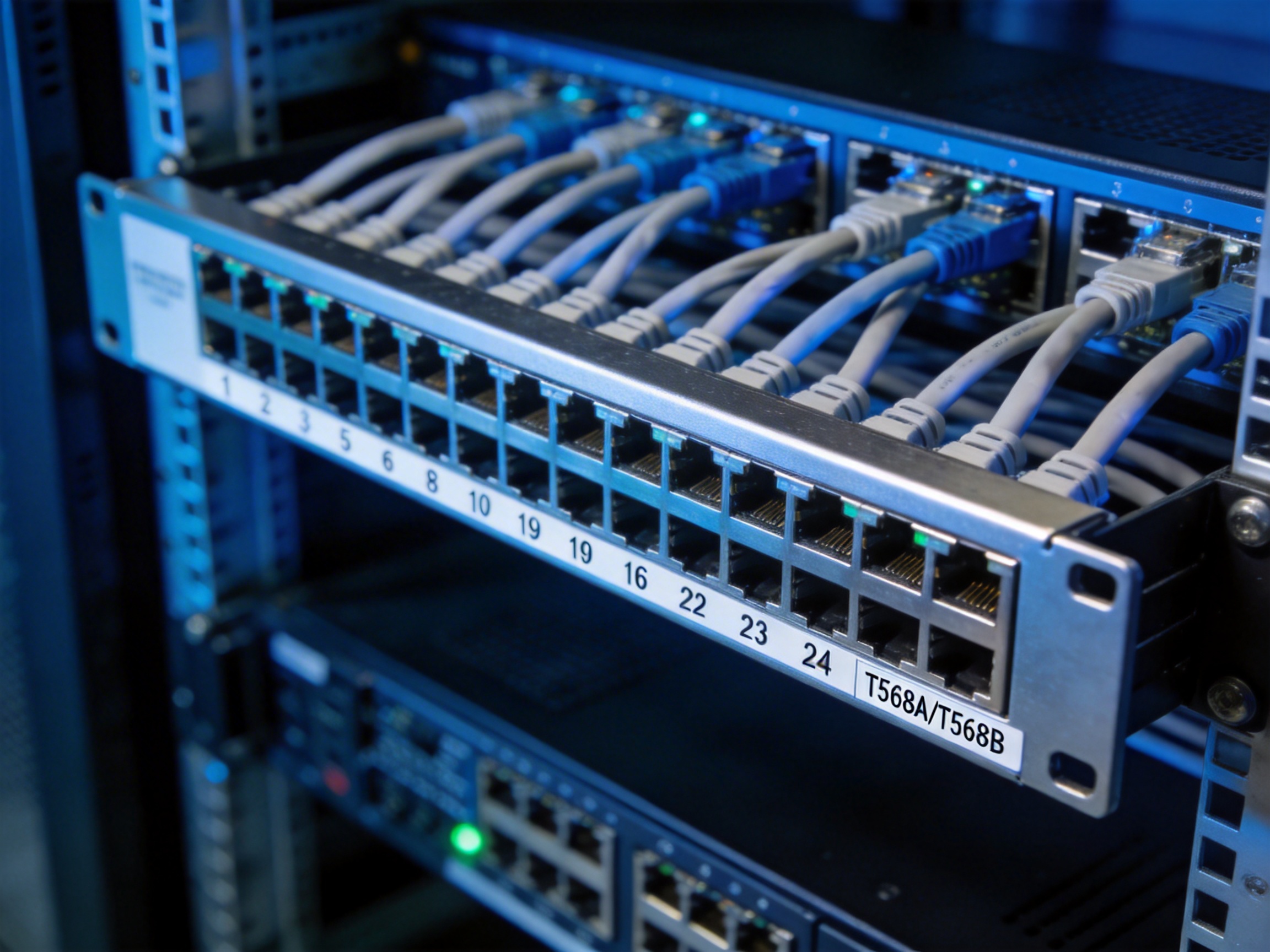
Front-facing 24-port labels enable quick port identification, reducing downtime during troubleshooting or reconfiguration. A built-in cable manager on the rear guides cables to termination points, eliminating tangles and improving airflow—an often-overlooked feature that many competitors omit, forcing users to purchase separate cable management solutions. The IDC (Insulation Displacement Connector) wiring method uses 110-type snap connections, which simplify termination without the need for special tools, cutting installation time by up to 40% compared to traditional punch-down systems.
2. Competitive Advantages: Outperforming Market Alternatives
What sets this patch panel apart from competitors? Its design and materials address common pain points in network cabling, from signal interference to durability in harsh environments. Below are key differentiators:
2.1 Signal Integrity: Reducing Crosstalk and Interference
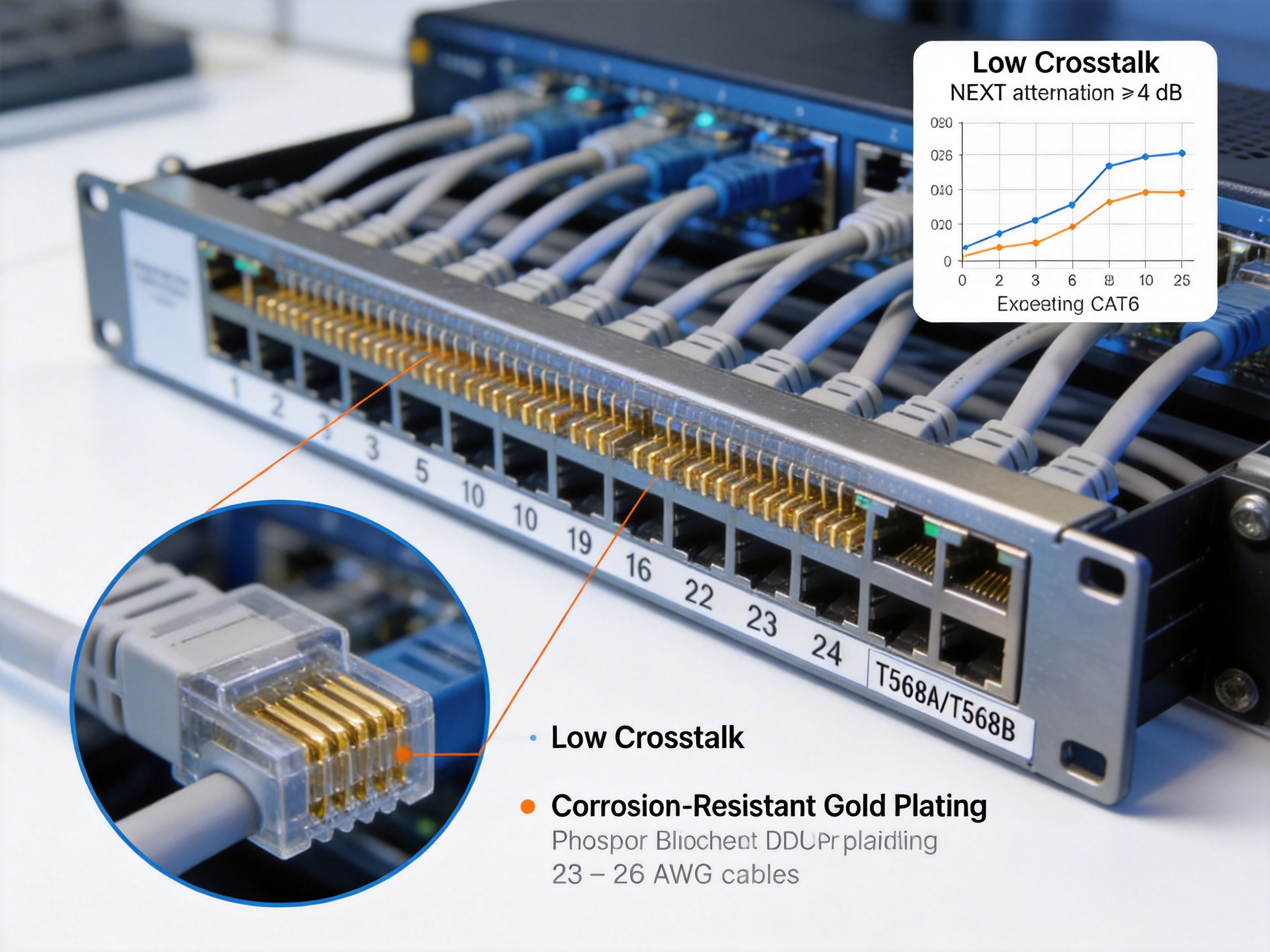
Signal crosstalk—unwanted signal transfer between adjacent cables—is a major issue in high-speed networks. The panel uses high-low dislocation technology for contact pins, which reduces near-end crosstalk (NEXT) attenuation to ≥4 dB—exceeding the CAT6 standard’s minimum requirements. Competitors often use flat pin arrangements, leading to higher crosstalk and degraded performance at high frequencies. This feature ensures stable 10Gbps transmission even in dense cabling setups.
2.2 Durability: Long-Lasting Materials and Construction
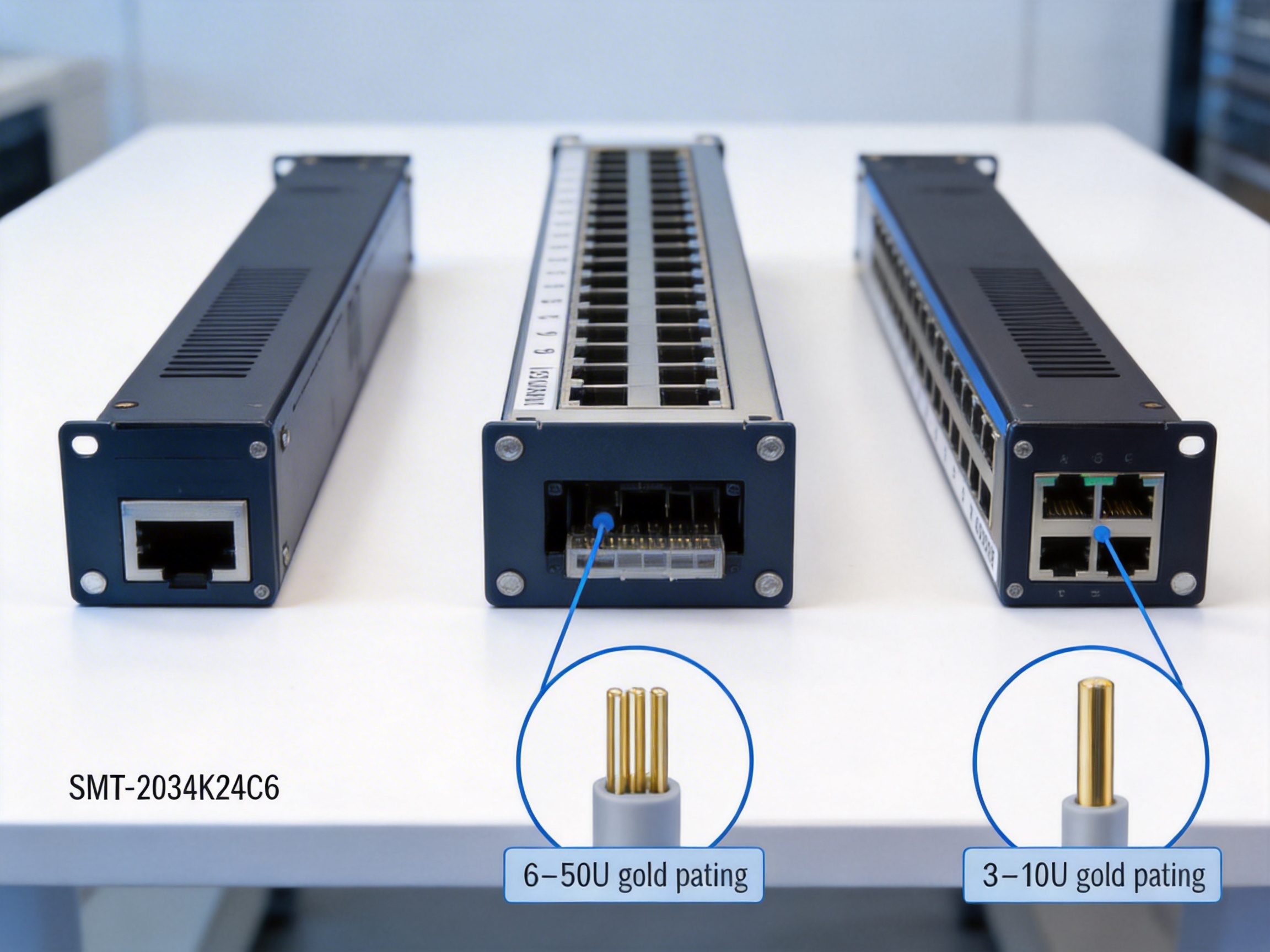
The panel’s metal components are built to withstand heavy use: - Brackets: Cold-rolled steel with plastic spraying, offering corrosion resistance and structural rigidity. - Gold needles: Phosphor bronze with 6–50U gold plating—thicker than the 3–10U typical in competitor models. This reduces wear and corrosion, extending the product’s lifespan by 3x compared to thinner-plated alternatives. - IDC terminals: Phosphor bronze nickel plating, compatible with 23–26 AWG twisted pair cables (wider range than competitors’ 24–26 AWG limit).
Non-metallic parts use PC polycarbonate and ABS, which resist impact, heat, and chemical damage—critical for industrial or outdoor-adjacent installations.
2.3 Environmental Resilience: Meeting Strict Global Standards
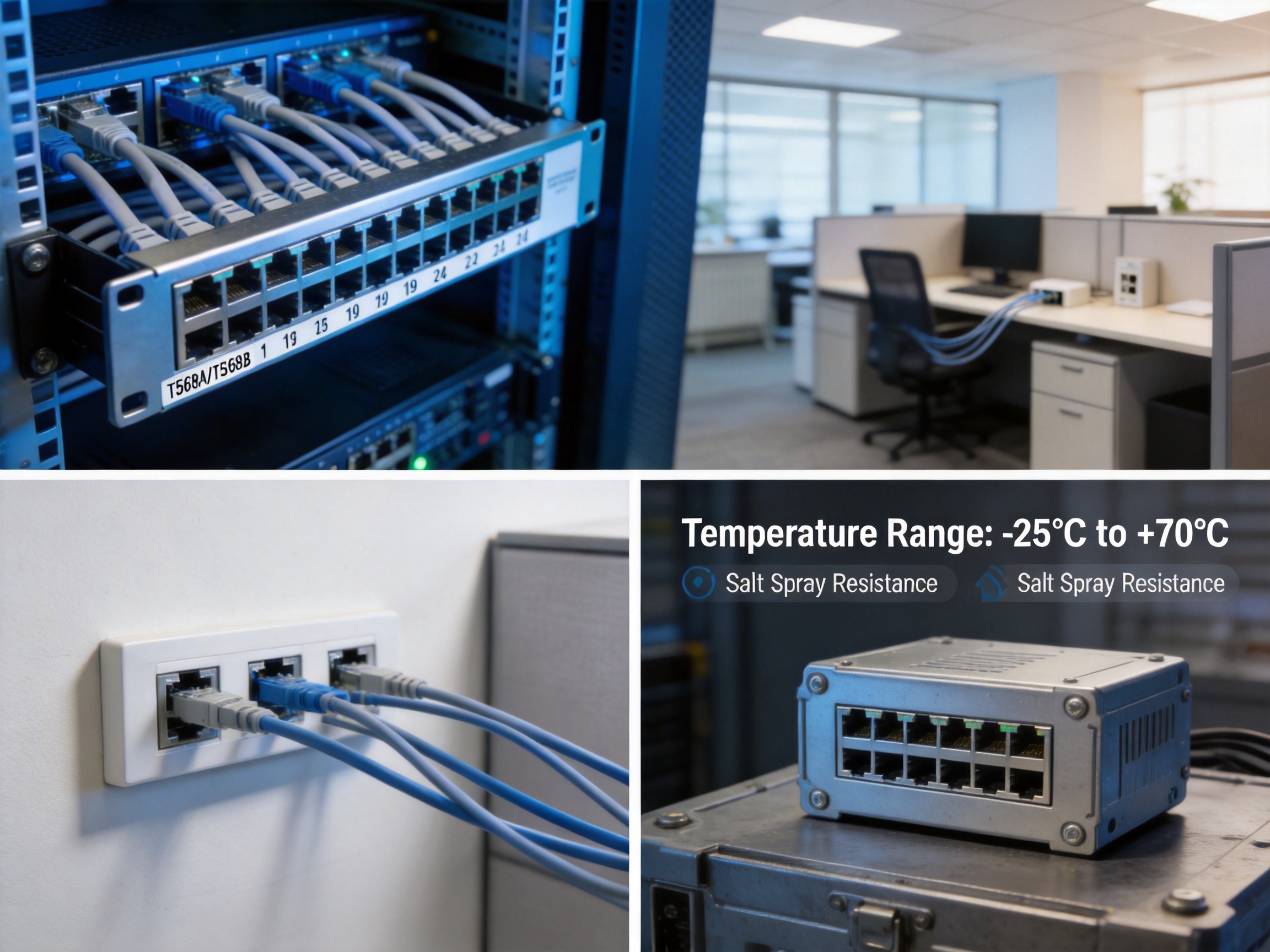
The product complies with ROHS (Restriction of Hazardous Substances) standards, eliminating lead, mercury, and other toxic materials. Its environmental performance exceeds industry norms: - Operating temperature range: -25°C to +70°C (vs. competitors’ typical -10°C to +60°C), making it suitable for cold storage facilities or hot industrial spaces. - Salt spray resistance: 48-hour continuous atomization test (per ISO 9227), ensuring reliability in coastal or industrial areas with high humidity and salt content. Competitors often only test for 24 hours, leading to premature corrosion.
2.4 Ease of Use: Simplified Installation and Maintenance
The built-in cable manager and clear front labels reduce installation time and minimize human error. The 110-type snap IDC connections require no special tools, unlike some competitors’ punch-down systems that need torque wrenches. Additionally, the panel’s compact 1U size saves rack space—valuable in data centers where space is at a premium.
3. Manufacturing Excellence: Behind the Product’s Quality
The patch panel’s performance is rooted in the manufacturer’s commitment to precision engineering and quality control. The company, a leading provider of network communication equipment with nearly 20 years of experience, integrates design, development, sales, and service to deliver reliable solutions.
3.1 R&D: Quality at the Source
A team of 10+ engineers and 30+ full-time technical staff drives product innovation. The R&D process includes: - Simulating real-world network environments to test signal integrity and durability. - Collaborating with clients to customize solutions (OEM/ODM services available). - Aligning designs with global standards (YD/T 926.1-2009, YD/T 926.3-2009, ANSI/TIA/EIA-568-C.2) to ensure compliance.
3.2 Production: Automated and Scalable
The factory features 10 regular and custom production lines, supported by: - 10 fully automatic injection molding machines: Produce non-metallic components with ±0.01mm precision, reducing defects by 30% compared to manual processes. - 20 semi-automatic injection molding machines: For small-batch custom orders. - 8 automatic assembly machines: Ensure consistent IDC terminal placement and gold needle alignment. - Annual output of over 9 million units: Meeting large-scale client demands without compromising quality.
3.3 Quality Control: Comprehensive Testing Protocols
Every product undergoes rigorous testing before shipment: - Electrical tests: Verify frequency range, voltage withstand, NEXT attenuation, and insulation resistance. - Mechanical tests: Check insertion/pull force (≤20N insertion, ≥20N pull-out), IDC clamping strength, and durability (750 insertions for RJ45 connectors, 250 wire terminations). - Environmental tests: Temperature cycling, humidity exposure, and salt spray testing to ensure long-term reliability.
4. Technical Deep Dive: Specifications and Performance Metrics
To fully understand the patch panel’s capabilities, let’s break down its key technical specifications:
4.1 Electrical Characteristics
| Parameter | Specification | |-----------|---------------| | Frequency Range | 1–250 MHz | | Working Voltage | 125 V DC | | Withstand Voltage | DC 1000V / AC 750V (1 minute, no breakdown/arcing) | | Near-End Crosstalk (NEXT) | ≥4 dB | | Insulation Resistance | Initial ≥100 MΩ; After Damp Heat Test ≥100 MΩ |These specs ensure the panel supports high-speed data transmission (up to 10Gbps) and meets safety standards for electrical systems.
4.2 Mechanical Properties
The panel’s mechanical design balances ease of use with durability: - Insertion force: ≤20N (comfortable for installers to use repeatedly). - Pull-out force: ≥20N (prevents accidental disconnection of RJ45 jumpers). - IDC terminal compatibility: 23–26 AWG twisted pair cables (supports a wider range of wiring than competitors). - Durability: 750 insertions for RJ45 connectors, 250 wire terminations (3x more than many CAT6 panels).
4.3 Environmental Performance
The panel’s environmental specs make it suitable for diverse settings: - Operating temperature: -25°C to +70°C (supports cold storage and industrial heat). - Operating humidity: ≤85% (at 85°C ±3°C). - Storage conditions: -5°C to +30°C, ≤70% humidity (no corrosive gases). - Storage lifespan: 3 years (properly stored).
4.4 Material and Surface Treatment
Materials are chosen for performance and longevity: - Metal: Cold-rolled steel (brackets), phosphor bronze (gold needles and IDC terminals). - Non-metal: PC polycarbonate and ABS (plastic housing). - PCB: FR4 (flame-retardant, high-temperature resistant). - Gold plating thickness: 6–50U (corrosion resistance).
5. Application Scenarios: Versatility Across Industries
The patch panel’s design makes it ideal for a wide range of applications:
5.1 Data Centers
Data centers require dense, reliable cabling to support high-speed servers and storage. The 1U form factor fits standard 19-inch racks, while the 24 ports enable efficient cable management. The low crosstalk and high-frequency range support 10Gbps Ethernet, making it suitable for cloud computing and big data environments.
5.2 Office Buildings
For office networks, the panel’s easy installation and labeled ports simplify setup and maintenance. It supports both T568A and T568B standards, compatible with existing office wiring. The built-in cable manager reduces clutter, improving network performance and aesthetics.
5.3 Industrial Facilities
Industrial settings often have harsh conditions (dust, humidity, temperature fluctuations). The panel’s wide temperature range, salt spray resistance, and robust materials make it suitable for factories, warehouses, and coastal installations.
5.4 Smart Homes
Smart homes require reliable connections for IoT devices (security cameras, thermostats, smart TVs). The panel’s compact size and easy installation make it a perfect fit for home networks, supporting high-speed streaming and IoT communication.
6. Q&A Section: Addressing Common User Questions
Below are answers to frequently asked questions about the patch panel:
Q1: What is the frequency range of the patch panel?
A: The panel supports a frequency range of 1–250 MHz, which is compliant with CAT6 standards and suitable for 10Gbps Ethernet transmission.
Q2: Does it support both T568A and T568B wiring standards?
A: Yes, the panel is pre-labeled for both T568A and T568B sequences, allowing flexibility for different network setups.
Q3: What is the maximum number of times the RJ45 connectors can be inserted?
A: The RJ45 connectors are rated for 750 insertions, ensuring long-term durability in high-traffic environments.
Q4: Is the product compliant with ROHS standards?
A: Yes, the panel meets ROHS requirements, eliminating hazardous materials like lead and mercury.
Q5: What materials are used for the gold needles?
A: The gold needles are made of phosphor bronze with a 6–50U gold-plated layer, enhancing corrosion resistance and signal stability.
Q6: How should the product be stored?
A: The panel should be stored in a warehouse with an ambient temperature of -5°C to +30°C, relative humidity ≤70%, and no corrosive gases. The storage lifespan is 3 years.
Q7: Does the panel come with a cable manager?
A: Yes, a built-in cable manager is included on the rear of the panel to guide cables and reduce tangles.
Q8: What is the applicable standard for this patch panel?
A: The panel complies with YD/T 926.1-2009 (General Specification for Telecommunication Cabling Systems) and YD/T 926.3-2009 (Component Specifications for Copper Cabling), as well as ANSI/TIA/EIA-568-C.2.
7. Comparative Analysis: SMT-2034K24C6 vs. Competitor Models
To highlight the panel’s advantages, below is a comparison with two leading competitor models:
| Feature | SMT-2034K24C6 | Competitor A | Competitor B |
|---|---|---|---|
| Gold Plating Thickness | 6–50U | 3–10U | 4–12U |
| IDC Cable Compatibility | 23–26 AWG | 24–26 AWG | 24–26 AWG |
| Integrated Cable Manager | Yes | No (sold separately) | No (sold separately) |
| Temperature Range | -25°C to +70°C | -10°C to +60°C | -15°C to +65°C |
| Salt Spray Duration | 48h | 24h | 36h |
| NEXT Attenuation | ≥4 dB | ≥3 dB | ≥3.5 dB |
| RJ45 Insertions | 750 | 500 | 600 |
| Compliance Standards | YD/T, TIA/EIA, ROHS | TIA/EIA, ROHS | TIA/EIA, ROHS |
8. Conclusion
The 1U24 Port 180 Degree CAT6 UTP Patch Panel represents a significant advancement in structured cabling. Its focus on signal integrity, durability, ease of use, and environmental resilience addresses key gaps in the market, making it a top choice for data centers, offices, industrial facilities, and smart homes. Backed by a manufacturer with nearly 20 years of experience and a commitment to quality, this product delivers reliable performance and long-term value.
References
1. YD/T 926.1-2009: General Specification for Telecommunication Cabling Systems—Part 1: General Requirements
2. YD/T 926.3-2009: Telecommunication Cabling Systems—Part 3: Component Specifications for Copper Cabling
3. ANSI/TIA/EIA-568-C.2: Commercial Building Telecommunications Cabling Standard—Part 2: Balanced Twisted-Pair Cabling
4. Restriction of Hazardous Substances (RoHS) Directive 2011/65/EU
5. ISO 9227:2017: Corrosion Tests in Artificial Atmospheres—Salt Spray Tests
6. IEEE 802.3ae: 10 Gigabit Ethernet Standard