Español
 عربى
عربى русский
Content
- 1 Product Overview: A Practical Platform for Modular Cabling
- 2 Core Specifications and Feature Summary
- 3 Why a Blank Patch Panel Is Often the Smarter Choice
- 4 Installation Efficiency in a Standard 19-Inch Rack Environment
- 5 Front Labeling: A Small Feature with Large Operational Value
- 6 Rear Cable Management for Better Cable Routing
- 7 Material Strength and Surface Treatment
- 8 Environmental Performance and Compliance
- 9 Electrical and Mechanical Considerations When Used with Compatible Connectors
- 10 Advantages Over Ordinary Competing Patch Panels
- 11 Manufacturing Strength Behind the Product
- 12 Quality Control from Design Source to Delivery
- 13 Applications in Structured Cabling Systems
- 14 How the Product Supports Long-Term Network Reliability
- 15 OEM and ODM Suitability
- 16 Packaging, Storage, and Logistics Advantages
- 17 Selection Guidance for Installers and Buyers
- 18 Best Practices for Installation
- 19 Q&A Section
- 19.1 What is the SMT-2041-24P used for?
- 19.2 Why choose a blank patch panel instead of a pre-loaded patch panel?
- 19.3 Is the panel compatible with standard network racks?
- 19.4 How many ports does the panel provide?
- 19.5 What materials are used in the product?
- 19.6 Does the panel include cable management?
- 19.7 Why is the large front label area important?
- 19.8 What environmental range does the product support?
- 19.9 Can it be used in both copper and fiber systems?
- 19.10 What makes this product competitive?
- 19.11 Does the manufacturer support OEM or ODM projects?
- 19.12 How is the product packaged?
- 20 Conclusion
- 21 References
- 22 Product: SMT-2041-24P 1U24 Port Blank Patch Panel
In modern structured cabling, the patch panel is far more than a simple rack accessory. It is the organized front end of a network, the point where permanent cabling becomes manageable, visible, serviceable, and scalable. The SMT-2041-24P 1U 24 Port Blank Patch Panel is designed for installers, integrators, data cabling contractors, and facility managers who need a durable, flexible, and easy-to-deploy solution for copper and fiber system termination points. As a blank patch panel, it provides the physical platform for modular connector installation while keeping rack space efficient, port identification clear, and cable routing controlled.
This product belongs to the blank patch panel category and supports structured cabling applications in copper systems and fiber systems. It is suitable for horizontal cabling, device termination between equipment, and centralized termination points in network cabinets, equipment rooms, wiring closets, smart buildings, data distribution areas, and industrial communication environments. With a standard 19-inch rack-mount form factor and 1U height, it helps users build clean, professional cabling infrastructures without sacrificing valuable cabinet space.
SMT-2041-24P 1U24 Port Blank Patch Panel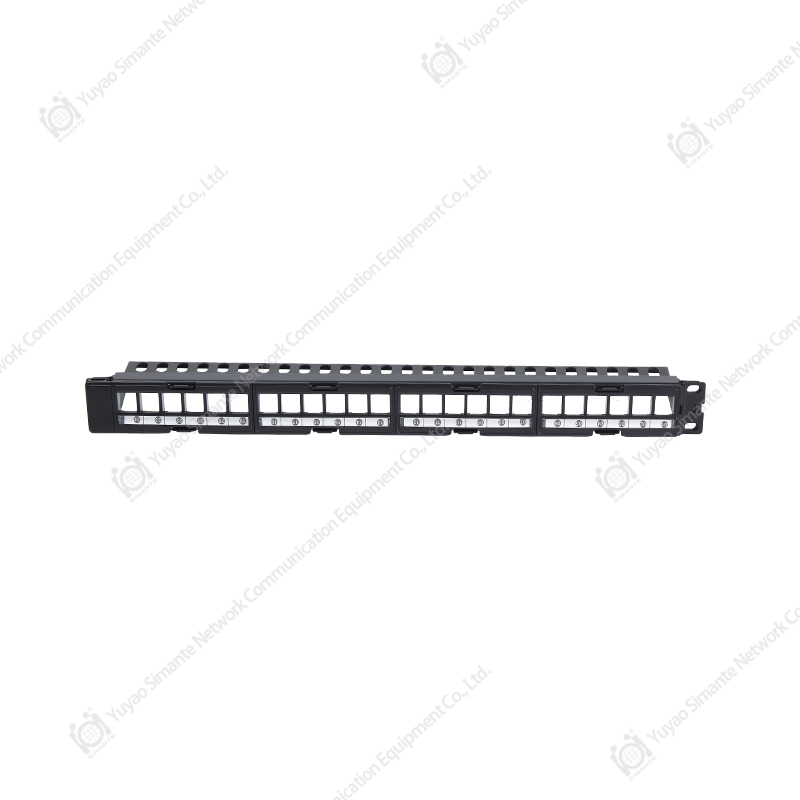
The key value of this 24-port blank patch panel lies in its balance of practicality, strength, compatibility, and installation efficiency. Its sturdy structure is intended to reduce installation time and simplify operation. Its large front label area helps technicians identify ports quickly, reducing troubleshooting time and lowering the risk of incorrect patching. Its rear cable management design guides cables toward termination points, helping maintain bend control and routing order behind the rack. These features may sound simple, but in daily network operation, they directly influence reliability, maintenance cost, and the long-term appearance of the cabling system.
Yuyao Simante Network Communication Equipment Co., Ltd. manufactures this product as part of its wider network cabling solution and optical fiber product portfolio. With nearly 20 years of service in the communication equipment field, the company integrates design, development, sales, production, and service. It supports OEM and ODM projects and has established mature research and development capability, stable production capacity, and comprehensive testing awareness. These manufacturing strengths give the SMT-2041-24P more than a basic hardware identity; they make it a dependable component for professional cabling systems where consistency matters.
Product Overview: A Practical Platform for Modular Cabling
The SMT-2041-24P is a 1U, 24-port blank patch panel designed for standard 19-inch racks, cabinets, and wall-mount frames. “Blank” means the panel provides empty port positions into which compatible modules or connectors can be installed according to project requirements. This gives installers flexibility when selecting connector types, cabling categories, or mixed configurations. In many structured cabling projects, this flexibility is a major advantage because not every installation needs a fixed factory-loaded panel. Some projects require customized port layouts, phased deployment, future expansion capacity, or different connector series in the same installation environment.
The product’s 24-port layout is especially practical for small to medium distribution points and for high-density cabinet planning. In a 1U space, 24 ports provide strong port capacity while leaving rack room for switches, fiber trays, cable managers, power distribution, and other network devices. A 24-port panel also aligns well with common access switch sizes, making cable planning more intuitive and equipment mapping easier. When used with the same standard series of connectors, the panel can support organized and standardized termination across the network.
The front face of the panel includes labels for port identification. The large front labeling space is a valuable feature because network rooms often evolve over time. Ports may be reassigned, devices may be replaced, users may move, and network zones may change. Clear labeling reduces confusion and makes maintenance safer. In large buildings, a mislabeled cable can lead to long troubleshooting sessions. A generous labeling area allows technicians to mark port numbers, room references, VLAN information, device names, service types, or other identification systems required by the project.
The rear of the panel includes a cable manager that helps guide cables toward termination points. Back-of-rack organization is often overlooked, yet it plays a crucial role in system reliability. Poorly routed cables can create unnecessary stress at termination points, restrict cabinet airflow, block access to adjacent devices, or make future service difficult. A panel that includes rear cable guidance supports cleaner installations and improves the long-term quality of the cabling system.
Core Specifications and Feature Summary
| Item | Specification or Feature | Practical Benefit |
|---|---|---|
| Product Type | 1U 24-port blank patch panel | Provides a flexible platform for modular connector installation |
| Rack Compatibility | Standard 19-inch rack mount | Fits common equipment racks, network cabinets, and wall mounts |
| Port Quantity | 24 ports | Supports efficient port density in a compact 1U space |
| Front Identification | Large label area with port labels | Improves port recognition, documentation, and maintenance speed |
| Rear Management | Integrated cable manager | Guides cables to termination points and supports orderly routing |
| Metal Material | Cold rolled steel bracket with plastic spray coating | Offers structural strength and improved surface protection |
| Plastic Materials | PC polycarbonate and ABS | Provides reliable non-metallic component performance |
| Environmental Compliance | Meets RoHS requirements | Supports responsible material control and market acceptance |
| Operating Temperature | -25°C to +70°C | Suitable for a wide range of installation environments |
| Storage Conditions | -5°C to +30°C, relative humidity not more than 70% | Protects product quality before installation |
| Packaging | Special blister bag and cardboard box, regular packing of 10 pieces per carton | Supports safe transport, identification, and inventory handling |
Why a Blank Patch Panel Is Often the Smarter Choice
A fixed patch panel can be useful when a project has a standardized connector requirement from the beginning. However, many real-world cabling systems benefit from a blank panel because it allows the installer or network designer to decide how ports will be populated. The SMT-2041-24P supports this approach by serving as a strong, standardized, and easy-to-install platform.
One major advantage of a blank design is project flexibility. A contractor may need to install different connector modules depending on the cabling area, customer preference, or future upgrade path. Instead of ordering multiple fixed panel types, the installer can use a consistent blank panel and populate it according to actual site requirements. This can reduce purchasing complexity and simplify inventory management.
Another advantage is maintainability. If a connector needs replacement, the modular nature of a blank panel system can make service more convenient. Instead of replacing an entire loaded panel, a technician can work with individual compatible modules, depending on the connector system used. This supports lower maintenance cost and better lifecycle management.
Blank panels also make phased network deployment easier. In some commercial buildings, all cable pathways may be planned in advance, but not all work areas are activated at the same time. A 24-port blank panel allows unused positions to remain available for future growth. This prevents premature overinvestment while keeping the cabinet layout ready for expansion.
For integrators serving different market segments, a blank panel is also helpful because it allows product standardization across projects. Whether the project involves office networks, smart home systems, automation equipment, or mixed copper and fiber communication needs, the same general panel format can support different configurations when combined with appropriate same-series connectors.
Installation Efficiency in a Standard 19-Inch Rack Environment
The 19-inch rack standard is the dominant mechanical format in communication cabinets and data equipment installations. The SMT-2041-24P is compatible with 19-inch equipment racks, cabinets, and wall mounts, making it suitable for a wide range of job sites. This compatibility reduces uncertainty during installation because technicians can integrate the panel into common rack systems without requiring special mounting structures.
The 1U height is equally important. Rack space is valuable, especially in compact wiring closets or equipment rooms where switches, routers, cable managers, fiber trays, power equipment, and other devices compete for space. A 24-port layout in a 1U panel provides a strong balance between density and accessibility. It avoids unnecessary bulk while preserving enough front surface area for port access and labeling.
The product’s sturdy and easy-to-install design is intended to improve work efficiency. During field installation, time is often consumed not only by cable termination but also by aligning hardware, securing panels, labeling ports, dressing cables, and correcting cabinet layout issues. A well-designed panel can reduce these hidden time costs. A strong steel bracket helps keep the panel stable during installation, while the standardized mounting style allows predictable rack placement.
For installers, repeatability matters. A patch panel that installs consistently from project to project helps teams work faster and with fewer mistakes. When technicians are familiar with a product’s hole spacing, labeling area, rear support, and mounting behavior, they can produce cleaner installations and maintain consistent workmanship. This is especially useful for contractors managing multiple sites, chain stores, office buildings, campus networks, or residential development projects.
Front Labeling: A Small Feature with Large Operational Value
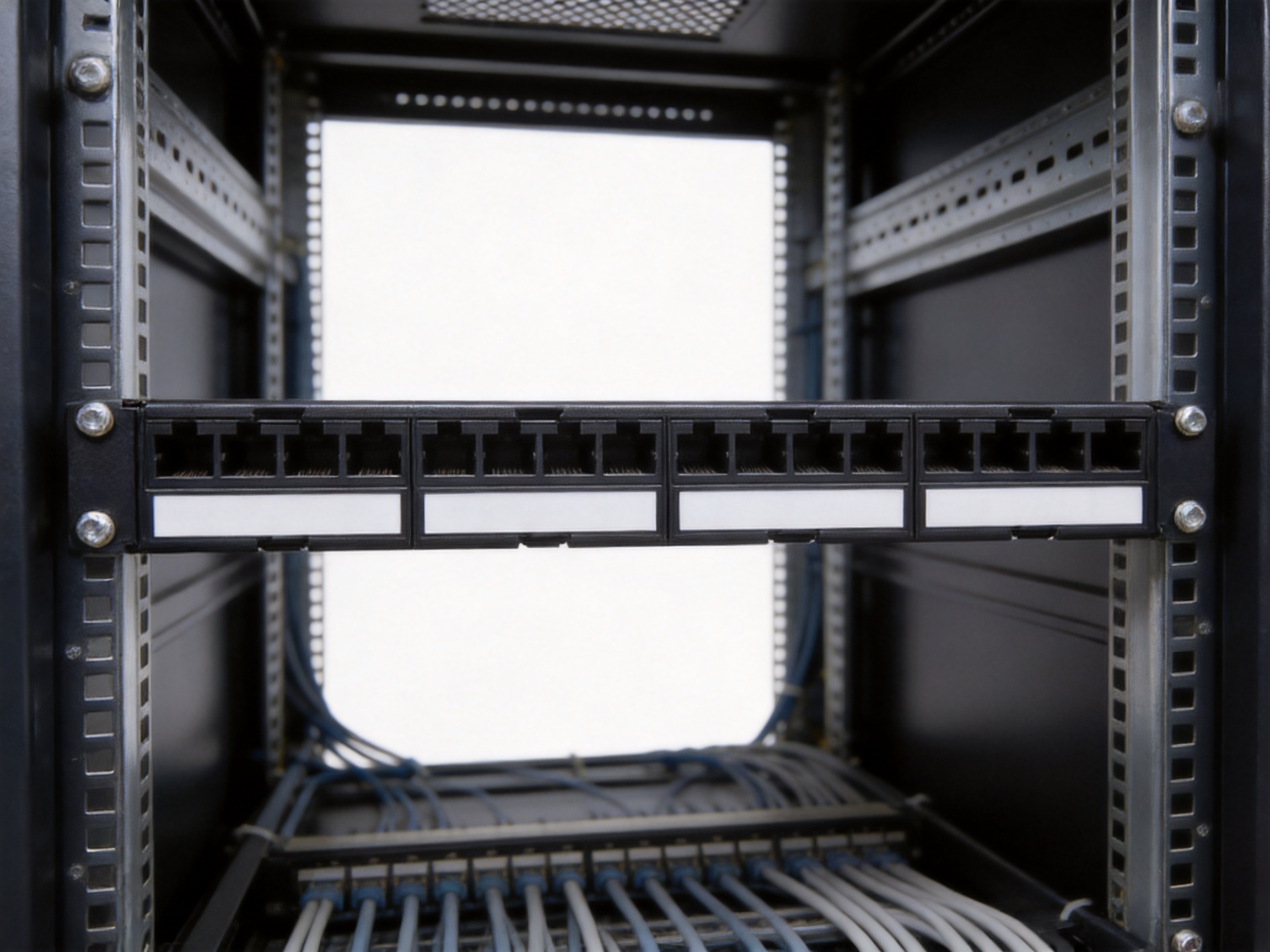
Clear port identification is one of the most important elements of cabling management. The SMT-2041-24P provides labels on the front for all 24 ports and includes a large label area. This design supports the documentation requirements of structured cabling standards and everyday network administration.
In a well-managed network, each port should correspond to a known cable route, location, device, service, or patching instruction. Without clear labeling, technicians may need to trace cables manually, consult outdated drawings, or perform time-consuming tests. In busy environments, incorrect patching can disconnect users, interrupt security devices, or cause service delays. The larger the network, the more valuable simple and visible labeling becomes.
A generous label area also improves adaptability. Some customers use simple numbering systems, while others require detailed labels that include floor numbers, room codes, cabinet IDs, workstation numbers, or functional descriptions. The front label space gives customers more freedom to implement their preferred identification method. This is especially useful for OEM, ODM, and customer-specified packaging or project requirements.
Compared with lower-cost panels that provide minimal or unclear marking space, the SMT-2041-24P is designed for practical field maintenance. Its labeling design reflects an understanding of how network rooms operate after installation. A cabling system does not end when the rack door closes; it must be maintained for years. Clear identification helps preserve installation value over the entire service life.
Rear Cable Management for Better Cable Routing
The rear cable manager on the SMT-2041-24P helps guide cables effectively to the termination point. This feature is important because the rear side of a patch panel often determines whether a rack remains serviceable over time. Even if the front of a cabinet looks neat, poorly managed rear cabling can cause strain, tangling, poor accessibility, and confusion during upgrades.
Good rear management supports cable bend control. Copper data cables and fiber cables both require careful handling. Excessive bending, pulling, or compression can degrade performance or increase the risk of failure. By guiding cables toward termination positions, the rear manager helps create a more controlled path. This can reduce stress around connectors and help maintain the intended transmission performance of the cabling system.
The rear manager also improves service access. When cables are routed in an orderly way, technicians can identify and work on individual cables without disturbing adjacent terminations. This reduces the risk of accidental disconnection and helps future maintenance proceed more safely. In high-density cabinets, cable organization is not merely aesthetic; it is essential for reliable operations.
For contractors, cable management features can also improve the final appearance of the installation. Customers often judge cabling quality by visible organization. A clean rack inspires confidence and supports professional project acceptance. The SMT-2041-24P helps installers create that organized result through its integrated rear routing support.
Material Strength and Surface Treatment
The product uses a cold rolled steel bracket with plastic spray surface treatment. Cold rolled steel is widely valued in rack hardware because it provides dimensional stability, strength, and rigidity. In a patch panel, the bracket must withstand installation handling, repeated rack service, cable forces, and long-term cabinet use. A rigid structure helps keep ports aligned and supports a stable front interface.
The plastic spray coating provides surface protection and contributes to a clean finished appearance. In communication cabinets, metal surfaces may be exposed to frequent handling, screw installation, and varying environmental conditions. A protective coating helps improve durability and supports a professional visual standard.
For non-metallic materials, the product uses PC polycarbonate and ABS. PC polycarbonate is known for good impact resistance and mechanical performance, while ABS is widely used for durable molded components. The selection of these materials supports product reliability and stable component performance in daily use.
Material selection is an important competitive factor. Some low-cost panels may reduce thickness, use inconsistent materials, or compromise finishing quality. Such decisions can lead to deformation, poor alignment, sharp edges, weak retention, or reduced service life. The SMT-2041-24P is positioned as a professional structured cabling component with attention to material composition, processing, and usability.
Environmental Performance and Compliance
The SMT-2041-24P meets RoHS requirements, reflecting responsible control of restricted hazardous substances. RoHS compliance is important for customers who operate in markets that require environmental material standards or who have internal sustainability and procurement policies. It also supports easier acceptance in international business environments.
The product is designed for an environmental temperature range of -25°C to +70°C, with humidity conditions up to 85% under specified high-temperature test conditions. This operating range makes the panel suitable for many indoor communication environments and certain challenging infrastructure areas where temperatures may vary. While patch panels should still be installed in appropriate cabinet conditions, this wide temperature tolerance gives installers confidence across different regions and building types.
Storage conditions are also specified. Packaged products should be stored in a warehouse where the ambient temperature is -5°C to +30°C, relative humidity is not more than 70%, and the surrounding air contains no acid, alkali, or other corrosive gases. These requirements help protect the product before installation. Proper storage is especially important for distributors, contractors, and project owners who may hold inventory before deployment.
The specified storage period is three years under proper conditions. This supports project planning and channel inventory management. Products are packed in a special blister bag and cardboard box, with accessories placed at the same time and carton labels indicating product model and quantity. Regular packing is 10 pieces per carton, with one piece per box. Clear packaging supports transport protection and simplifies warehouse handling.
Electrical and Mechanical Considerations When Used with Compatible Connectors
The product information includes technical parameters related to electrical and mechanical performance, including contact resistance, insulation resistance, insertion force, and pull-out force. When the panel is used with connectors of the same standard series, these parameters help define the performance expectations of the assembled system.
The stated contact resistance is not more than 2.5 milliohms under normal atmospheric pressure, and the initial insulation resistance is at least 1000 megohms. These values reflect attention to stable electrical performance in compatible connection systems. In structured cabling, low contact resistance and high insulation resistance contribute to signal integrity and long-term reliability.
The mechanical parameters include an insertion force not more than 10 newtons and a pull-out force not less than 20 newtons. Proper insertion and withdrawal characteristics matter because patching and connector service occur repeatedly during the life of a network. If insertion force is too high, technicians may struggle during installation or damage components. If pull-out retention is too weak, connections may loosen during service. Balanced mechanical performance improves usability and security.
Although the SMT-2041-24P is a blank patch panel, its value is realized as part of a matched connector system. The inter-matching relationship specified for the product emphasizes using connectors of the same standard series. This is important because modular compatibility affects fit, retention, electrical contact, and long-term stability. Professional installers should always use compatible modules and follow project specifications to achieve the best results.
Advantages Over Ordinary Competing Patch Panels
The SMT-2041-24P offers several advantages over generic or low-cost blank patch panels. These advantages are not limited to one feature; they come from the combination of mechanical design, labeling convenience, material selection, rear cable support, manufacturing capability, and system compatibility.
First, its standard 19-inch 1U structure provides universal applicability without wasting cabinet space. Some competing panels may be compatible in theory but less precise in mounting, surface quality, or dimensional consistency. A stable 19-inch format reduces installation uncertainty and makes the product easier to deploy in professional racks and cabinets.
Second, the 24-port layout provides practical density. It is suitable for office networks, equipment rooms, residential smart home distribution, automation systems, and network communication projects. The format aligns with common network switch port counts, making cabling design more logical.
Third, the large front label space is a meaningful advantage. Many low-cost panels minimize labeling area or provide labels that are difficult to read after cables are patched. This product’s labeling design supports daily operation and future maintenance, which can reduce total cost of ownership.
Fourth, the rear cable manager gives the product an edge in installation quality. Without rear cable guidance, cables may hang, twist, or apply uneven force to connectors. Integrated cable management helps maintain a more orderly and reliable cabling environment.
Fifth, the cold rolled steel bracket and PC and ABS material choices support durability. Competitive products that use thinner metal, weak plastic, or poor surface treatment may deform or deteriorate more easily. A robust panel provides better long-term value even if the initial purchase comparison appears similar.
Sixth, the product is backed by a manufacturer with significant production capacity, engineering resources, and export experience. This matters because professional buyers need not only a good sample but stable quality across repeated orders. Manufacturing consistency is often the real difference between a dependable supplier and an uncertain one.
Manufacturing Strength Behind the Product
Yuyao Simante Network Communication Equipment Co., Ltd. is a professional manufacturer of network cabling solutions and optical fiber products. The company integrates design, development, sales, and service, allowing it to respond to customer needs from concept to delivery. This integrated model supports faster communication, better product alignment, and more effective customization for OEM and ODM customers.
With nearly 20 years of industry service, the company has built experience in structured cabling, network communication, smart home systems, automation equipment, and related fields. Experience matters because communication infrastructure products must meet practical installation needs, not just catalog specifications. Over many years of working with customers, manufacturers learn how products are handled on job sites, what installers value, and where design improvements can reduce cost or improve reliability.
The company has more than 10 engineers and over 30 full-time technical personnel. This technical team helps maintain product development, quality improvement, process refinement, and product updates. In manufacturing, engineering strength is essential for maintaining dimensional accuracy, improving mold design, selecting materials, optimizing assembly methods, and resolving customer-specific technical requirements.
The company’s factory includes 10 regular and customization production lines. This gives it flexibility for standard production as well as tailored project orders. It also operates 10 fully automatic injection molding machines and 20 semi-automatic injection molding machines. Injection molding capability is especially important for network cabling components that use plastic parts, including PC polycarbonate and ABS components. In-house molding capability can improve quality control, reduce dependency on external suppliers, and support faster product development.
The factory also has 8 kinds of automatic installed machines, supporting assembly efficiency and consistency. Automation can reduce human error, improve throughput, and maintain more stable production quality. For products intended for export markets and repeated project supply, stable process control is highly valuable.
The company maintains a stable annual output of more than 9 million units. This production scale indicates strong capacity and mature manufacturing organization. Large-scale output also helps support competitive pricing, stable delivery, and supply reliability for distributors, contractors, and OEM customers.
Quality Control from Design Source to Delivery
Quality begins before production. According to the company’s philosophy, the mature research and development system helps guarantee quality stability at the design source. This is important because many product defects are not caused only by factory mistakes; they begin with poor design decisions, weak material choices, inadequate tolerance planning, or insufficient understanding of real installation conditions.
For a patch panel such as the SMT-2041-24P, design quality includes rack compatibility, port alignment, structural rigidity, labeling layout, cable manager usability, material matching, packaging protection, and compatibility with same-series connectors. When these factors are considered early, the final product is easier to manufacture and easier to use.
The company’s high-end market orientation also influences quality expectations. Serving demanding markets such as Europe, Australia, Africa, the Middle East, and Southeast Asia requires stable production standards and the ability to meet different customer requirements. Export business often involves strict documentation, packaging, testing, labeling, and performance expectations. A manufacturer that maintains stable export volume must be able to deliver consistency across batches.
Testing is another key element. The company emphasizes meeting customers’ comprehensive testing requirements through good performance testing. For structured cabling products, testing may include mechanical fit, material performance, electrical parameters when applicable, environmental endurance, packaging verification, and appearance inspection. Even a seemingly simple patch panel benefits from controlled testing because poor fit or weak structure can create field problems.
In competitive markets, suppliers may claim similar specifications, but buyers should look deeper into manufacturing systems. A patch panel made by a company with engineering resources, injection molding equipment, automatic assembly machines, and mature production lines is more likely to deliver consistent value than a product assembled through scattered outsourcing without strong process control.

Applications in Structured Cabling Systems
The SMT-2041-24P is suitable for horizontal wiring or device termination between devices, as well as mutual mating termination at centralized points. Horizontal cabling connects work areas to telecommunications rooms or distribution spaces. In such systems, patch panels provide the organized interface between installed cabling and active equipment.
In office networks, the panel can be installed in a network cabinet to manage workstation connections, wireless access points, IP phones, printers, security devices, and other endpoints. The 24-port format is convenient for department-level or floor-level distribution. The front labels can identify office rooms or work areas, while the rear cable manager keeps permanent cabling orderly.
In smart home and residential distribution systems, the panel can support structured wiring for data sockets, entertainment devices, security systems, and automation controllers. A blank panel gives integrators flexibility to populate only the required ports while reserving expansion space for future devices.
In automation equipment and industrial communication environments, clear termination points are important for maintenance and troubleshooting. The panel’s durable structure, wide temperature tolerance, and organized design make it suitable for controlled industrial cabinets and technical rooms where communication networks support operations.
In fiber and copper mixed infrastructures, blank panel flexibility can be valuable when project requirements evolve. While the product belongs to copper and fiber system categories, users should select compatible connectors and modules according to the cabling standard and performance requirements of the installation. The panel acts as a structured framework for reliable organization.
How the Product Supports Long-Term Network Reliability
Network reliability is often discussed in terms of switches, routers, servers, or cable categories, but passive infrastructure has a major influence on uptime. A poorly organized or weakly built termination panel can cause intermittent problems, slow service response, and unnecessary downtime. The SMT-2041-24P supports long-term reliability by improving physical organization and reducing common installation risks.
Its sturdy construction helps maintain stable port alignment and cabinet integrity. When a panel flexes excessively or deforms during installation, connectors may not seat correctly, and labels may become misaligned. A stronger panel preserves the intended layout and gives technicians confidence during patching and service.
The rear cable manager supports proper cable routing, reducing stress near termination points. Cable strain can lead to degraded contact, damaged connectors, or performance problems, especially after years of service or repeated maintenance. Controlled routing helps protect the cable path.
The large front labels improve operational accuracy. Many network interruptions are caused by human error, including unplugging the wrong cable or patching a port incorrectly. Better identification reduces this risk. In environments with frequent moves, adds, and changes, labeling quality becomes a reliability feature.
The environmental performance range also supports stable use across diverse conditions. While proper cabinet design remains necessary, the panel’s temperature tolerance provides assurance for installations in different building environments.
Finally, manufacturing consistency supports reliability across projects. When a buyer installs the same panel type in multiple cabinets or buildings, consistent quality simplifies maintenance and spare part management. This is one reason why selecting a capable manufacturer matters as much as selecting the product model.
OEM and ODM Suitability
The product information notes that packaging can be customer specified, and the company undertakes OEM and ODM projects. This is important for distributors, system integrators, brand owners, and project suppliers who need customized labeling, packaging, model identification, or product configuration.
OEM and ODM capability depends on more than willingness. It requires engineering communication, mold and process control, stable supply chain management, testing capability, and production flexibility. With regular and customization production lines, injection molding equipment, technical personnel, and export experience, the company is positioned to support customized structured cabling components.
For a blank patch panel, customization may involve packaging style, carton labeling, accessory kits, connector matching, surface requirements, port numbering schemes, or project-specific documentation. Buyers who serve different markets may need private label support or specification adjustments. A manufacturer with an integrated design and production structure can respond more effectively than a trading-only supplier.
Packaging, Storage, and Logistics Advantages
The SMT-2041-24P is packaged in a special blister bag and then placed in a cardboard box. Product accessories are placed at the same time, and labels indicating product model and quantity are affixed to the carton. Regular packing is 10 pieces per carton, one piece per box. This packaging structure supports protection, organization, and warehouse efficiency.
Good packaging reduces product damage during transport. Patch panels can be scratched, bent, or damaged if packed carelessly. A protective bag and individual box help keep the product clean and ready for installation. Clear carton labeling helps distributors and contractors identify inventory quickly, reducing errors during project staging.
The storage recommendations protect the product from environmental damage before installation. Avoiding corrosive gases and excessive humidity helps preserve metal surfaces and material condition. For large projects, products may be stored for weeks or months before deployment, so clear storage guidance is valuable.
Logistics reliability also reflects manufacturing discipline. Buyers do not only need the product itself; they need predictable delivery, consistent packing quantity, correct labeling, and accessory completeness. These details can significantly affect project efficiency, especially when many cabinets or job sites are involved.
Selection Guidance for Installers and Buyers
When selecting a blank patch panel, buyers should evaluate more than port count. The first consideration is rack compatibility. The SMT-2041-24P fits standard 19-inch racks, cabinets, and wall mounts, which makes it suitable for typical structured cabling environments.
The second consideration is port density. A 24-port 1U panel is a common and practical choice for many installations. It offers enough capacity for organized distribution while remaining accessible for patching and labeling.
The third consideration is connector compatibility. The product should be used with connectors of the same standard series. This helps ensure proper matching, retention, and performance. Buyers should confirm module selection according to the system category and project standards.
The fourth consideration is mechanical strength. Cold rolled steel construction with protective surface treatment supports durability. Buyers should avoid panels that feel weak, deform easily, or have poor finishing quality.
The fifth consideration is cable management. Rear guidance is important for maintaining clean cable paths and reducing termination stress. A panel without rear management may require additional accessories or may result in poorer cable organization.
The sixth consideration is manufacturer capability. A product from a factory with engineering resources, injection molding machines, automatic installation equipment, customization lines, and quality testing awareness offers stronger supply confidence. This is especially important for repeat orders and export business.
Best Practices for Installation
Before installing the SMT-2041-24P, technicians should confirm rack space, cabinet depth, cable entry direction, and the position of adjacent equipment. The panel should be mounted in a location that allows easy front access and enough rear space for cable routing.
All compatible connectors or modules should be prepared according to the project plan. Port numbering should be defined before termination begins. A clear numbering plan prevents confusion and supports accurate labeling. If the project uses floor, room, or device codes, labels should be printed or written clearly and consistently.
Cables should be routed to the rear cable manager with proper bend radius and without excessive pulling force. Cable ties or hook-and-loop straps should be used carefully to avoid compression. Fiber cables require particular attention to bend control, while copper data cables should also be protected from sharp bends and strain.
After termination and module installation, technicians should test connections according to the project requirements. Documentation should be updated immediately. The large label area should be used to match the test records and site drawings. Good documentation at the time of installation reduces future service cost.
After installation, the cabinet should be inspected for cable airflow, patch cord clearance, door closing, and service accessibility. A patch panel is part of a larger system, so its final performance depends on correct integration with cables, connectors, racks, cable managers, and active equipment.

Q&A Section
What is the SMT-2041-24P used for?
It is used as a 1U 24-port blank patch panel for structured cabling systems. It provides a rack-mounted platform for compatible modular connectors and is suitable for horizontal wiring, device termination, and centralized cabling points.
Why choose a blank patch panel instead of a pre-loaded patch panel?
A blank patch panel gives installers more flexibility. Ports can be populated according to actual project requirements, connector standards, phased deployment plans, or customer preferences. It is useful for customized cabling systems and future expansion.
Is the panel compatible with standard network racks?
Yes. The product is designed for standard 19-inch rack mounting and can be used with compatible equipment racks, cabinets, and wall mounts.
How many ports does the panel provide?
It provides 24 ports in a compact 1U height, offering efficient port density for structured cabling installations.
What materials are used in the product?
The metal bracket is made from cold rolled steel with plastic spray surface treatment. Non-metallic materials include PC polycarbonate and ABS.
Does the panel include cable management?
Yes. It includes a rear cable manager designed to guide cables effectively toward the termination point and support cleaner cable routing.
Why is the large front label area important?
The large label area helps technicians identify ports quickly and accurately. This reduces troubleshooting time, prevents patching errors, and supports professional documentation.
What environmental range does the product support?
The operating temperature range is -25°C to +70°C. The product also meets RoHS requirements and has specified storage conditions for maintaining quality before installation.
Can it be used in both copper and fiber systems?
Yes. The product is categorized for copper and fiber system applications, but users must select compatible connectors of the same standard series according to the specific cabling design.
What makes this product competitive?
Its competitive strengths include 19-inch rack compatibility, 1U 24-port efficiency, strong cold rolled steel construction, clear front labeling, rear cable management, RoHS compliance, and support from a manufacturer with nearly 20 years of industry experience and strong production capacity.
Does the manufacturer support OEM or ODM projects?
Yes. Yuyao Simante Network Communication Equipment Co., Ltd. supports OEM and ODM projects and can provide customer-specified packaging and related customization support.
How is the product packaged?
The product is placed in a special blister bag and then in a cardboard box, with accessories included. Regular packing is 10 pieces per carton, one piece per box.
Conclusion
The SMT-2041-24P 1U 24 Port Blank Patch Panel is a practical and dependable component for professional structured cabling. Its value comes from a thoughtful combination of rack-standard design, 24-port density, flexible blank configuration, large labeling area, rear cable management, durable materials, environmental compliance, and installation-friendly construction.
Compared with ordinary competing panels, it offers stronger field usability and better long-term service support. The large front label space improves identification, the rear cable manager improves routing, and the cold rolled steel bracket supports structural reliability. These features help contractors complete cleaner installations and help network operators maintain organized cabling over time.
Just as importantly, the product is manufactured by a company with nearly 20 years of experience, more than 10 engineers, over 30 full-time technical personnel, 10 regular and customization production lines, 10 fully automatic injection molding machines, 20 semi-automatic injection molding machines, 8 automatic installed machines, and an annual output of more than 9 million units. This manufacturing background supports stable quality, customization capability, and reliable export supply.
For buyers seeking a flexible 1U 24-port blank patch panel for copper and fiber structured cabling systems, this product offers a strong balance of performance, practicality, and supply confidence. It is designed not only to hold connectors, but to help build organized, maintainable, and professional network infrastructure.
References
1. Commercial Building Telecommunications Cabling Standard, Telecommunications Industry Association.
2. Information Technology Generic Cabling for Customer Premises, International Organization for Standardization and International Electrotechnical Commission.
3. Data Center Telecommunications Infrastructure Standard, Telecommunications Industry Association.
4. RoHS Restricted Substances Compliance Guidance, European Union Technical Documentation.
5. Structured Cabling Design and Installation Practices, industry training materials for network infrastructure professionals.
6. Manufacturer product specification materials for the SMT-2041-24P 1U 24 Port Blank Patch Panel.