Español
 عربى
عربى русский
Content
- 1 Product Overview
- 2 Core Technical Characteristics
- 3 Why the Slim Type Design Matters
- 4 Toolless Termination as an Installation Advantage
- 5 Transmission Performance and Contact Engineering
- 6 Material Selection for Long-Term Reliability
- 7 Environmental and Compliance Considerations
- 8 Applications in Structured Cabling Systems
- 9 Advantages Over Common Competing Products
- 10 Manufacturing Strength Behind the Product
- 11 Quality Control and Process Stability
- 12 Design Details That Support Installer Confidence
- 13 Role in Copper and Fiber Structured Cabling Portfolios
- 14 Packaging, Storage, and Project Logistics
- 15 OEM and ODM Value for Global Customers
- 16 Best Practices for Installation
- 17 Frequently Asked Questions
- 17.1 What is the SMT-1041T8C6 used for?
- 17.2 Why is the 180-degree design useful?
- 17.3 What does “toolless” mean in this product?
- 17.4 Is it compatible with both T568A and T568B wiring?
- 17.5 What cable sizes does the IDC terminal support?
- 17.6 What makes this product different from ordinary CAT6 keystone jacks?
- 17.7 Can it be used in high-density patch panels?
- 17.8 What is the rated durability of the RJ45 interface?
- 17.9 Does the product meet environmental requirements?
- 17.10 Can the packaging be customized?
- 18 Conclusion
- 19 References
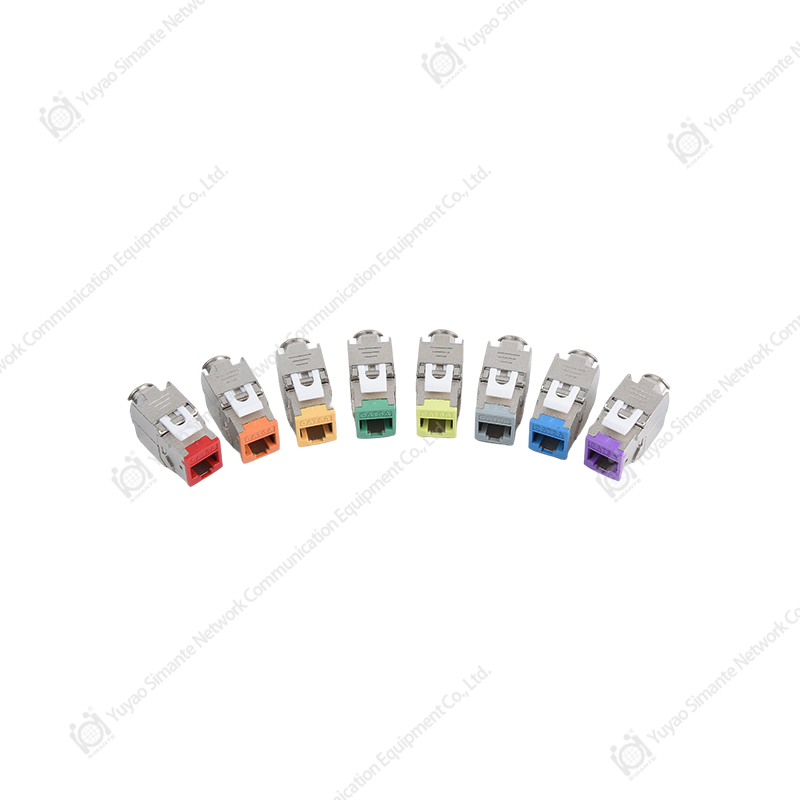
In modern buildings, the performance of a network is influenced not only by switches, routers, servers, and optical transceivers, but also by the small passive components hidden inside walls, cabinets, patch panels, and work-area outlets. Among these components, the CAT6 keystone jack plays a decisive role because it is the exact point where horizontal copper cabling meets the user interface or the distribution frame. The SMT-1041T8C6 180 Degree CAT6 Toolless Keystone Jack Slim Type is designed for installers, system integrators, distributors, and project contractors who need a compact, reliable, and efficient termination solution for structured cabling systems.
This product belongs to the copper system segment and is used in CAT6 structured cabling projects where stable data transmission, installation efficiency, modular compatibility, and long-term mechanical durability are essential. Its 180-degree design supports neat cable routing, while the slim body helps installers work in crowded wall plates, modular patch panels, and high-density installation spaces. The toolless termination structure reduces installation complexity and helps technicians complete terminations accurately and quickly, even in projects involving hundreds or thousands of network points.
Unlike ordinary keystone jacks that may require punch-down tools, larger installation space, or more time for wiring confirmation, this slim type CAT6 toolless keystone jack integrates a compact housing, a clearly marked universal wiring label, IDC termination, and RJ45 connection in one practical module. It follows T568A and T568B wiring sequences and is suitable for communication socket connections between equipment rooms and work areas. In a professional cabling environment, these details are not minor; they directly influence installation speed, rework rate, cable organization, system performance, and the overall cost of ownership.
Yuyao Simante Network Communication Equipment Co., Ltd. manufactures this product as part of a wider portfolio of copper and fiber structured cabling components. With nearly 20 years of experience in network cabling solutions and optical fiber products, the company combines design, development, production, sales, and service capabilities. Its manufacturing strengths include multiple production lines, injection molding equipment, automatic assembly machines, engineering support, and stable annual output capacity. This combination allows the product to be supported not only by a technical specification sheet, but also by a manufacturing system built for consistency, customization, and scalable supply.
Product Overview
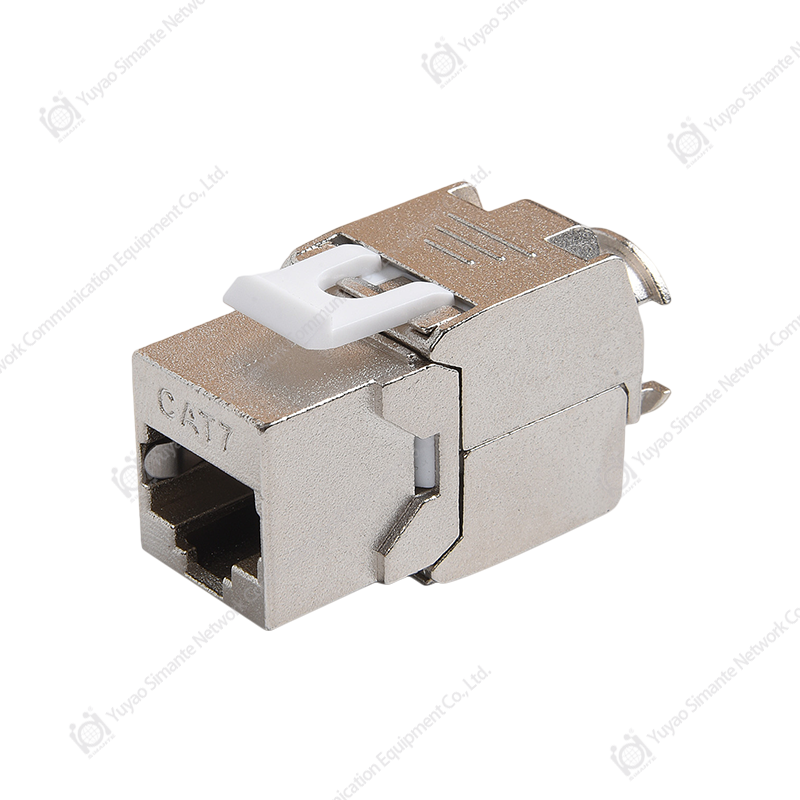
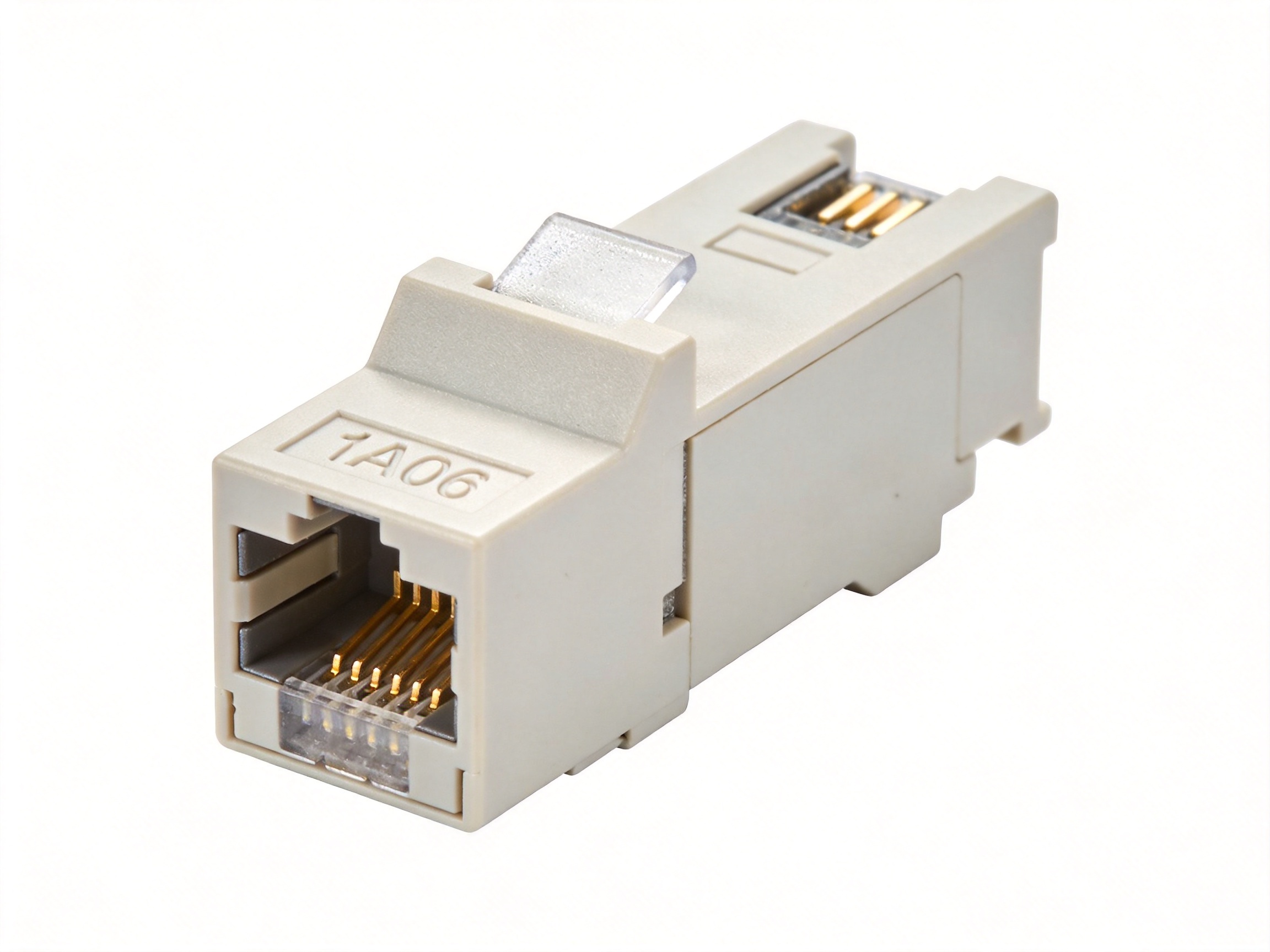
The SMT-1041T8C6 180 Degree CAT6 Toolless Keystone Jack Slim Type is a Category 6 modular connector intended for copper structured cabling. It is designed to connect horizontal wiring with work-area wiring on the same floor of a building and can be used in wall outlets, data sockets, modular patch panels, or other compatible connection points. The front interface is an RJ45 jack for connection with a patch cord, while the rear termination area uses IDC contact technology for horizontal twisted-pair cable termination.
Its product category is CAT6 keystone jack, and its application is primarily within copper-based local area network cabling. CAT6 systems are commonly used for office networks, smart building infrastructure, IP surveillance systems, data centers, education facilities, healthcare environments, hotels, industrial control spaces, and residential intelligent wiring systems. In each of these environments, a keystone jack must support stable electrical characteristics while remaining easy to install and maintain.
The “180 degree” structure means that the cable termination direction is aligned in a straight-through form, which is useful when cables need to enter from the rear in an organized direction. This configuration is often preferred in patch panels and wall-mounted installations because it supports consistent cable routing and can help reduce bending stress around the termination area. When combined with a slim housing, the product becomes especially suitable for dense installation spaces where standard-sized jacks may feel bulky or difficult to manage.
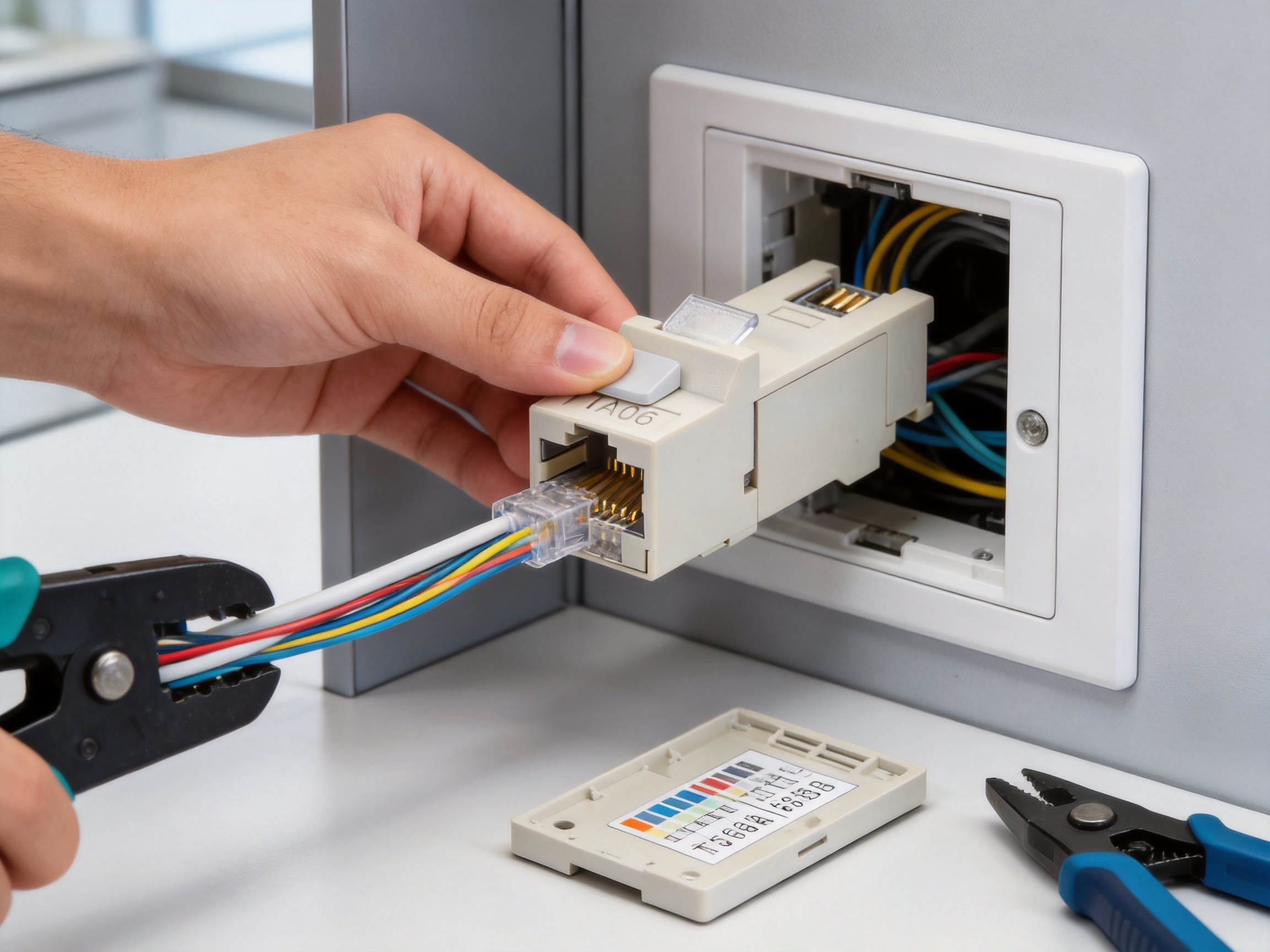
The “toolless” design is one of the product’s central advantages. During installation, the technician positions the twisted pairs according to the printed wiring guide, presses the dust-proof cover or termination cap into place, and completes the IDC connection without requiring a separate punch-down tool. This can reduce labor time, improve termination consistency, and lower the risk of poor workmanship caused by incorrect tool force. In large cabling projects, the time saved on each point can become a significant advantage.
The module is designed to meet Category 6 transmission standards and supports a frequency range from 1 MHz to 250 MHz. It is compatible with T568A and T568B line sequences, allowing flexible adaptation to different project specifications. The clear universal wire sequence label on the dust-proof wire cover helps installers verify pair positions before final termination. This is particularly important because most cabling faults are not caused by cable quality alone; they are often caused by wrong pair arrangement, pair untwisting, inconsistent termination pressure, or improper cable management at the connector.
Core Technical Characteristics
The SMT-1041T8C6 is built around a practical set of electrical, mechanical, material, and environmental characteristics that make it suitable for professional network cabling. Its working voltage is 125 V, and its withstand voltage is DC 1000 V or AC 750 V for one minute without breakdown or arcing. Its insulation resistance is initially at least 100 MΩ and remains at least 100 MΩ after a constant damp heat test. These values reflect the need for stable insulation performance in real building environments where temperature and humidity conditions may vary.
The front RJ45 interface is intended for repeated connection with compatible patch cords. The product is rated for 750 plug-and-socket insertion cycles, supporting long-term service in office and equipment-room environments where ports may be moved, tested, or reconfigured. The IDC termination section is designed for 22 to 26 AWG twisted-pair cable, which covers common solid copper conductors used in structured cabling projects. The number of wire terminations is rated at 250 times, providing flexibility for maintenance, testing, and installation adjustment when needed.
Mechanically, the product is designed with insertion force not more than 20 N and pull-out force not less than 20 N. These values help balance user convenience and connection security. A connector that is too tight may damage plugs or make daily use inconvenient, while one that is too loose may cause intermittent contact, link instability, or poor field-test results. The connector connection device can withstand 50 N for 60 ± 5 seconds, indicating a focus on mechanical robustness.
The metal contact components are selected for conductivity and corrosion resistance. The gold needle contact is made from phosphor bronze with gold plating, while the IDC terminal is phosphor bronze with nickel plating. Phosphor bronze is widely used in connectors because it offers good elasticity, strength, and conductivity. Gold plating on the contact surface supports stable low-resistance contact and helps reduce oxidation-related degradation. The gold-plated layer can range from 6 to 50 microinches according to product requirements, enabling adaptation to different market or customer specifications.
The non-metallic materials include PC polycarbonate and PA66 nylon 66. These engineering plastics are selected for their mechanical strength, dimensional stability, and suitability for connector housings. The PCB material is FR4, a common glass-reinforced epoxy laminate used in electronic applications. The combination of these materials supports a balance of durability, electrical insulation, and production consistency.
| Item | Specification | Practical Value |
|---|---|---|
| Product Type | 180 Degree CAT6 Toolless Keystone Jack Slim Type | Suitable for compact and high-density structured cabling installations |
| Transmission Category | Category 6 | Supports CAT6 copper network applications up to 250 MHz |
| Wiring Sequence | T568A and T568B | Flexible for different project standards and regional practices |
| Connection Method | RJ45 jack with jumper; IDC termination with horizontal wiring | Provides standard front connection and efficient rear cable termination |
| Cable Compatibility | 22 to 26 AWG twisted pair | Works with common structured cabling conductors |
| Frequency Range | 1 MHz to 250 MHz | Meets the bandwidth range expected for CAT6 systems |
| Working Voltage | 125 V | Suitable for standard communication cabling applications |
| Withstand Voltage | DC 1000 V or AC 750 V for 1 minute | Supports insulation reliability under test conditions |
| Insulation Resistance | Initial value at least 100 MΩ; after damp heat test at least 100 MΩ | Maintains stable insulation performance in humid environments |
| Durability | 750 plug insertion cycles; 250 wire terminations | Supports long service life and maintenance flexibility |
| Materials | Phosphor bronze, PC, PA66, FR4 | Balances conductivity, strength, insulation, and reliability |
| Environmental Range | -25°C to +70°C; humidity up to 85% | Suitable for many indoor building and equipment-room environments |
| Environmental Compliance | RoHS requirements | Supports environmentally responsible procurement |
Why the Slim Type Design Matters
Space is one of the most underestimated challenges in structured cabling. In a drawing, a network outlet may appear as a simple symbol, but in the field, installers must route cables through conduit, back boxes, floor boxes, cabinets, wall plates, and patch panels while preserving bend radius and pair geometry. Standard keystone jacks can become difficult to handle when back-box depth is limited or when multiple ports are installed side by side. A slim type keystone jack addresses this challenge by reducing the physical footprint of the module.
The slim body of the SMT-1041T8C6 gives installers more room to manage cables and reduces the chance of excessive compression inside faceplates or panels. This is valuable in office renovations, hotel rooms, education buildings, compact control cabinets, and home networking locations where available space is not always ideal. It also helps distributors and project contractors offer a more versatile product that can fit a wide range of installation scenarios.
Compared with bulkier competitive products, a slim type keystone jack can simplify stock management. A distributor can supply the same module for patch panels, wall plates, and other modular accessories, reducing the need to keep many different connector bodies for different spaces. For contractors, using one compact module across several installation areas can help standardize training, reduce installation errors, and improve project consistency.
The 180-degree layout also supports clean cable routing. In patch panel installations, cable bundles often approach from the rear. A straight termination direction allows the cable to remain more naturally aligned, while the toolless termination cap secures the conductor positions. This helps reduce unnecessary bending and twisting immediately behind the jack. Although proper installation technique is still essential, the product structure makes correct routing easier to achieve.
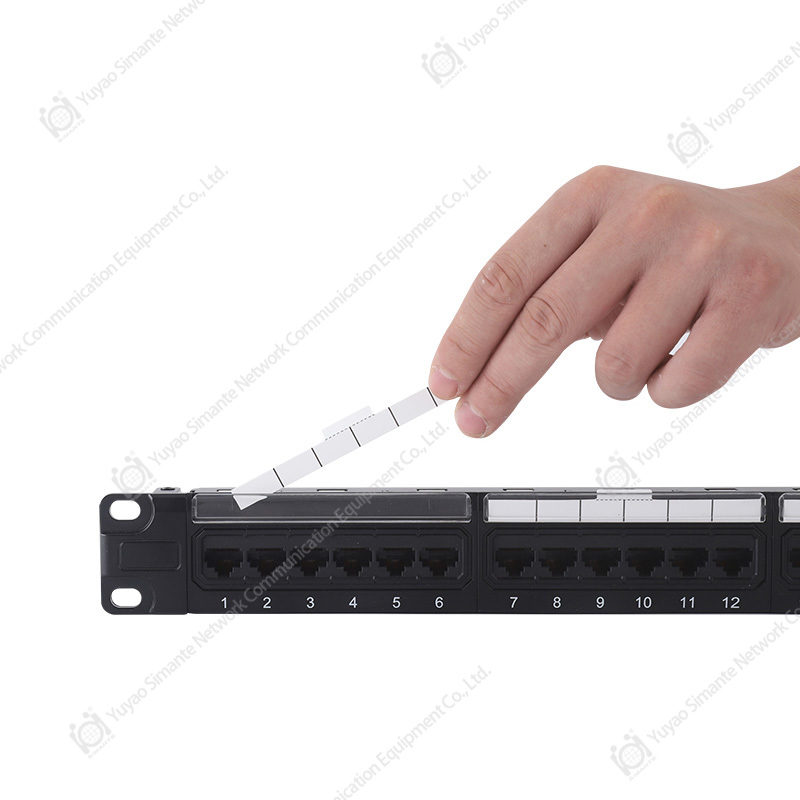
In high-density environments, minor design differences can produce major field advantages. A connector that saves only a small amount of space per port can become much more manageable when multiplied across 24-port, 48-port, or larger modular distribution frames. The embedded design of this module allows it to be installed on a distribution frame to form a modular patch panel, supporting flexible deployment and easier maintenance.
Toolless Termination as an Installation Advantage
Labor efficiency is one of the strongest competitive advantages of a toolless keystone jack. In traditional punch-down modules, installers must place each conductor into the IDC slot and then use a punch-down tool to seat and cut the wire. This method can be reliable when performed by trained technicians, but it also introduces several variables: tool condition, blade sharpness, applied force, hand angle, conductor positioning, and technician fatigue. In large projects, these variables can increase inconsistency.
The SMT-1041T8C6 reduces these variables with a toolless design. The installer follows the T568A or T568B sequence label, arranges conductors, closes the termination structure, and completes the IDC connection. Because the wire sequence label is clearly marked on the dust-proof wire cover, technicians can confirm the wiring plan directly at the point of termination. This helps prevent pair reversal, split pairs, and other common wiring faults.
Toolless termination is also useful for projects with tight schedules. Commercial buildings, campuses, and smart facilities often require network cabling to be completed before interior handover or equipment commissioning. Faster termination can help contractors keep pace with project timelines. In addition, reducing the number of hand tools required at the work point can simplify logistics. Installers can move between rooms, cabinets, and floors more efficiently.
Compared with low-cost competitors that may use unclear labels, weak termination caps, or less stable IDC contacts, this product is designed to combine speed with reliability. The toolless structure does not simply aim to be convenient; it must also hold conductors firmly, maintain contact pressure, and preserve transmission performance. The use of phosphor bronze IDC terminals and an engineered plastic housing supports this balance.
Another advantage is training efficiency. When a contractor has a large team or must use different installation crews across multiple sites, products with intuitive wiring labels and toolless operation can reduce the learning curve. This does not eliminate the need for professional cabling practices, but it supports more consistent results when technicians follow the correct process.
Transmission Performance and Contact Engineering
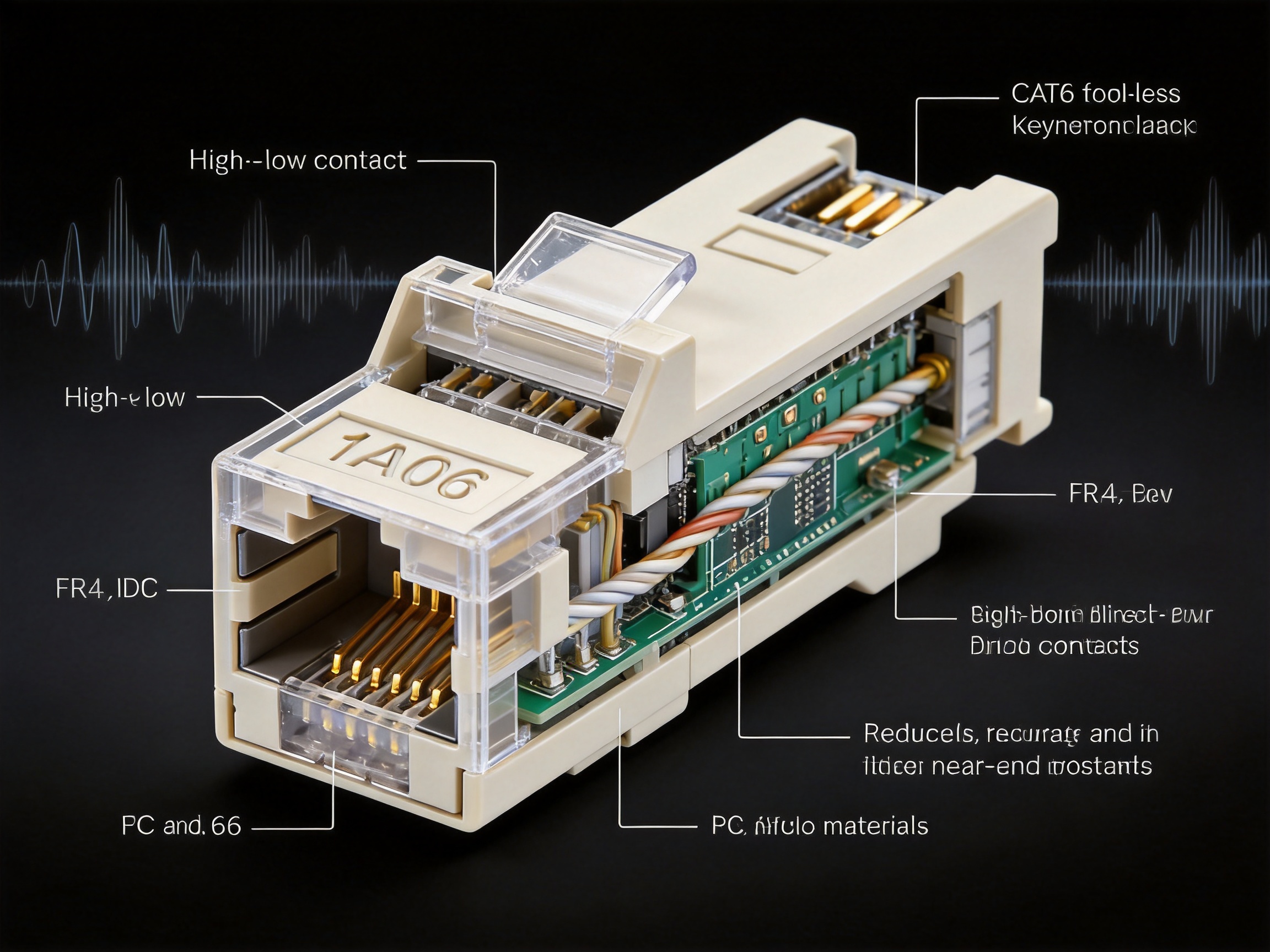
CAT6 performance depends heavily on how well the connector manages signal integrity. At frequencies up to 250 MHz, poor contact design, excessive conductor untwisting, incorrect pair positioning, and inconsistent impedance can lead to crosstalk and return loss problems. The SMT-1041T8C6 is designed to meet Category 6 transmission standards, and its internal contact arrangement uses high and low dislocation technology to help reduce near-end crosstalk.
Near-end crosstalk, commonly called NEXT, occurs when signals from one pair interfere with another pair near the transmitting end of the link. In structured cabling, NEXT performance is a critical part of field testing. A keystone jack must therefore be designed not only as a mechanical connector, but also as a transmission component. The dislocated contact pin structure helps manage electromagnetic coupling among pairs and supports the performance required for CAT6 applications.
Gold-plated phosphor bronze contact pins provide another performance advantage. The RJ45 plug and jack interface is repeatedly inserted and removed during use, and the contact surface must resist oxidation and wear. Gold plating is widely used in network connectors because it maintains stable contact performance over repeated cycles. Depending on customer requirements, the product supports gold plating thickness from 6 to 50 microinches, allowing the manufacturer to serve different quality levels, market requirements, and procurement budgets.
The IDC terminal area is equally important. A good IDC contact must cut through insulation, grip the conductor, and maintain pressure over time without damaging the conductor excessively. The phosphor bronze nickel-plated IDC terminal supports this function. Nickel plating helps improve surface protection, while the spring properties of phosphor bronze help maintain reliable contact force.
The product’s insulation resistance and withstand voltage specifications also contribute to system stability. Although Ethernet data transmission uses low voltages, insulation quality is important for safety, reliability, and compliance testing. The ability to withstand DC 1000 V or AC 750 V for one minute without breakdown or arcing indicates that the connector is designed with proper separation and insulation integrity.
Material Selection for Long-Term Reliability
Material quality is a key difference between professional-grade keystone jacks and low-end alternatives. A connector may look simple from the outside, but its long-term reliability depends on the combination of metal elasticity, plating quality, plastic dimensional stability, PCB material, and assembly precision. The SMT-1041T8C6 uses phosphor bronze for both the gold needle and IDC card wire terminal, supported by different surface treatments according to the function of each part.
Phosphor bronze is preferred in many connector applications because it offers an effective combination of conductivity, fatigue resistance, and spring performance. In an RJ45 jack, the contact pins must deflect when a plug is inserted and then return to a stable position while maintaining pressure. If the metal loses elasticity, the contact may become unstable. If the plating is poor, oxidation may increase resistance. By using phosphor bronze with gold plating, the product supports stable signal contact across repeated insertions.
For the plastic housing and internal structure, PC polycarbonate and PA66 nylon 66 provide durability and insulation. PC is known for impact strength and dimensional stability, while PA66 is valued for mechanical strength, heat resistance, and toughness. In keystone jack manufacturing, dimensional accuracy is crucial because small deviations can affect plug fit, latch performance, IDC alignment, and termination consistency. Suitable engineering plastics help maintain the required tolerances.
The FR4 PCB material supports the internal transmission design. In a Category 6 connector, the PCB is not merely a carrier; it forms part of the signal path. Material stability and manufacturing precision influence impedance and crosstalk behavior. Using FR4 helps provide a reliable foundation for the contact arrangement and electrical performance.
Compared with products that reduce cost by using weaker plastics, inconsistent plating, or lower-grade contact metals, this keystone jack is positioned for projects where reliability matters. In a structured cabling system, the cost of replacing a failed connector after building completion can be far higher than the initial price difference. A faulty jack may require user downtime, wall plate removal, retesting, documentation updates, and labor cost. Strong material selection reduces this risk.
Environmental and Compliance Considerations
Network cabling components are often installed in environments that are not perfectly controlled. Equipment rooms may become warm, ceiling spaces may experience seasonal temperature variation, and some buildings may have humidity challenges. The SMT-1041T8C6 is designed for an environmental temperature range from -25°C to +70°C and humidity up to 85% under specified conditions. This range supports many indoor communication environments, including office buildings, schools, residential systems, and light commercial installations.
The product is designed to meet RoHS requirements, which is increasingly important for international procurement. RoHS compliance supports the restriction of certain hazardous substances in electrical and electronic equipment. For distributors and project contractors serving Europe, Australia, Southeast Asia, the Middle East, Africa, and other regions, environmental compliance helps simplify product acceptance and supports responsible supply chain management.
The product information also includes salt spray test conditions, including pH value of the salt solution, concentration, continuous atomization, and environmental control requirements. While keystone jacks are typically used indoors, salt spray testing is valuable for evaluating surface treatment and corrosion resistance of metal parts. This is especially relevant for products shipped globally or installed in coastal regions where humidity and airborne salt may influence material aging.
Storage conditions are also defined. Packaged products should be stored in a warehouse with ambient temperature from -5°C to +30°C, relative humidity not more than 70%, and no acid, alkali, or other corrosive gases in the surrounding air. The stated storage period is three years. Clear storage guidance helps distributors and contractors maintain product quality before installation.
Regular packaging is 10 boxes per carton, 50 pieces per box, and 500 pieces per carton. Such packaging supports project-scale logistics while protecting the modules during transportation and storage. Packaging can be specified according to customer requirements, which is useful for OEM, ODM, distributor branding, and project-based supply.
Applications in Structured Cabling Systems
The SMT-1041T8C6 is suitable for a wide range of copper cabling installations. In office networks, it can be used in wall face plates and data sockets to provide user access points for computers, IP phones, printers, wireless access points, and other network devices. Its slim structure helps in office renovation projects where existing wall boxes may be shallow or crowded.
In equipment rooms and telecommunications rooms, the module can be installed in compatible distribution frames to create modular patch panels. This supports organized horizontal cabling management and simplifies moves, additions, and changes. When a port needs replacement or reconfiguration, modular keystone systems can be more flexible than fixed-port panels because individual modules can be changed without replacing an entire panel.
In smart home and building automation applications, the product can support data connections for routers, smart control panels, surveillance cameras, access control terminals, and other IP-based devices. As homes and buildings become more connected, reliable copper cabling remains important. Wireless networks depend heavily on wired backhaul, and many smart devices still require stable Ethernet connections for bandwidth, power, security, or reliability.
In education and healthcare environments, structured cabling must support many user points and frequent changes. Classrooms, laboratories, offices, nurse stations, and administrative areas require durable outlets. The rated 750 insertion cycles help support repeated use, while the toolless termination design helps contractors complete installation and maintenance efficiently.
For hotels, apartments, and commercial complexes, compact modules are especially valuable because installation spaces may be repetitive and constrained. A slim CAT6 keystone jack can be used across guest rooms, service areas, reception areas, and management offices. Standardized components improve maintenance efficiency because facility teams can keep compatible spare parts and replace modules quickly when needed.
Advantages Over Common Competing Products
The first advantage is installation speed. Many competing keystone jacks still rely on traditional punch-down termination or have toolless designs that are less intuitive. The SMT-1041T8C6 combines toolless operation with a clearly marked universal wiring label, helping installers complete terminations more quickly and accurately. In large projects, this saves measurable labor time and helps reduce rework.
The second advantage is compactness. Some CAT6 keystone jacks are physically large, making them difficult to install in dense panels or shallow wall boxes. The slim type design gives this product a practical advantage in high-density or limited-space environments. Contractors can use it in more installation scenarios without changing product type.
The third advantage is modular compatibility. The embedded design allows the module to be installed on distribution frames to form modular patch panels. This supports flexible system architecture and easier maintenance. Compared with fixed solutions, modular systems help project teams adapt to changing requirements.
The fourth advantage is contact design. The high and low dislocation technology used in the contact pin arrangement helps reduce near-end crosstalk, supporting CAT6 transmission requirements. Low-end competing products may focus only on mechanical connection while neglecting internal signal optimization. In contrast, this product is designed as a transmission component, not just a plastic housing with contacts.
The fifth advantage is material reliability. Gold-plated phosphor bronze contacts, nickel-plated phosphor bronze IDC terminals, PC, PA66, and FR4 all contribute to durability and performance. Cheaper competitors may use less stable plastic, thinner or inconsistent plating, or lower-grade metals. Those savings may not be visible at first, but they can lead to contact instability, housing deformation, or field-test failures over time.
The sixth advantage is manufacturing support. Yuyao Simante Network Communication Equipment Co., Ltd. has established production resources, engineering capability, testing awareness, and export experience. This is important for distributors and contractors because product quality is not determined by design alone. Consistent production, stable tooling, inspection processes, and experienced staff all contribute to reliable supply.
Manufacturing Strength Behind the Product
A high-quality keystone jack depends on repeatable manufacturing. Even a well-designed connector can fail if injection molding tolerances are inconsistent, metal stamping lacks precision, plating quality varies, or assembly processes are unstable. Yuyao Simante Network Communication Equipment Co., Ltd. supports this product with a manufacturing system developed through nearly 20 years of service in network cabling solutions and optical fiber products.
The company integrates design, development, sales, and service, enabling product feedback to move from customers to engineering and production teams. This is particularly valuable in structured cabling, where field installers often identify practical details that influence product success: latch feel, label readability, termination cover strength, panel compatibility, and packaging convenience. A manufacturer with internal development capability can respond to these requirements more effectively than a supplier that only trades finished products.
The company has more than 10 engineers and over 30 full-time technical personnel who contribute to product improvement, quality enhancement, and product updates. This technical foundation helps ensure that design decisions are supported by manufacturing knowledge and performance expectations. For a CAT6 keystone jack, engineering capability is needed to manage electrical parameters, mechanical fit, material selection, and tooling accuracy.
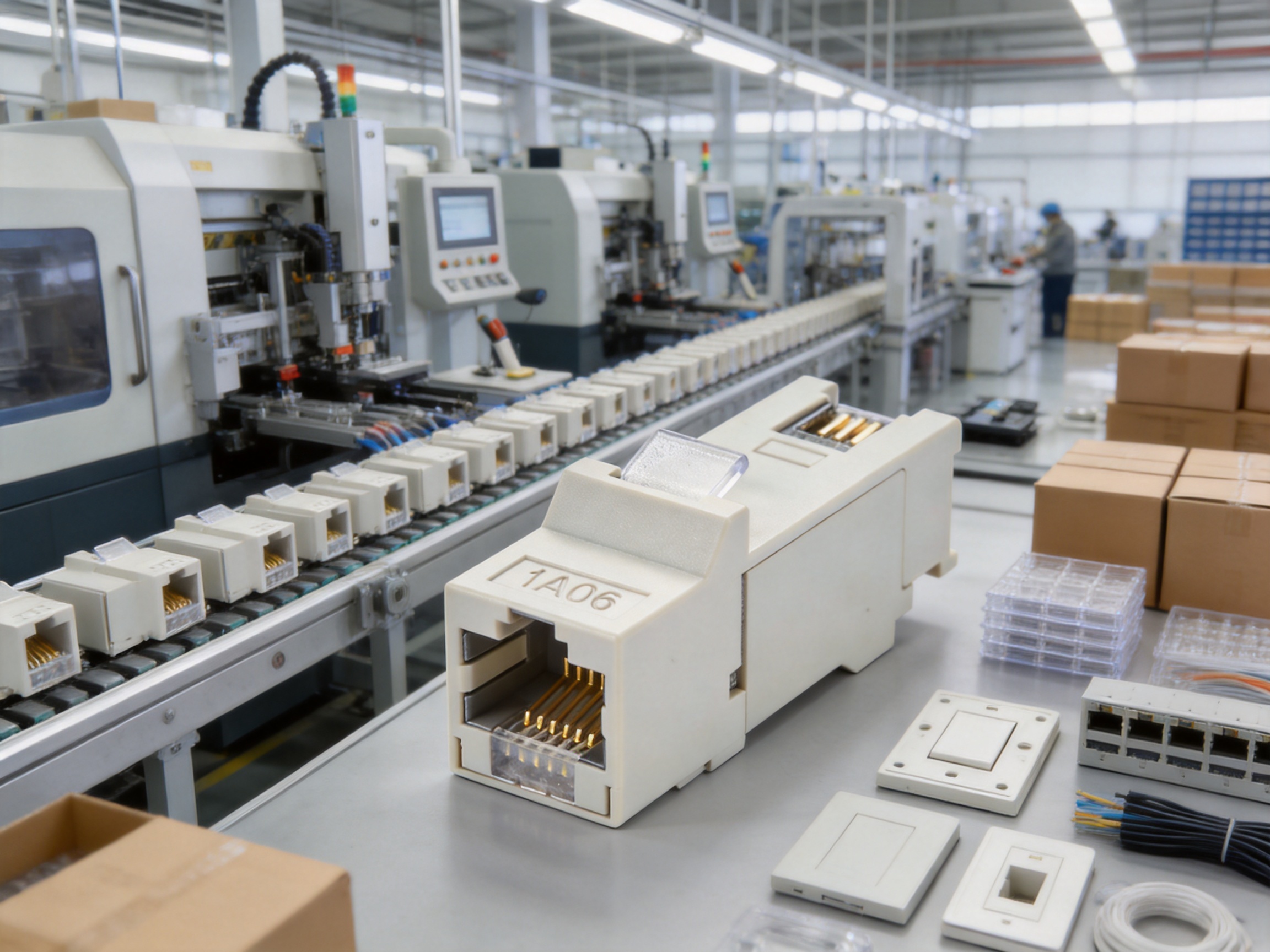
Production capacity is another important strength. The factory operates 10 regular and customized production lines, 10 fully automatic injection molding machines, 20 semi-automatic injection molding machines, and 8 automatic assembly machines. This equipment base supports stable annual output of more than 9 million pieces. For distributors and large project buyers, stable capacity reduces supply risk and supports consistent delivery schedules.
Automatic and semi-automatic equipment also improves production consistency. Injection molding machines help produce plastic housings with controlled dimensions, while automatic assembly equipment helps reduce variation in component placement. In connector manufacturing, precision and repeatability are essential. A small dimensional error can affect plug insertion, IDC alignment, or panel mounting. Advanced manufacturing processes help keep these factors under control.
Quality Control and Process Stability
Quality in structured cabling products begins at the design source. Yuyao Simante emphasizes mature research and development systems to support quality stability from the beginning of product creation. This approach is important because testing at the end of production can detect defects, but it cannot fully compensate for weak design or unstable tooling. By focusing on design-stage quality, the manufacturer reduces the likelihood of recurring production problems.
For the SMT-1041T8C6, quality control must address several areas. First, the plastic housing must be dimensionally accurate so that the module fits compatible face plates and patch panels. Second, the RJ45 contact pins must be positioned correctly to ensure proper plug contact and insertion force. Third, the IDC terminals must align with conductor paths and maintain clamping strength. Fourth, labeling must be clear and durable enough for field use. Fifth, the assembled product must satisfy relevant electrical and mechanical requirements.
The company’s production system supports good performance testing and customer testing requirements. This is essential for customers in high-end markets who demand more than visual inspection. Structured cabling components may be tested for continuity, contact reliability, insertion force, durability, environmental performance, and transmission parameters. Supporting comprehensive testing helps build confidence among OEM partners, distributors, and project contractors.
Stable export volume in Europe, Australia, Africa, the Middle East, and Southeast Asia indicates that the manufacturer is familiar with varied market requirements and international customer expectations. Different regions may have different preferences for packaging, gold plating thickness, color, labeling, and compliance documentation. OEM and ODM capability allows the product to be adapted to these needs while maintaining the core performance and manufacturing foundation.
Compared with suppliers that rely on short-term production outsourcing, a manufacturer with established production lines and technical staff can better control quality and delivery. This matters when customers need repeat orders with consistent performance. A keystone jack installed today should match the one ordered six months later in fit, feel, and test behavior. Process stability is therefore a competitive advantage.
Design Details That Support Installer Confidence
Installer confidence comes from predictable product behavior. When an installer opens a box of keystone jacks, each module should feel consistent, the wiring label should be easy to read, the termination cap should close properly, and the jack should mount securely into the selected panel or face plate. The SMT-1041T8C6 is designed with these practical needs in mind.
The universal wire sequence label supports both T568A and T568B wiring schemes. This eliminates uncertainty when different projects require different termination standards. The label is located on the dust-proof wire cover, placing the information close to the actual termination point. This reduces the need to consult separate instructions during every termination.
The dust-proof cover also contributes to protection of contacts. Dust and debris can affect contact areas during installation or storage. A protective structure helps maintain cleanliness and supports long-term reliability. In construction environments, where dust is common, such details can be valuable.
The RJ45 interface is designed for inter-matching with connectors of the same standard series. This supports compatibility with standard patch cords and modular accessories. In structured cabling, compatibility is essential because systems often combine components from different batches or product families. A standard interface helps reduce integration risk.
The product’s insertion and pull-out force values are also relevant to user experience. A properly designed jack allows plugs to be inserted without excessive effort, while still holding them securely. This is especially important in locations where users may frequently connect and disconnect devices, such as conference rooms, training rooms, test benches, and IT service areas.
Role in Copper and Fiber Structured Cabling Portfolios
Although the SMT-1041T8C6 is a copper system component, it is part of a broader structured cabling ecosystem that may include both copper and fiber solutions. Modern buildings often use copper cabling for horizontal runs to work areas and fiber cabling for backbone, inter-building links, or high-speed equipment connections. A manufacturer that supplies both copper and fiber products can provide more integrated support for project buyers.
Yuyao Simante’s main product range includes keystone jacks, patch panels, wall face plates, data sockets, and related cabling components. These products are used in structured cabling, network communication, smart home systems, automation equipment, and other fields. This broad product coverage helps customers source compatible components from one supplier and simplifies procurement.
For installers and distributors, product ecosystem compatibility is important. A keystone jack must fit face plates, patch panels, and data sockets properly. When these items come from a manufacturer with coordinated product development, the chance of mechanical incompatibility is reduced. This can lower installation delays and customer complaints.
In a complete copper cabling system, the keystone jack forms one end of the permanent link or channel. Its performance must coordinate with cables, patch panels, and patch cords. A weak connector can compromise the entire link. Therefore, using a reliable CAT6 keystone jack is not only a component choice but also a system-level quality decision.
The same logic applies to hybrid copper-fiber projects. While fiber supports high-speed backbone transmission, copper remains essential for device-level access. Strong manufacturing capability across both product categories allows the supplier to support diverse project requirements and provide customers with a more complete cabling solution.
Packaging, Storage, and Project Logistics
Good packaging protects product quality between manufacturing and installation. The SMT-1041T8C6 is placed into a special blister bag and then into a cardboard box, with product accessories included at the same time. A label indicating product model and quantity is affixed on the upper left corner of the front of the carton. This helps warehouse staff, distributors, and contractors identify products quickly.
The regular packing quantity is 10 boxes per carton, 50 pieces per box, and 500 pieces per carton. This format is practical for project distribution because it supports both bulk shipping and smaller on-site allocation. A contractor can issue boxes to different installation teams while maintaining carton-level inventory control.
Storage requirements are clearly defined. Products should be stored in a warehouse where the ambient temperature is -5°C to +30°C, relative humidity is not more than 70%, and the surrounding air contains no acid, alkali, or other corrosive gases. The storage period is three years. These conditions help preserve the quality of metal contacts, plastic parts, and packaging before installation.
Customer-specified packaging is also available. This is valuable for private label distributors, OEM customers, retail packaging needs, and project-specific documentation. In competitive markets, packaging can influence brand presentation, inventory management, and user convenience. The ability to customize packaging reflects the manufacturer’s flexible service capability.
For international customers, stable packaging and clear labeling reduce shipping confusion and improve warehouse efficiency. When a product is used across multiple regions, consistent carton markings and product identification are especially important. They help reduce mistakes during receiving, dispatching, and installation.
OEM and ODM Value for Global Customers
Many distributors and network solution providers need more than a standard catalog product. They may require specific colors, gold plating thickness, packaging design, labeling language, model numbers, or compatibility with their own wall plates and patch panels. Yuyao Simante undertakes OEM and ODM projects, allowing customers to customize structured cabling components according to market needs.
For the SMT-1041T8C6, customization possibilities may include packaging, product marking, accessory combinations, or specification adjustments within the manufacturer’s capability. Because the product uses a modular design and standardized CAT6 interface, it can be adapted for different sales channels while maintaining core performance characteristics.
OEM and ODM support is especially valuable for customers entering competitive markets. A distributor may want a product line that appears consistent across keystone jacks, patch panels, face plates, and data sockets. A project contractor may need custom packaging for a large construction site. A regional brand may require private labeling. Manufacturing flexibility helps meet these needs.
Advanced production resources make customization more practical. With regular and customized production lines, injection molding machines, and automatic assembly equipment, the manufacturer can support both standard production and customer-specific orders. Engineering and technical personnel help evaluate feasibility and maintain quality during customization.
Compared with suppliers that only resell standard items, a manufacturer with OEM and ODM capability offers more long-term value. Customers can develop product differentiation, respond to market feedback, and adjust specifications without changing supplier. This creates a more stable business relationship and supports continuous improvement.
Best Practices for Installation
To achieve the best performance from the SMT-1041T8C6, installers should follow standard structured cabling practices. The cable jacket should be stripped carefully without damaging conductors. Pair untwisting should be minimized as much as possible near the termination point. Conductors should be arranged according to the chosen T568A or T568B wiring sequence, using the label on the dust-proof cover as a guide.
The cable should be routed naturally into the 180-degree termination area, avoiding sharp bends and excessive pulling force. Maintaining proper bend radius is important because cable deformation can affect transmission performance. After the conductors are positioned, the toolless termination mechanism should be closed firmly and evenly to complete the IDC connection.
Installers should confirm that the module is fully seated in the face plate or patch panel. The RJ45 front interface should be inspected to ensure that no debris is present. After installation, the link should be tested according to project requirements. For CAT6 systems, field certification testing may include wire map, length, insertion loss, NEXT, return loss, propagation delay, and other parameters depending on the tester and standard used.
During maintenance, technicians should avoid unnecessary repeated retermination unless required. Although the module supports 250 wire terminations, good practice is to complete each termination correctly the first time. If retermination is needed, conductors should be inspected for damage and trimmed appropriately when necessary.
Proper installation is a partnership between product design and technician skill. The toolless structure, clear labeling, slim body, and engineered contacts make correct installation easier, but following cabling standards remains essential for achieving reliable network performance.
Frequently Asked Questions
What is the SMT-1041T8C6 used for?
It is used as a CAT6 keystone jack in copper structured cabling systems. It connects horizontal twisted-pair cable to an RJ45 outlet interface and can be installed in wall plates, data sockets, modular patch panels, and compatible distribution frames.
Why is the 180-degree design useful?
The 180-degree structure supports straight rear cable entry and neat cable routing. It is especially useful in patch panels and wall outlets where cables need to be organized behind the module without excessive bending.
What does “toolless” mean in this product?
Toolless means that the cable can be terminated without a separate punch-down tool. The installer arranges the conductors according to the T568A or T568B label and closes the termination mechanism to complete the IDC connection.
Is it compatible with both T568A and T568B wiring?
Yes. The product includes a universal wiring sequence label for both T568A and T568B, allowing it to be used in projects with different wiring standards.
What cable sizes does the IDC terminal support?
The IDC terminal is designed for 22 to 26 AWG twisted-pair cable, which covers common conductor sizes used in structured cabling installations.
What makes this product different from ordinary CAT6 keystone jacks?
Its key advantages include slim type construction, toolless termination, clear wiring labels, 180-degree cable entry, CAT6 transmission design, high and low dislocated contact pin technology, durable phosphor bronze contacts, and compatibility with modular distribution frames.
Can it be used in high-density patch panels?
Yes. The slim body and embedded modular design make it suitable for high-density patch panel applications, provided that the selected panel is compatible with the module format.
What is the rated durability of the RJ45 interface?
The plug-and-socket insertion durability is rated at 750 cycles, supporting repeated connection and disconnection in normal network use.
Does the product meet environmental requirements?
The product is designed to meet RoHS requirements and is specified for operating temperatures from -25°C to +70°C, with humidity up to 85% under defined conditions.
Can the packaging be customized?
Yes. Customer-specified packaging is available, supporting OEM, ODM, distributor, and project-based requirements.
Conclusion
The SMT-1041T8C6 180 Degree CAT6 Toolless Keystone Jack Slim Type is a practical and performance-oriented component for modern copper structured cabling systems. It combines a compact body, 180-degree cable entry, toolless IDC termination, clear T568A and T568B labeling, CAT6 transmission support, durable materials, and modular installation flexibility. These features help installers work faster, reduce termination errors, and build cleaner, more reliable network outlets and patching points.
Its advantages over common competing products are strongest in projects where space, labor efficiency, and long-term reliability matter. The slim design supports dense or constrained installations. The toolless structure reduces dependence on punch-down tools. The high and low dislocated contact arrangement helps address crosstalk performance. Gold-plated phosphor bronze contacts, nickel-plated IDC terminals, engineering plastics, and FR4 PCB material support stable service life.
Behind the product is the manufacturing strength of Yuyao Simante Network Communication Equipment Co., Ltd., a professional manufacturer with nearly 20 years of experience in network cabling solutions and optical fiber products. Its engineering team, technical personnel, injection molding equipment, automatic assembly machines, regular and customized production lines, and annual output capacity of more than 9 million pieces provide a strong foundation for consistent quality and scalable supply.
For distributors, contractors, OEM customers, and structured cabling solution providers, this keystone jack offers more than a connection point. It provides a dependable building block for copper network infrastructure, supported by a manufacturer capable of design, production, customization, testing, and global supply. In an era where every network depends on stable physical-layer performance, choosing a reliable CAT6 keystone jack is a decision that protects the entire cabling investment.
References
1. YD/T 926.1-2009, Generic Cabling for Customer Premises, General Specification.
2. YD/T 926.3-2009, Generic Cabling for Customer Premises, Connecting Hardware and Patch Cord Requirements.
3. ISO/IEC 11801, Information Technology, Generic Cabling for Customer Premises.
4. ANSI/TIA-568, Commercial Building Telecommunications Cabling Standard.
5. IEC 60603-7 Series, Connectors for Electronic Equipment, Detail Specifications for 8-Way Connectors.
6. RoHS Directive Technical Documentation for Restricted Substances in Electrical and Electronic Equipment.